

E-max or zirconia: which material is more suitable for front teeth?
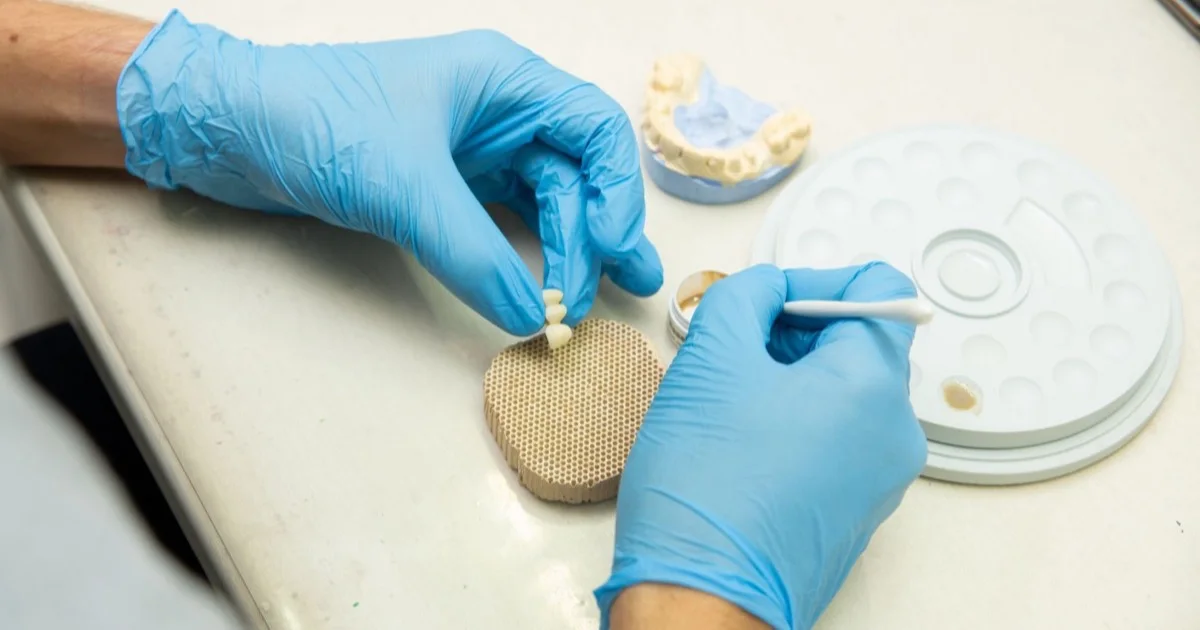
E-max (lithium disilicate glass-ceramic) transmits light in a way that is closer to a natural tooth and works very well in thin veneers and crowns when bonded to enamel; zirconia, on the other hand, is stronger and has the advantage when the tooth has been heavily prepared, is dark in colour or is under heavy load. In front teeth the choice comes down to two questions: how much aesthetics is needed, and what thickness and bonding the condition of the tooth allows. In most cases E-max is chosen for a healthy front tooth, and zirconia for a patient with a root-treated tooth or bruxism.
Key points
- E-max is a lithium disilicate glass-ceramic; zirconia is a glass-free oxide ceramic based on zirconium dioxide.
- In terms of aesthetics and translucency lithium disilicate is superior; in terms of strength, zirconia is.
- E-max becomes “one whole” with the enamel through adhesive bonding; zirconia relies more on mechanical seating and cement.
- Zirconia is not recommended for thin veneers; both materials work for crowns.
- Highly translucent zirconia has improved aesthetics, but at the same thickness it is still not as translucent as lithium disilicate.
What are these materials?
E-max is an abbreviation of the product name “IPS e.max” and in everyday speech it is used as a synonym for lithium disilicate glass-ceramic. Inside a glass-based matrix there are lithium disilicate crystals; the glass part gives the material its translucency, while the crystals give it strength. It is widely used in small to medium restorations such as veneers, crowns and inlays/onlays.
Zirconia is an oxide ceramic made from zirconium dioxide (ZrO₂). It contains no glass, which is why it is opaque, white and very strong. In the past, veneering ceramic was layered onto a zirconia framework for aesthetics (layered zirconia); today “monolithic” crowns milled entirely from zirconia are widespread. Highly translucent classes of zirconia are intended for front teeth and transmit more light than classic zirconia, but in return they lose part of their strength.
Both can be produced in a CAD/CAM system (digital design and automated milling); in the clinic, an intraoral scanner and a digital workflow increase the precision of these materials.
Aesthetics and translucency
A natural front tooth partly transmits and partly scatters light. The restorative material has to mimic this, otherwise the tooth looks “plastic” or “opaque white”. The microstructure of lithium disilicate gives it an advantage here: a 2025 systematic review notes that, because of its high crystalline content, zirconia is less translucent than lithium disilicate, while lithium disilicate gives a more lively, natural appearance.
But there are two important nuances. First, on a dark or discoloured tooth root, a translucent material shows that darkness through — in such a case a somewhat more opaque material (an opaque type of lithium disilicate, or zirconia) masks the colour better. Second, the same review emphasises the effect of the colour of the luting cement on the final shade: in a thin, translucent restoration the colour of the cement can change the result even more than the material itself.
Strength and fracture behaviour
In terms of flexural strength, zirconia is considerably superior to lithium disilicate. In a 2021 laboratory study, the mean flexural strength of highly translucent zirconia was approximately 20–35% higher than that of zirconia-reinforced lithium silicate ceramic, and within the 0.4–2.0 mm thickness range the thickness had no significant effect on the result. This is an in vitro (outside the mouth, laboratory) result — it does not fully reflect real conditions in the mouth, but it shows the general picture.
The clinical results are more interesting. A 2023 meta-analysis compared CAD/CAM lithium disilicate and zirconia crowns: over follow-up periods of 1–9.3 years, the survival of zirconia restorations varied between studies starting from around 85%, with some studies recording no failures at all during the follow-up period, while lithium disilicate looked somewhat better in terms of technical complications. The main problems noted with zirconia were chipping of the veneering ceramic in layered zirconia and, rarely, fracture of the framework. In other words, the statement “zirconia is stronger” refers to the material; how the restoration as a whole behaves in the mouth depends on the design (monolithic / layered), the thickness and the bonding.
With veneers the picture is clear: a 2025 meta-analysis calculated the survival of lithium disilicate veneers (the veneer staying in place) at around 97% over follow-up of 7 years and longer (mean 10.4 years), and over the same period technical complications (cracks, fractures, debonding) were considerably fewer than with feldspathic ceramic. Long-term data on zirconia veneers is scarce.
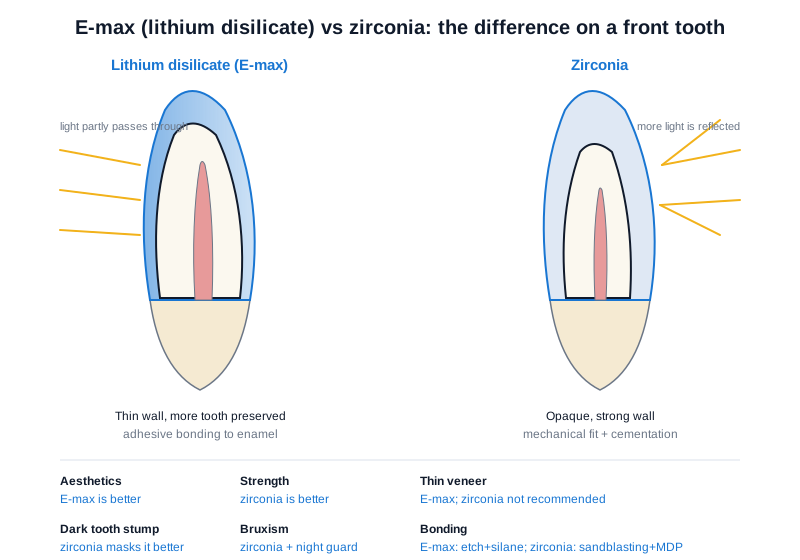 Left: lithium disilicate — thin, light-transmitting, adhesively bonded to enamel. Right: zirconia — more opaque, strong, with mechanical seating and cementation on a prepared tooth.
Thickness and how much is removed from the tooth
The strength of the material directly determines how much will be prepared away from the tooth. A lithium disilicate veneer can be made at a thickness of around 0.3–0.7 mm; for a crown, usually 1–1.5 mm of space is needed. Because zirconia is strong, in some cases it can work with a thinner crown wall, but on a front tooth a certain thickness is still needed for the aesthetic layers (shade transitions).
The practical meaning is this: if we want to remove as little as possible from a healthy front tooth, a lithium disilicate veneer is the natural choice. If the tooth has already been heavily prepared, or an old crown is being replaced, a zirconia crown makes sense both for strength and for masking colour. The choice between a veneer and a crown is a separate matter: the article veneer or crown explains how the decision is made according to the condition of the tooth.
The difference in bonding
This is one of the points patients rarely ask about, yet it has the greatest influence on the result.
Lithium disilicate contains glass. Its inner surface is etched with hydrofluoric acid, silane is applied, and it is bonded to the tooth with composite cement. The enamel is etched following the same logic. As a result, the tooth, the cement and the ceramic become “one whole” chemically and micromechanically — this is why a thin veneer stays in place for years. A 2023 review of bonding shows that an error at any of these steps (etching time, silane layer, cement thickness, light curing) shortens the lifespan of the restoration.
Zirconia contains no glass, so hydrofluoric acid does not work on it. The zirconia surface is roughened by sandblasting (aluminium oxide particles) and bonded with a special MDP-containing primer/cement. This bond is not as strong as with glass-ceramic; a zirconia crown relies more on the mechanical grip provided by the shape of the tooth preparation. It is precisely for this reason that the same review notes that zirconia is not suitable for thin veneers.
Comparison table
| Criterion | E-max (lithium disilicate) | Zirconia |
|---|---|---|
| Material type | Glass-ceramic | Oxide ceramic, glass-free |
| Light transmission (translucency) | High, close to a natural tooth | Low to medium; better in highly translucent types |
| Masking a dark tooth root | Weak when thin; opaque types are available | Good |
| Flexural strength | Medium to high | High |
| For veneers | The main choice | Not recommended |
| For front crowns | Very suitable | Suitable (especially for a prepared, dark tooth) |
| Minimum thickness (approximate) | Veneer 0.3–0.7 mm; crown ~1–1.5 mm | The crown wall can be thin, but space is needed for aesthetics |
| Bonding | Acid + silane + adhesive cement; strong bond to enamel | Sandblasting + MDP primer; more mechanical grip |
| Repairability | Local repair with composite is possible | Polishing on monolithic; on layered, the veneering ceramic can chip |
| Bruxism | With caution; with a night guard | More durable; a guard is still advisable |
| Effect on the opposing tooth | Gentle on a polished surface | Gentle on a polished monolithic surface; a rough surface causes wear |
Which material is chosen in which situation?
The following breakdown is not an absolute rule, but a summary of the clinical logic:
- Colour/shape correction on a healthy front tooth, veneer: lithium disilicate. Zirconia veneers lack long-term evidence and bonding is limited.
- Crown on a healthy front tooth or one with small fillings: both are possible; if aesthetics is the priority, lithium disilicate, and if there is a dark tooth root, zirconia or opaque lithium disilicate.
- A root-treated, dark, heavily prepared front tooth: zirconia (monolithic, or with a thin aesthetic layer on the front surface) is often preferred.
- Bruxism, deep bite, a history of fractures: zirconia; in any case a night guard is planned.
- Bridge on front teeth: a zirconia framework, because the durability of lithium disilicate for bridges is limited.
- Front crown on an implant: the tooth itself is not there, so the adhesive advantage is lost — here zirconia and other options are discussed in the article implant-supported prosthesis materials.
A general overview of crown types is in the article types of dental crown, and the basics of veneers are in the article what is a veneer.
Frequently asked questions
Can an E-max crown fracture? Yes, especially when it is made very thin, in bruxism, or when biting hard food. With the right thickness and bonding, fractures are rare, but not zero.
Does a zirconia crown look artificial? Classic opaque zirconia can look artificial on a front tooth. With highly translucent zirconia and veneering ceramic this problem has been greatly reduced; the result also depends on the quality of the laboratory work.
Does zirconia wear down the opposing teeth? A rough zirconia surface, or one whose polish has been damaged, can wear down the opposing tooth. Well-polished monolithic zirconia, on the other hand, behaves gently. That is why repolishing the surface after bite adjustment is important.
Can both materials be combined in the same mouth? Yes, and this is often done: lithium disilicate veneers on the front teeth and a zirconia crown on a root-treated tooth. Shade matching is planned together with the laboratory.
Which one is more expensive? The price depends on the brand, the laboratory and the extent of the work; the difference in material is often not the main part of the price.
Conclusion
On front teeth, lithium disilicate (E-max) is superior in terms of aesthetics and bonding to enamel, while zirconia is superior in terms of strength and masking colour. For thin veneers the choice in most cases is lithium disilicate; for crowns, the condition of the tooth, its colour, the amount of preparation and the bite load determine the decision. The right answer lies not in the question “which material is better”, but in “which one is suitable for this tooth and this patient”. To assess your individual situation, an examination, photographs and digital planning are carried out at a veneer treatment consultation.
Sources
- Survival and Complication Rates of Feldspathic, Leucite-Reinforced, Lithium Disilicate and Zirconia Ceramic Laminate Veneers: A Systematic Review and Meta-Analysis — Journal of Esthetic and Restorative Dentistry, 2025
- Clinical Outcomes of CAD/CAM (Lithium disilicate and Zirconia) Based and Conventional Full Crowns and Fixed Partial Dentures: A Systematic Review and Meta-Analysis — Cureus, 2023
- Impact of Zirconia Coping Overlapped by Lithium Disilicate on Esthetic Outcome: A Systematic Review — Cureus, 2025
- Biaxial Flexural Strength of High-Translucence Monolithic Ceramics upon Various Thicknesses — The Scientific World Journal, 2021
- Risk Factors with Porcelain Laminate Veneers Experienced during Cementation: A Review — Materials (Basel), 2023
This article is for general information only and does not replace an individual diagnosis, examination or treatment. Consult a doctor for a decision about your case.