

What is an aesthetic crown and when is it needed? Types of crowns
An aesthetic crown (cap, crown) is an all-ceramic restoration without a metal framework that covers the entire visible part of the tooth. It protects a tooth that has lost a lot of structure, has had root canal treatment, is cracked or is severely discoloured, and at the same time gives it an appearance close to a natural tooth. A crown is chosen when a filling is not enough, and when too little healthy tooth structure remains for a veneer. The choice of material (zirconia, lithium disilicate, metal-ceramic) depends on the position of the tooth, the chewing load and the shade requirements.
Key points
- A crown does not replace a tooth; it covers and protects the existing tooth. What to put in the place of a lost tooth is a separate question.
- By an aesthetic crown we mean an all-ceramic crown without a metal framework: zirconia or lithium disilicate.
- For a crown the tooth is prepared on all sides; this is an irreversible step, so the indication must be precise.
- The choice of material is not decided by the question which one is more beautiful, but by the condition of the tooth and the load on it.
- According to systematic reviews, modern all-ceramic crowns show survival similar to metal-ceramic at 5 years of follow-up.
How does a crown differ from a filling and a veneer?
It is convenient to think of these three restorations along a single line: the more tooth structure has been lost, the bigger the restoration.
- A filling (composite restoration) fills a cavity in one part of the tooth. It is enough when the walls of the tooth are still in place.
- A veneer is a thin ceramic shell bonded only to the front surface of the tooth. It does not touch the back or the chewing surface. It works when there is plenty of healthy enamel (the hard outer layer of the tooth).
- A crown covers the tooth from every side — front, back, sides and the chewing surface. It holds the remaining part of the tooth together like a bandage.
The choice between a veneer and a crown is a topic in its own right; we have compared criteria such as healthy tooth structure, root canal treatment and cracks in detail in the article veneer or crown.
In which cases is an aesthetic crown needed?
The logic behind the decision to place a crown is simple: if the remaining walls of the tooth cannot withstand the chewing load, or if the appearance cannot be corrected in another way, a crown is considered. Specific situations:
After root canal treatment. A tooth that has had root canal treatment becomes hollow inside, drier and more brittle. In the back teeth (premolars and molars) the chewing load is high, so the risk of cracking increases; a crown holds the walls together. In a front tooth, however, if not much of the walls has been lost, sometimes a smaller restoration rather than a crown is enough — the dentist decides this with an X-ray and an examination.
A large filling or extensive loss of tooth structure. If more than half of the tooth is filling material, the remaining thin walls break under load. In this case placing a new filling postpones the problem rather than solving it.
A cracked tooth. If there is a crack in the tooth, the edges of the crack move apart with every bite and cause pain. A crown squeezes the tooth from the outside and slows the spread of the crack.
Severe discolouration. Root canal treatment, trauma or certain medications can darken a tooth from the inside. If the discolouration is deep, a thin veneer cannot cover it; a crown is thicker and therefore masks the dark background.
Significant wear and loss of shape. If a tooth has become shorter and lost its shape because of clenching (bruxism) or erosion, a crown restores both its length and its chewing surface. In a patient with bruxism the choice of material requires particular attention.
On implants and bridges. A crown is also placed on top of an implant and covers the abutment teeth of a bridge. Materials for crowns on implants are chosen according to a different logic; we have explained this in the article prosthetic materials on implants. Whether to place an implant or a bridge in the place of a lost tooth is the subject of the article implant vs bridge.
When is a crown NOT needed?
It is important to write about this too, because a crown is an irreversible treatment. Once the tooth has been prepared, the enamel layer does not come back.
- If the shade of the tooth has changed only on the surface (tea, coffee, cigarettes), professional cleaning and whitening are usually enough.
- Small cracks and chipped edges can be corrected with a composite restoration.
- If there is a problem with the shape and shade of a front tooth but the tooth is healthy, a veneer can give the same aesthetic result with less preparation.
- Covering a healthy tooth with no fillings with a crown just to make it whiter is not recommended.
How does a crown stay on the tooth?
So that the crown sits correctly on the tooth, the tooth is prepared to a certain thickness on all surfaces. This thickness depends on the material: because zirconia can be thin, it requires less preparation, while layered ceramic needs more space. The line where the preparation meets the gum is called the margin (marginal line). The more precise and smooth the margin, the fewer bacteria get under the crown and the healthier the gum stays.
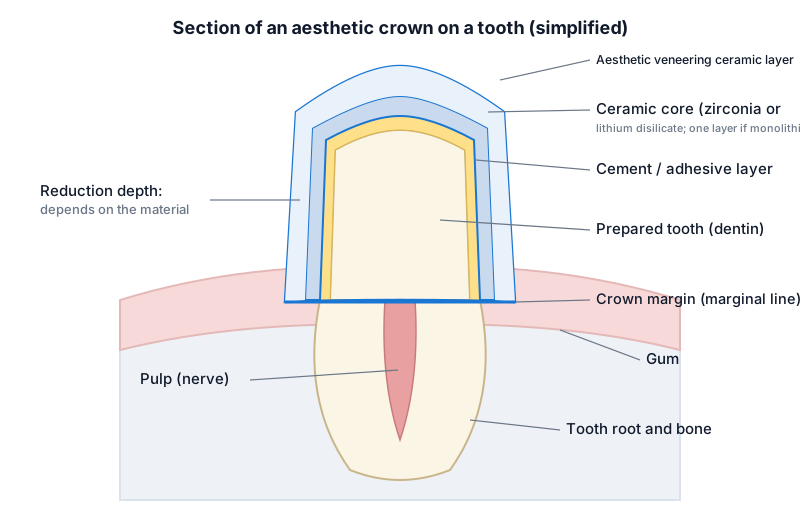 A simplified cross-section: the prepared tooth (dentin), a thin layer of cement, the ceramic framework and the aesthetic outer layer; the margin at the gum line.
Between the inside of the crown and the tooth there is a thin layer of cement (adhesive). Zirconia is usually bonded with conventional or resin cement, while lithium disilicate is bonded with a special adhesive protocol — this difference also affects the strength of the material.
Types of crowns: by material
The aim of this section is not to say which one is better; every material has its place.
Zirconia (zirconium dioxide) crown
Zirconia is the strongest dental ceramic. According to the review by Zhang and Lawn (J Dent Res, 2018), classic 3Y-TZP zirconia has a flexural strength of 1.0–1.5 GPa; this is an advantage for back teeth and bridge frameworks, where the chewing load is high. Its drawback is opacity: classic zirconia does not transmit light the way a natural tooth does. For this reason manufacturers have developed more translucent (light-transmitting) 4Y and 5Y zirconias; they look more natural in front teeth, but their strength drops by roughly half. In other words, zirconia is not a single material but a family, and which one is chosen depends on the position of the tooth.
A zirconia crown is made in two ways: monolithic (a single solid piece of zirconia) and layered (aesthetic ceramic over a zirconia framework). The layered version looks more natural, but there is a risk of the outer layer chipping. We have discussed this choice separately in the article monolithic zirconia or layered zirconia.
Lithium disilicate (E-max) crown
Lithium disilicate is a glass-ceramic. It is less strong than zirconia, but it transmits light very naturally and is chemically bonded to the tooth. It is widely used in front teeth and in cases with moderate load. In the 2019 study by Malament and colleagues, 1960 lithium disilicate crowns in 556 patients were followed for more than 10 years; the annual failure risk was below 0.2%, and 5 of the 7 failures occurred in molars. This shows that the material also works in back teeth, but that the highest load is on the molars. More about the material: what E-max is. A head-to-head comparison with zirconia is in the article E-max or zirconia.
Metal-ceramic crown
Ceramic over a metal framework. It was the standard for decades and is still reliable. Its aesthetic limitation is the grey line that can show at the margin when the gum recedes, and the fact that it does not transmit light. For this reason all-ceramic crowns are preferred in the front zone; in back teeth it can still be an option in terms of budget and strength.
Full metal crown
Gold or an alloy. It requires minimal preparation and causes little wear to the opposing tooth. Because of its appearance, it is only considered for back teeth that are not visible.
Types of crowns: by fabrication method
Apart from the material, the way the crown is made also differs. In the conventional method an impression is taken, the laboratory makes the crown in 1–2 weeks, and a temporary crown is worn during this time. In the CAD/CAM method the tooth is scanned with an intraoral scanner (a digital intraoral camera), the crown is designed on a computer and milled by a milling machine. In some cases this can be completed on the same day — we have explained when this is possible in the article a CAD/CAM crown in a single day.
How long do all-ceramic crowns last?
The systematic review by Sailer and colleagues in the journal Dental Materials (2015) covers 4663 metal-ceramic and 9434 all-ceramic single crowns across 67 studies. The 5-year survival was ~94.7% for metal-ceramic, ~96.6% for leucite/lithium disilicate glass-ceramic and ~92.1% for layered zirconia; chipping of the outer ceramic was reported more often with layered zirconia than with metal-ceramic. This review did not yet cover monolithic zirconia.
The 2026 meta-analysis by Pjetursson and colleagues (Int J Prosthodont) brings together 8051 all-ceramic and 3509 metal-ceramic single crowns across 64 studies. The 5-year crown survival was ~98.5% for monolithic lithium disilicate, ~97.3% for layered zirconia, ~97.1% for metal-ceramic and ~96.8% for monolithic zirconia; ceramic chipping was seen significantly less often with the monolithic versions than with the layered ones.
These figures were measured under study conditions, in selected groups of patients. The individual outcome depends on hygiene, clenching, the quality of the preparation and the precision of the margin. You can read about when a crown should be replaced in the article when to replace old crowns.
How is the material chosen in practice?
At the appointment the decision usually follows this order:
- Where is the tooth located? In a front tooth light transmission comes first, in a back tooth strength does.
- How much healthy tooth is left? If little structure remains, a material that is adhesively bonded rather than cemented can strengthen the tooth further.
- What is the colour underneath? If there is a dark root or a metal post, a more opaque material or a layered technique is needed.
- Does the patient clench their teeth? With bruxism, monolithic versions and a night guard are considered.
- What is the opposing tooth? Natural enamel, composite, ceramic — the wear of the opposing tooth is taken into account.
At the clinic these choices are made with digital impressions and a CAD/CAM workflow as part of the prosthodontic treatment service; a consultation is needed to assess the individual situation.
Frequently asked questions
Does a front tooth that has had root canal treatment definitely need a crown? Not always. The chewing load on a front tooth is low; if the walls are in place and the shade has not changed, a smaller restoration or a veneer may be enough. In back teeth, a crown is recommended more often.
Does a zirconia crown look artificial in a front tooth? Classic opaque zirconia can look flat in a front tooth. Translucent zirconia, a layered technique or lithium disilicate reduces this problem. The choice is made according to the colour of the underlying tooth and the neighbouring teeth.
Can a tooth decay under a crown? Yes. If plaque builds up at the edge of the crown, at the gum line, decay can start. That is why cleaning the margin with floss or an interdental brush and having regular check-ups is important.
How much is the tooth prepared when a crown is placed? It depends on the material: monolithic zirconia needs little space, layered ceramic needs more. The dentist plans the exact thickness according to the material and the size of the tooth.
Why does a grey line appear at the gum line? Usually it is the metal margin of a metal-ceramic crown showing when the gum recedes. This appearance does not occur with all-ceramic crowns. The causes and solutions are explained in the article a dark line at the gum margin.
Conclusion
An aesthetic crown is chosen to protect a tooth that has lost a lot of structure, has had root canal treatment, is cracked or is deeply discoloured. On a healthy tooth with little damage, a filling or a veneer may be enough. The choice between zirconia, lithium disilicate and metal-ceramic is made according to the position of the tooth, the remaining tooth structure, the colour underneath and the chewing load. Modern all-ceramic crowns show survival similar to metal-ceramic at 5 years of follow-up; longevity, however, depends on a correct indication, a precise margin and daily care.
Sources
- All-ceramic or metal-ceramic tooth-supported fixed dental prostheses (FDPs)? A systematic review of the survival and complication rates. Part I: Single crowns (SCs) — Dental Materials, 2015 (Sailer, Makarov, Thoma, Zwahlen, Pjetursson)
- A Systematic Review and Meta-analysis Evaluating the Survival, Failure, and Complication Rates of Metal-Ceramic, Veneered, and Monolithic All-Ceramic Tooth-Supported Single Crowns — Part 1 — The International Journal of Prosthodontics, 2026 (Pjetursson et al.)
- Ten-year survival of pressed, acid-etched e.max lithium disilicate monolithic and bilayered complete-coverage restorations — The Journal of Prosthetic Dentistry, 2019 (Malament et al.)
- Novel Zirconia Materials in Dentistry — Journal of Dental Research, 2018 (Zhang, Lawn)
This article is for general information only and does not replace an individual diagnosis, examination or treatment. Consult a doctor for a decision about your case.