

Prosthetics
We restore missing or damaged teeth with ceramic crowns, bridges and implant-supported prosthetics — for comfortable chewing and a natural look.
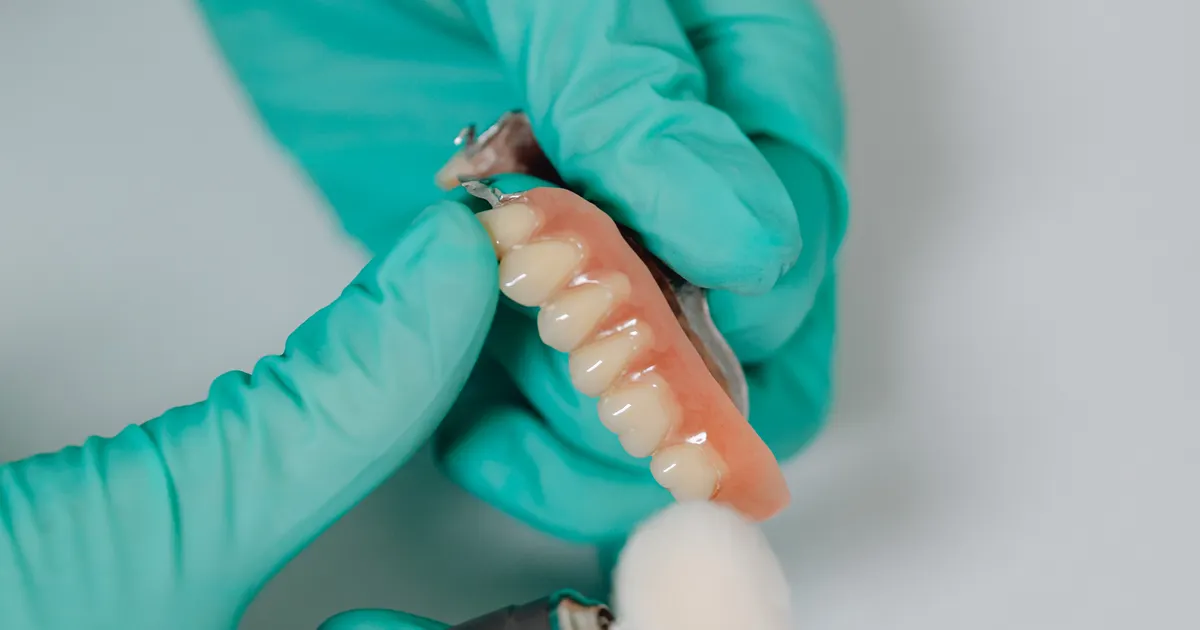
Prosthetics means rebuilding teeth that are badly damaged or missing. In Baku, at Smile by Dr. Bakhtiyar, this work is done with a digital scan (taking the impression with an intraoral scanner) and CAD/CAM technology (design and production on a computer). Zirconia crowns, E-max crowns, bridges and implant-supported prosthetics are made individually. Shape and shade are matched to your own teeth.
A crown or bridge is usually needed when a tooth has become weak after root canal treatment and may crack, when a large filling covers more than half of the tooth, when one or several teeth are missing, or when you chew only on one side. A dark old crown with a visible gap at the gum line should also be replaced.
Treatment starts with a first consultation and examination. If needed, we take a panoramic X-ray or a 3D CBCT (cone-beam scan). The tooth is then prepared, a digital scan is taken and a temporary crown is placed. When the final work is ready, the dentist checks the bite, the shade and the fit at the gum, then bonds it permanently.
For the first few days the bite may feel slightly different; this is normal and settles quickly. Crowns and bridges are cared for like natural teeth: brushing twice a day plus an interdental brush or floss. Avoid cracking very hard things with your teeth. A check-up and professional hygiene once or twice a year help the restoration last longer.
The price depends on the material and the number of teeth. At our clinic a zirconia crown for back teeth starts at 465 AZN, a zirconia crown on an implant at 600 AZN, and an E-max crown or Empress veneer at 840 AZN. The first consultation with a treatment plan is 60 AZN and a 3D scan is 100 AZN. The exact plan and timing are agreed after the examination.
What is prosthodontic treatment?
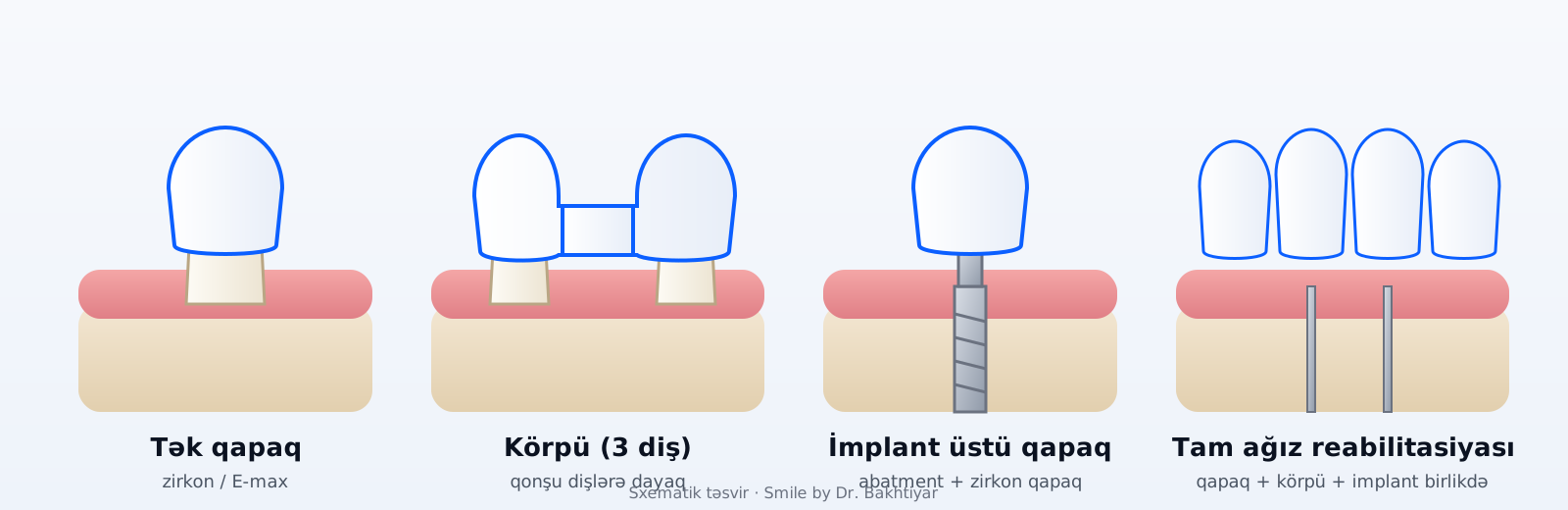
Fixed prosthodontics restores missing or badly damaged teeth with restorations that are not removed: crowns, bridges and implant-supported prostheses. The aim is threefold: to return chewing function, to protect the remaining tooth structure from fracture and to restore a natural appearance. This page covers all fixed prostheses; purely aesthetic restoration of front teeth (veneers) and the surgical stage of implants are explained on separate service pages.
When is a prosthesis needed?
For small defects a filling or an onlay (partial crown) may be enough; the decision depends on how much tooth structure has been lost.
- A large filling occupies more than half of the tooth and the walls are thin
- A root-treated back tooth is at risk of fracture — a crown keeps it intact
- A cracked or broken tooth (if the root can be kept)
- One or more teeth are missing — a bridge or an implant-supported prosthesis
- Old crowns and bridges: dark margin, decay, gap, crack
- Generalised wear and loss of bite height — full-mouth planning
Types of crowns
The clinic uses two main all-ceramic options: monolithic zirconia (the strongest; back teeth, bridges, implant-supported) and lithium disilicate E-max (high translucency; front teeth, single crowns). Veneered (ceramic-layered) zirconia improves aesthetics, but chipping of the veneering ceramic occurs more often than with the monolithic version — systematic reviews show this consistently. Metal-ceramic remains a reliable standard, but because of the grey line at the gum and lack of translucency it is chosen less often in the aesthetic zone.
E-max and zirconia
E-max (lithium disilicate glass-ceramic) gives translucency close to a natural tooth and can be adhesively bonded to enamel; its strength is sufficient for a single crown but not for long bridges. Zirconia (yttria-stabilised zirconium dioxide) has higher flexural strength and is preferred for bridges and implant work; new-generation translucent zirconias are also used in the aesthetic zone, but strength decreases as translucency increases. So the question is not “which is better” but “which is right for this tooth”: a front tooth with a thin preparation → usually E-max; a back tooth, bruxism, a bridge → usually zirconia.
When is a bridge chosen?
A bridge replaces a missing tooth with a restoration supported by the neighbouring teeth, which are prepared and crowned. If the neighbours already have large fillings or old crowns, if there is not enough bone for an implant or surgery is not wanted, a bridge is a logical choice. If preparing healthy neighbouring teeth is undesirable, an implant crown is preferred. Systematic reviews report high 5-year survival for all-ceramic and metal-ceramic multi-unit bridges; for zirconia bridges the main technical problem is chipping of the veneering ceramic, so a monolithic or minimally layered design is chosen.
Implant-supported prostheses
The implant is the post in the bone; the abutment and crown (or bridge) on top are the prosthetic stage, which this page is about. The clinic's standard solution is a zirconia crown on the implant; for front teeth a custom abutment and gum shaping are part of the plan. A screw-retained prosthesis can be removed and carries no risk of residual cement; a cement-retained one can give a more aesthetic transition — the choice depends on the position. According to a 2012 systematic review the 5-year survival of implant-supported fixed prostheses is about 95%; the most common complications are chipping of the veneering ceramic and screw loosening, most of them repairable.
Full-mouth rehabilitation
With multiple tooth loss, generalised wear, loss of bite height (vertical dimension) or failing old prosthetic work, the whole occlusion has to be planned together rather than one or two teeth. It is the most staged prosthetic work: diagnostic models and a digital design (wax-up), functional analysis where needed, testing the new occlusion with long-term provisional restorations, then making the definitive crowns, bridges and implant prostheses together. Reviews indicate that increasing the vertical dimension is well tolerated when done in stages and under supervision — but not every patient needs it. This page serves as the commercial context for full-mouth rehabilitation; implant concepts for the fully edentulous jaw are explained on the All-on-4 page.
How is the treatment plan built?
Prosthetic work is not “covering a tooth” but planning a system. First the diagnosis: which teeth are kept, which need root canal treatment or extraction, the condition of the gums and bone, the bite. Then the choice of material and design, the sequence (therapy and hygiene first, then surgery, then prosthetics) and the timeline in a written plan. In larger cases the result is shown in advance with a digital design and mock-up.
Occlusion and functional planning
Every crown is part of the occlusion: a high crown can cause muscle pain and jaw-joint complaints, a low one lets the opposing tooth over-erupt. That is why in multi-unit work the bite is recorded, centric relation and vertical dimension are determined when needed, and a protective splint is included in the plan for bruxism. Patients with jaw-joint complaints have a gnathological assessment before prosthetic treatment.
The digital CAD/CAM workflow
The impression is taken digitally with an intraoral scanner, the prosthesis is designed on a computer and produced by milling or pressing. According to a 2017 systematic review, the complete digital workflow for single crowns gives clinically acceptable accuracy compared with the conventional method and shortens the time; for long bridges and full-mouth cases conventional steps (a physical model, try-in) are still combined with the digital ones. The benefit for the patient: a comfortable impression, fewer visits, and a design that can be seen in advance.
Treatment stages
- 1
Diagnosis and plan
Examination, X-ray/3D, assessment of the bite; which teeth are kept, the material and the sequence — in a written plan.
- 2
Preparatory treatment
Where needed, decay and root canal treatment, gum treatment and professional hygiene — the prosthesis is built on a healthy foundation.
- 3
Tooth preparation
Under local anaesthesia the tooth is prepared for the crown as minimally as needed; the margin is planned relative to the gum level.
- 4
Digital impression
An intraoral scan, bite registration and shade selection (with photographs).
- 5
Provisional restoration
A temporary crown or bridge that protects the tooth and tests the new shape and bite.
- 6
Laboratory / CAD/CAM
Design and production (zirconia milling, E-max pressing); framework try-in in larger cases.
- 7
Try-in
Margin fit, bite, shade and shape are checked; adjustment or return to the laboratory when needed.
- 8
Fixation and review
Cement or adhesive fixation, final bite adjustment; review after 1–2 weeks, then hygiene and a check once or twice a year.
How long it takes
A single crown usually takes 2–3 visits over 1–2 weeks; a bridge 2–4 visits over 2–3 weeks; an implant-supported prosthesis is planned after the implant has healed, so the overall process is measured in months; full-mouth rehabilitation with its provisional stage can take several months. The digital workflow reduces the number of visits, but the laboratory stage is not rushed for the sake of quality.
Risks and limitations
- Sensitivity and pulp reaction — in a vital tooth after preparation; root canal treatment is rarely needed
- Chipping of the veneering ceramic — more common with layered zirconia and metal-ceramic; a monolithic design reduces the risk
- Loss of cement or a crown coming off — re-cementation is possible
- Decay at the margin — prevented by hygiene and review; a crown does not “insure” the tooth against decay
- Loss of an abutment tooth (in a bridge) — related to load distribution and hygiene
- Bite problems — a high/low crown; resolved by adjustment in the first weeks
- Irreversibility — a prepared tooth will always need a crown
Factors that affect the price
The prices below come from the same source as the site's Prices section. The total depends on the number of teeth, the material (zirconia or E-max), the design (single crown, bridge, implant-supported), the extent of preparatory treatment (root canals, gums, hygiene) and diagnostics (3D CBCT). For full-mouth work the price is given in a written plan broken down by stage.
| Initial visit, consultation and personalised treatment plan | $35 |
| 3D tomography (CBCT) | $60 |
| Zirconia crown (posterior teeth) | $275 |
| E-max crown | $495 |
| Zirconia crown on implant | $355 |
Prices are set in Azerbaijani manat (AZN); US dollar amounts are approximate, converted at the exchange rate of 2026-10-27. The AZN amount is what is charged. Prices come from the same source as the Prices page; the final amount is set after your examination. Prosthodontics prices →
Doctor and clinic
At Smile by Dr. Bakhtiyar (Baku, Babek Avenue 1131) prosthetic and implant-prosthetic work is planned by Dr. Bakhtiyar Aliyev; digital design, preparation, laboratory communication and fixation take place in one clinic. Occlusion and jaw-joint questions are assessed together with orthodontist-gnathologist Dr. Maharram Mammadov; gum preparation and professional hygiene are carried out within the team.
Sources
- All-ceramic or metal-ceramic tooth-supported fixed dental prostheses (FDPs)? A systematic review of the survival and complication rates. Part I: Single crowns (SCs) — Dental Materials, 2015
- All-ceramic or metal-ceramic tooth-supported fixed dental prostheses (FDPs)? A systematic review of the survival and complication rates. Part II: Multiple-unit FDPs — Dental Materials, 2015
- A Systematic Review and Meta-analysis Evaluating the Survival, Failure, and Complication Rates of Metal-Ceramic, Veneered, and Monolithic All-Ceramic Single Crowns — International Journal of Prosthodontics, 2026
- A systematic review of the survival and complication rates of implant-supported fixed dental prostheses (FDPs) after a mean observation period of at least 5 years — Clinical Oral Implants Research, 2012
- Clinical considerations for increasing occlusal vertical dimension: a review — Australian Dental Journal, 2012
- The complete digital workflow in fixed prosthodontics: a systematic review — BMC Oral Health, 2017
If this sounds familiar
If you have one of these complaints, this service may be right for you:
- “My tooth broke and almost only the root is left”
- “The tooth went dark after root canal treatment and they say it is cracked”
- “I have no teeth on one side and chew only on the other”
- “My old crown looks dark and there is a black line at the gum”
- “My filling keeps falling out and I have it redone again and again”
- “My front tooth is prepared down and I am shy to smile”
- “My removable denture does not stay in place when I talk”
- “It hurts when I press on the tooth while chewing”
Frequently asked questions
When is a crown needed?
When a large part of the tooth is lost, a large filling occupies more than half of the tooth, a root-treated back tooth needs protection from fracture, or the tooth is cracked. For small defects a filling or an onlay may be enough — the examination decides.
E-max or zirconia — which is better?
There is no universal answer. On front teeth and where translucency matters, E-max (lithium disilicate) is preferred; on back teeth, in bridges and under heavy chewing load, zirconia is stronger. The choice depends on the tooth position, the remaining structure and the bite.
Bridge or implant?
A bridge requires preparing the neighbouring teeth and loads them; an implant leaves the neighbours untouched but requires surgery and enough bone. If the neighbouring teeth need crowns anyway, a bridge can make sense; with healthy neighbours an implant is usually the first choice.
How long do crowns and bridges last?
Systematic reviews report 5-year survival of about 90–95% for single ceramic crowns and around 90% for multi-unit fixed bridges; for implant-supported fixed prostheses about 95% at 5 years. Hygiene, occlusal load, clenching and regular review determine the lifespan.
Does tooth preparation hurt?
Preparation is done under local anaesthesia; a vital tooth may be temporarily sensitive afterwards. The temporary crown protects the tooth; persistent pain or prolonged cold sensitivity needs a review.
Why is a temporary crown needed?
It protects the prepared tooth from sensitivity and movement, keeps the gum shape and lets you test the new shape and bite in daily life. In larger cases the provisional stage is the “trial version” of the final design.
How many visits are needed?
Usually 2–3 visits over 1–2 weeks for a single crown; more for bridges and multi-unit work; months for implant-supported prostheses because osseointegration has to be waited for. The exact schedule is given in a written plan.
When should an old crown be replaced?
When there is a dark line at the margin, a gap between crown and gum, signs of decay, a crack, odour, pain under the crown or a marginal discrepancy on a digital X-ray. Replacement for purely aesthetic reasons is also possible, but every replacement removes a little tooth structure.
Who needs full-mouth rehabilitation?
When there is multiple tooth loss, generalised wear, loss of bite height or failing old prosthetic work — the whole occlusion is planned together, not one or two teeth. It is the most staged prosthetic work, requiring functional analysis and a provisional stage.

Doctor performing this treatment
Implantologist · Digital Dentistry · Founder of the clinic
Read more on this topic
- Implant-supported prosthesis: zirconia, metal-ceramic or temporary PMMA? Screw-retained vs cement-retained
- What is full-mouth aesthetic rehabilitation?
- Monolithic or layered zirconia: which is chosen when?
- When do old crowns need to be replaced?
- 3Shape TRIOS intraoral scanner: how does a digital dental impression work?
- Why does a black line appear at the gum edge of a crown and how is it fixed?