

Why does a black line appear at the gum edge of a crown and how is it fixed?

A black or grey line where a crown meets the gum is usually caused by one of four things: the metal margin of a metal-ceramic crown becoming visible, the gum receding and exposing the crown margin and the darker part of the root, a change in the colour of the root of a root-treated tooth, or the metal beneath the crown showing through as a shadow in thin gums. The solution is chosen according to the cause: sometimes only polishing the margin is needed, but more often the crown has to be replaced with metal-free ceramic and the gum level corrected.
Key points
- A black line is often not a disease but an optical and anatomical problem; still, choosing a solution without clarifying the cause is not the right approach.
- The most typical cause: the gum recedes around an old metal-ceramic crown and the metal margin becomes visible.
- A metal margin does not transmit light to the root and the gum, which is why the gum itself also looks darker.
- All-ceramic crowns (zirconia, lithium disilicate) contain no metal, so this type of line does not appear — but gum recession can still show.
- If the gums are thin and prone to recession, this must be taken into account in advance when planning a new crown.
What exactly is this black line?
Patients describe it in different ways: the crown looks dull, the base of my tooth has gone dark, there is a grey shadow in my smile. During the clinical examination we determine exactly where this shadow is — at the margin of the crown itself, on the tooth root beneath the margin, or within the gum. Each points to a different mechanism and requires a different solution.
Cause 1: The margin of a metal-ceramic crown
A metal-ceramic (PFM) crown consists of two layers: a metal framework inside and ceramic over it. The ceramic covers the visible part of the crown, but at the margin — just below the gum line — the metal is often left exposed, or the ceramic there is very thin. When the crown is fitted, this margin is hidden beneath the gum. As the years pass, the gum recedes by a millimetre or two and the metal line comes into view.
In addition, metal does not transmit light. A review published in the International Journal of Dentistry (Sikka et al., 2010) shows that a metal margin reduces light transmission to the adjacent dental tissue, and as a result both the root surface and the gum look darker. In other words, even if the metal is not visible, the gum itself can take on a greyish shade. This is precisely why the collarless metal-ceramic design was created years ago: ceramic is used at the margin instead of metal so that the neck area looks more natural.
A metal-ceramic crown is not a bad choice in itself. In a retrospective study published in The Journal of Prosthetic Dentistry in 2025 (D'Souza et al.; 403 patients, 515 single crowns, follow-up of up to 7 years), the failure rates of metal-ceramic and zirconia crowns did not differ statistically (9.8% and 6.7% respectively). The issue here is not strength, but aesthetics in the front teeth.
Cause 2: Gum recession and root exposure
Gums can recede somewhat with age and with brushing habits even around a perfectly made crown. When they recede, three things become exposed: the crown margin, the tooth root and the plaque that gathers along the margin. The root is more yellow-brown in colour than enamel and stands out sharply against the white ceramic of the crown — and this dark band, too, appears to the patient as a black line.
There is an important question here: does the crown margin itself cause gum recession? The proceedings of the 2017 World Workshop in Periodontology (Ercoli & Caton, 2018) conclude the following: a crown margin placed within the gum pocket does not in itself cause inflammation if the patient maintains hygiene and attends regular check-ups; but when the margin goes deeper — into the connective tissue attachment zone — it is associated with inflammation and recession. In other words, a margin placed too deep can, years later, lead to the very recession that reveals the line it was meant to hide.
Another cause of recession is gum disease. If plaque and inflammation persist, recession will continue too, and no new crown will stop it. In this case treatment of the gum disease comes first, and the aesthetic solution is planned afterwards.
Cause 3: The colour of the root (a root-treated tooth)
A root-treated tooth can darken over time: residual tissue inside the root, old filling materials or a metal post give the tooth a grey-brown colour. If the gums are thin, this dark root shows through the gum as a shadow. Here the problem is not in the crown but in the tooth itself — which is why simply replacing the crown may not give a result. The options are: internal bleaching of the root, replacing the post with a metal-free (glass fibre) one, and using a less light-transmitting (opaque) ceramic layer at the crown margin.
Cause 4: Thin gums (thin biotype)
In some people the gums are naturally thin and translucent. Such gums show everything beneath them — metal, a dark root, even dark-coloured cement — as a shadow, and they are more prone to recession. In a patient with thin gums, a metal-ceramic crown darkens particularly quickly. When a new crown is planned, the dentist can anticipate this and either choose a metal-free material or, if needed, discuss thickening the gum (a soft tissue graft).
A rare cause: pigmentation in the gum itself
Sometimes the gum itself stays dark even when the crown is removed. This is the trace of pigment or metal particles that have permeated the gum. A clinical report published in The Journal of Prosthetic Dentistry (Tian et al., 2016) described gum pigmentation around metal-ceramic crowns with nickel-chromium frameworks; although brown deposits were found on tissue examination, no direct trace of nickel or chromium was detected — meaning the mechanism is not limited to the direct absorption of metal ions. Such cases are rare; the solution may be a minor surgical correction of the gum together with replacing the crown with a metal-free material.
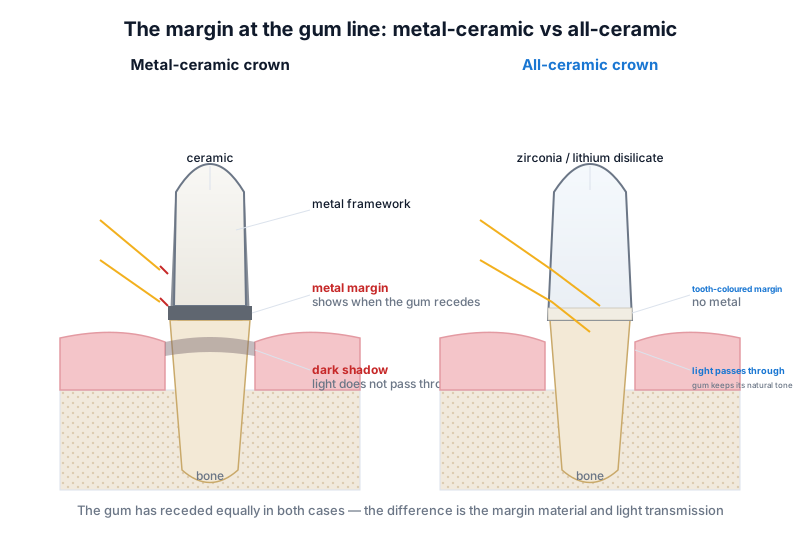 On the left, a metal-ceramic crown: the metal margin comes into view when the gum recedes and it does not transmit light. On the right, an all-ceramic crown: there is no metal, and the margin stays the same tone as the tooth and the gum.
Which solution for which cause?
| Cause | What is seen | Suitable solution |
|---|---|---|
| Exposed metal-ceramic margin | A thin grey-black line at the base of the crown | Replacing the crown with all-ceramic (zirconia or lithium disilicate) |
| Gum recession, exposed root | A yellow-brown band between the crown and the gum | If the gums are healthy — a new crown with the margin at the correct level; if recession is extensive — combined with gum coverage surgery |
| Dark root of a root-treated tooth | A grey shadow showing through the gum | Internal bleaching or a metal-free post, a crown with an opaque margin |
| Thin gums | An overall greyish shadow, a tendency to recede | Metal-free material, thickening the gum if needed |
| Gum pigmentation | A dark patch remains even when the crown is removed | Minor surgical correction of the gum + a metal-free crown |
| Plaque and old cement at the margin | A dark, rough line, bleeding gums | Professional cleaning and polishing; sometimes this is enough |
As the table shows, replacing the crown is not the only answer. Sometimes the problem is only plaque and old cement gathering at the margin, and after professional cleaning the line is considerably reduced. We have explained separately in the article when should old crowns be replaced in which cases a crown needs to be replaced.
What is taken into account when planning a new crown?
To avoid a repeat of the black line problem on a front tooth, there are several points in the plan for a new crown:
- Material. Zirconia and lithium disilicate (E-max) are metal-free; they transmit light in the neck area and cast no shadow on the gum. Which one is chosen depends on the colour, position and load of the tooth — the articles E-max or zirconia and monolithic or layered zirconia explain this decision.
- The level of the margin. The margin is placed at the gum line or only very slightly inside the pocket; it does not enter the tissue attachment zone. This reduces the risk of future recession.
- The condition of the gums. If there is inflammation, it is treated first; if the gums are thin, thickening is discussed.
- The colour of the cement. In thin gums, dark cement can also cast a shadow; that is why a light, tooth-coloured adhesive is chosen.
- Digital planning. The gum contour and the neck form of the crown are modelled in advance with an intraoral scan and CAD/CAM design.
All of these steps are assessed together during a prosthodontic treatment consultation. You can read about the types of crowns available in general in the article types of aesthetic crowns.
Can the black line be hidden without replacing the crown?
There are short-term options, but their effect is limited:
- Polishing and cleaning the margin — this works if plaque and cement are the cause.
- Covering the margin with composite — a thin layer of composite is applied over the metal margin; the aesthetics improve temporarily, but composite stains over time and can make hygiene at the margin more difficult.
- Gum coverage surgery — if recession is the main cause and the crown is sound, the gum can be brought down; the result depends on the thickness of the gum and the type of recession.
For a crown with a metal margin problem, the long-term solution is usually to replace the crown.
Frequently asked questions
Is a black line dangerous for health?
In itself — no, it is an optical problem. But if plaque gathers along the line, if the gum bleeds or if the margin is open, there is a risk of decay and inflammation there; the dentist checks this during the examination.
Does a black line never appear on a zirconia crown?
A metal line does not appear, because there is no metal. But if the gum recedes, the crown margin and the root can still show — it is just that this is not black, but close to the colour of the tooth.
My gum has receded, but everything was fine when the crown was fitted. Why?
Recession happens slowly, over years: age, hard brushing, inflammation, thin gums and the depth of the margin all play a part. The margin that was hidden when the crown was fitted comes into view over time.
There is a black line on just one tooth and the ones next to it are fine. Can only that one be replaced?
Yes. A single crown can be replaced; the main difficulty here is matching the colour of the new crown to the neighbouring natural teeth.
Is gum treatment essential before replacement?
If there is inflammation, bleeding or ongoing recession — yes. The margin of a crown made over unhealthy gums soon becomes exposed.
Conclusion
A black line at the gum edge is most often the visible margin of a metal-ceramic crown or an exposed root; thin gums and a dark root make it more pronounced. The solution is chosen according to the cause — sometimes cleaning is enough, but more often a metal-free crown and a correct margin level are needed. A consultation with an examination and X-rays is helpful in assessing your individual situation.
Sources
- Marginal Strength of Collarless Metal Ceramic Crown — International Journal of Dentistry, 2010 (Sikka et al.)
- Gingival pigmentation by Ni-Cr-based metal ceramic crowns: A clinical report — The Journal of Prosthetic Dentistry, 2016 (Tian et al.)
- Dental prostheses and tooth-related factors — Journal of Clinical Periodontology, 2018 (Ercoli & Caton; World Workshop)
- Comparison of clinical outcomes between single metal-ceramic and zirconia crowns — The Journal of Prosthetic Dentistry, 2025 (D'Souza et al.)
This article is for general information only and does not replace an individual diagnosis, examination or treatment. Consult a doctor for a decision about your case.