

A crown (an artificial cap that covers the whole top of a tooth) is not replaced simply because it has become old. Replacement needs a specific reason: a gap at the crown margin with decay underneath, a crack or fracture extending into the root, gum recession that exposes the margin, persistent inflammation, or an aesthetic concern that bothers the patient. If the crown fits well, the X-ray shows no problem and the gums are healthy, it can be kept even at 15–20 years old. The decision is made on the basis of an examination and X-rays.
Key points
- A crown has no expiry date; the reason for replacement is not the crown's age but its condition.
- The most important problems are decay under the crown and a poorly fitting margin — these often develop painlessly and are only visible on an X-ray.
- Gum recession exposes the margin: this can create both an aesthetic and a hygiene problem.
- Oral hygiene affects a crown's lifespan as much as the material does.
- In some cases, instead of replacement, monitoring, a small adjustment or polishing of the margin is enough.
Why does a crown deteriorate?
A crown is bonded to the tooth with cement, and its edge (the margin) meets the tooth. Over the years, three things happen at that margin: the cement is slowly washed out, the gum recedes a little, and plaque builds up along the margin. As a result, a microscopic gap forms between the tooth and the crown — bacteria pass through it and decay (caries) begins underneath the crown.
What speeds this process up? In a long-term clinical study published in 2023 in the journal Clinical and Experimental Dental Research (Alenezi et al.; 423 patients, fixed prostheses supported by 1116 teeth, mean follow-up 7 years), recurrent decay was recorded in 8.4% of the prostheses. In patients with good hygiene this figure was 4%, and in those with poor hygiene 18.4%. In the same study, Kaplan-Meier analysis over follow-up of up to 14 years calculated the probability of remaining free of recurrent decay at 88% with good hygiene and 40% with poor hygiene. In other words, the same crown lives a completely different lifespan in different mouths.
6 signs that call for replacement
1. A marginal gap and a catching sensation
If the instrument catches when the dentist runs a probe (a fine instrument) along the crown margin, the margin has opened up. Patients sometimes notice this as dental floss tearing or snagging in that spot. A small gap does not yet mean replacement — but if the X-ray shows a dark zone underneath, decay has already started.
2. Decay under the crown
The most common and the most silent reason. A metal-ceramic crown does not show what is under the metal on an X-ray, so decay is only visible at the margin. In a clinical and radiographic study published in 2018 (Al Refai & Saker; 151 patients attending a dental faculty for replacement, 249 failed metal-ceramic prostheses), a defective margin was found in 90.4% of the prostheses that were re-evaluated; decay and apical problems were mainly seen in single crowns, while ceramic wear and loss of cement retention predominated in bridges. These figures apply only to prostheses already considered failures — they cannot be extended to all crowns, but they do show what to look out for.
If decay is confirmed, the crown is removed, the decay is cleaned out, and depending on how much of the tooth remains, a new crown or another restoration is planned.
3. Gum recession and an exposed margin
When the crown was fitted, its margin was hidden under the gum; years later, when the gum recedes, the margin becomes exposed. On a front tooth this looks like a dark or grey line; we have explained that topic separately in the article on the dark line at the gum margin. Recession is not only a matter of aesthetics: the exposed root surface can cause sensitivity and creates a new place for plaque.
But not every case of recession is a reason for replacement. According to the conclusions of the World Workshop on Periodontology (2017, review by Ercoli & Caton), a crown margin placed within the gum pocket does not in itself cause inflammation as long as the patient maintains hygiene and attends regular check-ups; the problem arises when the margin encroaches on the connective tissue attachment — in that case inflammation and recession are to be expected.
4. A crack, fracture or chipped ceramic
A small chip in the ceramic can be polished and kept. But if the crack reaches the metal framework or the zirconia substructure, or if there is a suspected crack in the tooth beneath the crown, replacement is needed. Root-canal-treated teeth are more vulnerable here — in a retrospective study published in 2025 in The Journal of Prosthetic Dentistry (D'Souza et al.; 403 patients, 515 single crowns, follow-up of up to 7 years), 8.5% of the crowns failed (9.8% for metal-ceramic, 6.7% for zirconia; the difference was not statistically significant), and with both materials the most frequently recorded biological complication was fracture not of the crown itself but of the tooth underneath it.
5. Persistent inflammation, bleeding or an apical problem
If the gum around the crown is constantly red and swollen and bleeds when brushed, the cause is excess cement at the margin, a rough margin that traps plaque, or a margin placed too deep. Sometimes, though, the problem is not under the crown but in the tooth root: the nerve tissue of a tooth that has not had root canal treatment can die years later, and inflammation develops at the root tip. This appears on an X-ray as a dark area at the tip of the root, and although root canal treatment is often possible without removing the crown, a new crown may still be needed.
6. An aesthetic concern
The colour differs from the neighbouring teeth, the shape looks flat and artificial, or an old metal-ceramic crown looks dull because it does not transmit light. This is not a medical indication but the patient's choice — and a perfectly legitimate reason. In such cases, the material of the new crown is a key part of the plan; the articles on aesthetic crown types and monolithic or layered zirconia help with that choice.
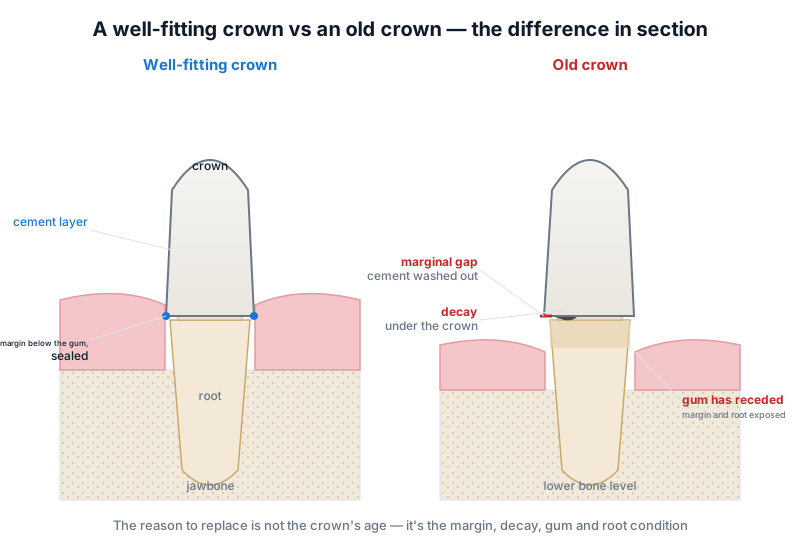 Three typical problems with an old crown in a single cross-section: the marginal gap, decay passing inwards through the gap, and the gum receding to expose the margin.
When is it fine to wait?
Not every old crown needs to be replaced. If a crown meets the following conditions, monitoring is usually enough:
- the probe does not catch at the margin and the X-ray shows no dark zone along it;
- the gum is healthy, does not bleed, and pocket depth is normal;
- there are no signs of inflammation at the root tip;
- the patient is comfortable — there is no sensitivity or pain on biting;
- the aesthetics do not bother the patient.
In this case the sensible approach is a check-up every 6–12 months with periodic X-rays. Replacing a crown preventively means removing more tissue from the tooth; every replacement weakens the tooth a little. That is why we do not recommend replacement without an indication.
| Situation | What to do |
|---|---|
| The margin has opened up and the X-ray shows decay | Replacement |
| The margin has opened up slightly, no decay, hygiene is good | Monitoring, X-ray in 6–12 months |
| A small chip in the ceramic, the framework is sound | Polishing, sometimes composite repair |
| The crack has reached the framework or the tooth is fractured | Replacement; the chance of saving the tooth is assessed |
| The gum has receded and a dark line is visible on a front tooth | Replacement at the patient's request |
| Inflammation at the root tip | Root canal treatment first, then a decision on the crown |
How is the assessment carried out?
The condition of an old crown cannot be judged at a glance. A standard assessment looks like this:
- Clinical examination — the margin is checked with a probe, gum pockets are measured, and the crown is checked for mobility.
- X-ray — decay along the margin, inflammation at the root tip, bone level. With metal-ceramic, the metal hides what is underneath, so CBCT (3D imaging) or diagnostic removal is sometimes needed.
- Sensitivity and bite testing — this gives information about the condition of the pulp (the nerve tissue). We have written separately about lingering reactions to cold in the article on tooth sensitivity.
- Photographs and shade assessment — if there is an aesthetic reason.
After these steps the dentist suggests one of three options: keep and monitor, make a small adjustment, or replace. If the decision is to replace, the material of the new crown, where the margin will sit and the condition of the gums are all planned together — this is a key part of a prosthodontic treatment consultation. In a modern digital workflow, once the old crown has been removed, the new one can sometimes be made in a single day with CAD/CAM.
Does removing an old crown harm the tooth?
This is the question patients ask most often. With the right technique — cutting the crown and sectioning it — additional damage to the tooth is minimal. Pulling it off by force can fracture the tooth, which is why dentists do not do this. Once it is removed, the condition of the tooth is assessed: if there is enough sound tissue, a new crown; if the decay is deep, restoration first (sometimes root canal treatment and a post); and if the tooth cannot be saved, extraction, followed by a discussion of which option is suitable to replace the extracted tooth.
Frequently asked questions
My crown has been in place for 20 years — does it definitely have to be replaced?
No. Age in itself is not an indication. If the examination and X-ray show that the margin, decay status, gums and root tip are all fine, it can be kept.
Can I feel it myself if there is decay under the crown?
Usually not. Decay progresses painlessly under the crown; the first signs may be a bad smell, floss snagging, or sensitivity to cold. That is why an annual X-ray check is advisable.
If one crown is replaced, do the ones next to it need replacing too?
Only if they also have a problem. For colour matching it sometimes makes sense to replace several front crowns together, but that is an aesthetic decision, not a medical necessity.
Is it worth replacing a metal-ceramic crown with zirconia?
For the material alone — no. In studies with follow-up of up to 7 years, the failure rates of the two materials did not differ statistically. There has to be an aesthetic or clinical reason for replacement.
The gum has receded but the crown is sound — what should I do?
If hygiene is good and there is no inflammation, you can wait. If a dark margin on a front tooth is bothering you, the crown can be replaced, or the replacement can be planned together with gum treatment.
Conclusion
The decision to replace an old crown rests on facts, not on age: the margin, decay, the gums, the root and the patient's aesthetic expectations. If there is an indication, delaying increases the risk of losing the tooth; if there is no indication, replacement means removing unnecessary tissue from the tooth. To assess your individual situation, a consultation with an examination and X-rays is all that is needed.
Sources
- Clinical and Radiographic Assessment of Reasons for Replacement of Metal-Ceramic Fixed Dental Prostheses in Patients Referring to Dental School — Journal of Clinical and Experimental Dentistry, 2018 (Al Refai & Saker)
- Secondary caries in fixed dental prostheses: Long-term clinical evaluation — Clinical and Experimental Dental Research, 2023 (Alenezi et al.)
- Comparison of clinical outcomes between single metal-ceramic and zirconia crowns — The Journal of Prosthetic Dentistry, 2025 (D'Souza et al.)
- Dental prostheses and tooth-related factors — Journal of Clinical Periodontology, 2018 (Ercoli & Caton; World Workshop)
This article is for general information only and does not replace an individual diagnosis, examination or treatment. Consult a doctor for a decision about your case.