

Same-Day Crowns with CAD/CAM: When Is It Possible?
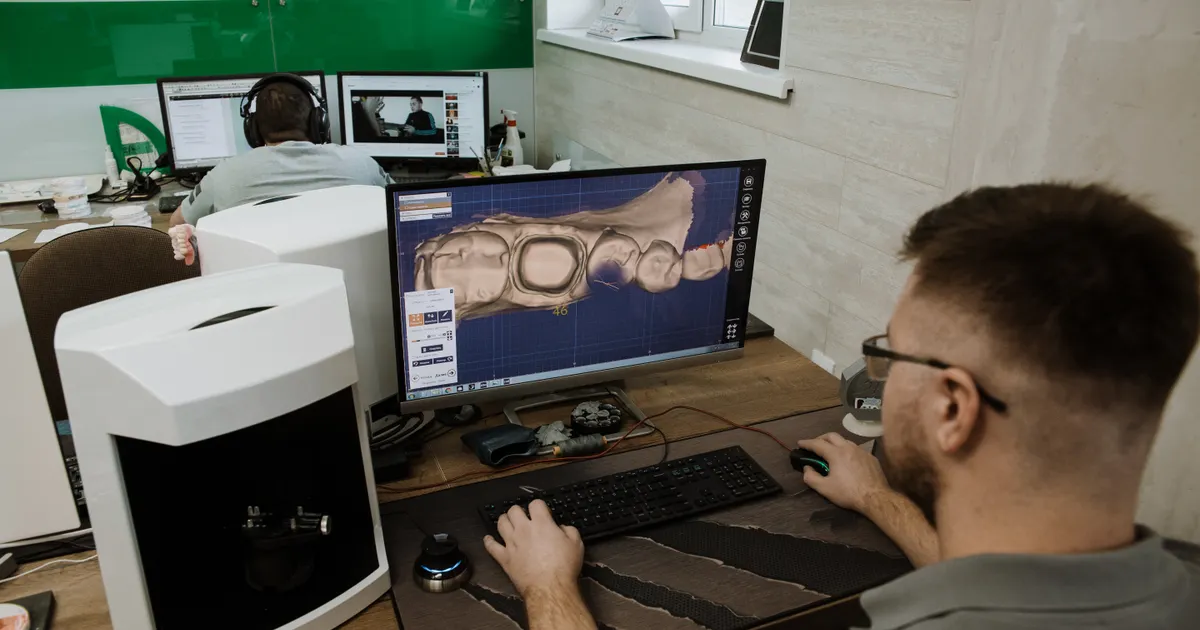
In suitable clinical cases, CAD/CAM technology can allow a crown to be made within a single visit — through digital scanning, computer design and in-clinic milling. In some situations this approach removes the impression tray, temporary crown and laboratory waiting stages that are typical of the traditional method. However, not every tooth and not every situation is suitable for a same-day crown; this is determined by examination and digital planning.
What does the research say? According to systematic reviews, a fully digital workflow provides clinically acceptable accuracy for single crowns compared with the traditional method and shortens chair time; the marginal fit of zirconia crowns made from digital scans is comparable to that achieved with traditional impressions. At the same time, the single-visit protocol is not suitable for every case: multi-unit bridges, complex aesthetic cases and deep subgingival margins still require a laboratory stage. The long-term survival of monolithic ceramic crowns is similar to that of metal-ceramic crowns, while chipping of the veneering ceramic is less frequent. Related: Prosthodontic treatment service · What is digital prosthodontic treatment? · Types of dental crowns.
What is CAD/CAM and how does it work?
CAD/CAM stands for Computer-Aided Design / Computer-Aided Manufacturing — that is, computer-assisted design and production. In dentistry this process usually consists of three stages:
- Digital scan: a precise digital impression of the tooth and surrounding tissues is taken with an intraoral scanner (instead of a traditional putty impression).
- Design (CAD): the crown is modelled on the computer in line with the anatomy of the tooth and the way the teeth bite together.
- Manufacturing (CAM): the design is produced from a ceramic or composite block in a milling machine.
In some cases this workflow can be completed within the same day, but this depends on the clinical circumstances.
When is a same-day crown possible?
A crown in a single visit is most often considered in the following situations:
- when the tooth root and surrounding tissues are healthy,
- when the condition of the gums is suitable for a digital scan,
- when the restoration is a single crown or a small-scale piece of work,
- when the bite and aesthetic requirements can be met with a standard material block.
In complex cases — extensive bridgework, implant-supported prostheses, demanding aesthetic requirements or teeth needing additional treatment — the work is often carried out in stages and laboratory involvement is required.
In which cases may it not be possible?
- If there is gum inflammation or infection, that problem is treated first.
- If root canal treatment or bone surgery is needed, the crown is placed at a separate stage.
- High aesthetic expectations (particularly matching colour and translucency on the front teeth) sometimes make individual laboratory work preferable.
- Multiple restorations cannot be planned in a single day.
Only an examination and digital planning can show whether the same-day option is suitable for your case.
Advantages of a CAD/CAM crown and points to consider
Possible advantages:
- a comfortable digital scan instead of a putty impression,
- in some cases, no need for a temporary crown or a second visit,
- a design that is precise and reproducible on the computer.
Points to consider:
- not every case is completed in one day; a staged plan may also be the clinically correct choice,
- the choice of material (type of ceramic) varies according to the tooth and the aesthetic requirement,
- the long-term result depends on proper hygiene and regular check-ups,
- no guaranteed outcome is promised with any prosthetic work.
Questions and Answers (FAQ)
Is a same-day crown lower in quality than a traditional crown? No, this is not a difference in quality but a difference in workflow. Which approach is suitable is determined by the condition of the tooth and the aesthetic requirement. Both methods can be reliable when carried out according to clinical indications.
Is the CAD/CAM crown procedure painful? Preparing the tooth is carried out under local anaesthesia and no pain is felt during this. The scanning stage is comfortable and does not require impression putty.
Is a same-day crown possible for every tooth? No. Complex cases, extensive work and teeth requiring additional treatment often call for a staged plan. An examination will show whether it is suitable.
How long does a CAD/CAM crown last? Longevity depends on the material, the condition of the tooth and daily care. Your dentist will explain precise expectations on an individual basis; no specific time period is guaranteed.
Clinical note: This article is for general information only and does not replace individual advice from a dentist. To discuss your crown and prosthetic treatment plan, book an appointment.
Sources: Peer-reviewed dental literature on CAD/CAM dentistry and fixed prosthodontics. The clinical content is based on Dr. Bakhtiyar's experience in digital dentistry.
Sources
- The complete digital workflow in fixed prosthodontics: a systematic review — BMC Oral Health, 2017
- Time efficiency and cost analysis between digital and conventional workflows for the fabrication of fixed dental prostheses: A systematic review — Journal of Prosthetic Dentistry, 2025
- Marginal and internal fit of zirconia CAD-CAM fabricated with conventional impression and digital scanning techniques: A systematic review — Journal of Prosthetic Dentistry, 2026
- A Systematic Review and Meta-analysis Evaluating the Survival, Failure, and Complication Rates of Metal-Ceramic, Veneered, and Monolithic All-Ceramic Single Crowns — International Journal of Prosthodontics, 2026
This article is for general information only and does not replace an individual diagnosis, examination or treatment. Consult a doctor for a decision about your case.