

What is digital prosthodontics and how does it differ from the classic method?
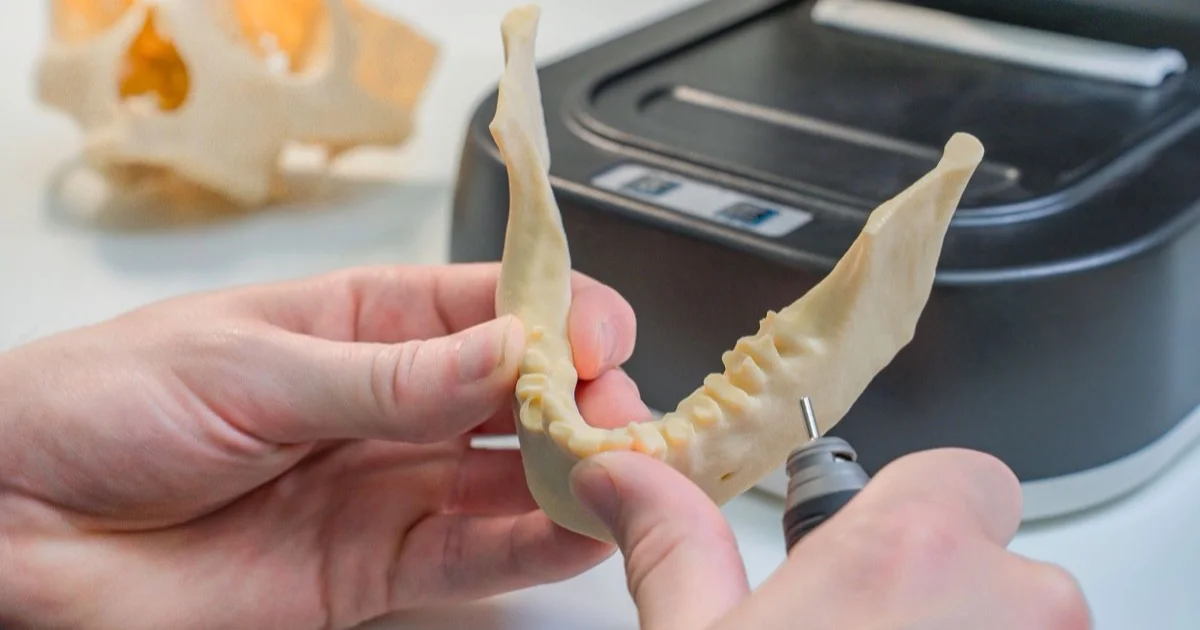
Digital prosthodontics means making crowns, veneers, bridges and implant-supported prostheses through a computer workflow instead of plaster and handwork: the teeth are measured in 3D with an intraoral scanner, the prosthesis is designed in CAD software, and it is then milled from zirconia or ceramic on a milling machine, or produced by 3D printing. According to systematic reviews, there is no significant difference in accuracy between digital and classic impressions for single crowns and short bridges; the digital method is more comfortable and faster, while for full-arch impressions the classic method still has the edge.
Key points
- The digital workflow has four links: scanning → design → production (milling/3D printing) → try-in in the mouth.
- For single crowns and short bridges, marginal fit is within the clinically acceptable range with both methods.
- For the patient, the biggest difference is comfort: there is no impression material to trigger the gag reflex, and repeating the impression is easy.
- In a full-arch scan (all the teeth) small errors accumulate; in such cases a classic impression or a combined method is used.
- The digital workflow merges the design with digital smile design and 3D planning in the same file — this is a broader concept than a same-day crown.
How does the classic workflow work?
Let us first recall the familiar method. After the tooth is prepared, a tray filled with silicone or alginate material is placed in the mouth and left to set for a few minutes. The impression is sent to the laboratory, where plaster is poured, the model is mounted in an articulator (a device that mimics jaw movement), the technician shapes the prosthesis by hand in wax, and the finished work then comes out through casting or ceramic firing. Small changes are possible at every link: the impression material shrinks, the plaster expands, the wax is shaped by hand. In a good laboratory these errors are controlled, but they add up.
The four links of the digital workflow
1. Intraoral scanning. A small camera is moved over the teeth and, within seconds, a 3D model is built from thousands of images. It is visible on screen straight away: has the margin of the prepared tooth come out clearly or not? If it has not, only that part is rescanned — the whole impression is not repeated. The bite is also recorded with the scanner.
2. CAD design. The software proposes the prosthesis based on the neighbouring teeth, the opposing jaw and the anatomy of the tooth; the dentist or technician adjusts the shape, the contacts and the chewing surface on screen. For front teeth this stage merges with the digital smile design file: the shape of the temporary teeth approved during the trial is carried over to the definitive design.
3. Production. There are two main routes. Milling (CAM): a block of zirconia, lithium disilicate or PMMA (a temporary material) is milled on the machine; the zirconia is then sintered and the ceramic is stained or layered. 3D printing: temporary crowns, surgical guides, trial prostheses and models are printed in photopolymer resin. Definitive crowns are mostly milled today.
4. Try-in in the mouth and cementation. The marginal fit, the contacts and the bite are checked; if needed, minor adjustments are made.
A single crown milled in the clinic in one day is a special case of this workflow; we have explained it separately: same-day crown with CAD/CAM. This article, however, is about the whole workflow — including veneers, bridges and implant-supported prostheses made together with the laboratory.
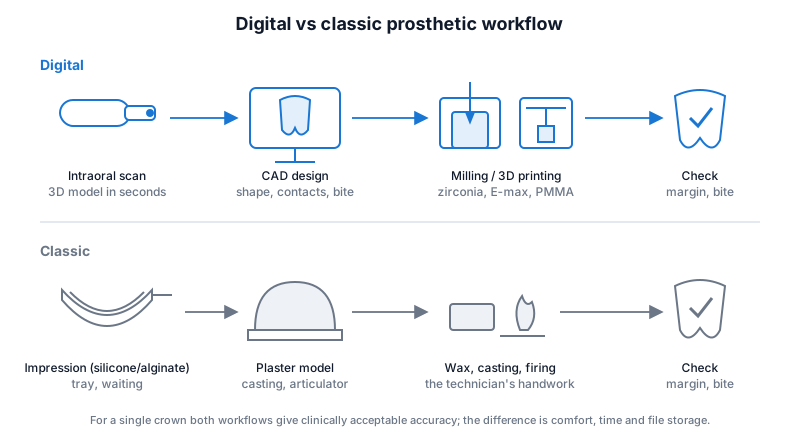 Top row: the digital workflow — scanning, CAD design, milling/3D printing, try-in. Bottom row: the classic workflow — impression, plaster model, wax and casting/firing, try-in.
Accuracy: is digital really more accurate?
This is the most frequently asked question, and the answer starts with «for which type of work?»
Single crown and short bridge. A review published in The Journal of Prosthetic Dentistry in 2025 combined 28 systematic reviews (12 of them with meta-analysis): for single crowns, bridges and implant-supported prostheses, no statistically significant difference was found between digital scanning and classic impressions in terms of accuracy (trueness and precision), marginal fit and internal fit. A systematic review of 12 studies published in Cureus (2024) reaches the same conclusion and adds that in crowns made from digital impressions the marginal gap was below 120 micrometres — the clinically acceptable threshold — in all the studies. In other words, for a single tooth it is correct to say not that «digital is more accurate», but that it is «equally accurate».
Full arch. The same JPD review points to one exception: for complete-arch prostheses, classic impressions were more accurate than digital scanning. The reason is simple: the scanner «stitches» small images together, and over a long distance small errors accumulate. A meta-analysis published in Clinical Oral Investigations (2022), combining 13 clinical studies, found the 3D difference between digital scanning and alginate impressions in a dentate jaw to be around 0.09 mm (90 micrometres) on average, and showed that accuracy was better than 0.1 mm with both methods; there was no difference in tooth widths and interdental distances. The conclusion: a full-arch scan is sufficient for orthodontic and diagnostic models, whereas for a full-arch fixed implant prosthesis the dentist often uses a classic impression, a combined method or an additional check (a verification jig, for example).
Time and comfort
In one clinical study cited in the Cureus review, the digital impression took around 4 minutes on average, while the classic impression took around 10 minutes (one impression session, single-tooth work). In the same review, patients rated their discomfort on a visual scale out of 100 at an average of 6.5 for the digital impression and an average of 44.9 for the classic impression. For patients with a strong gag reflex, those who cannot keep their mouth open for a long time, or those who dislike the taste of impression material, this difference is very noticeable.
The time saving is not only in the chair: the file reaches the laboratory within minutes, the courier and plaster-pouring stages drop out, and for an adjustment the file is simply sent again — no new impression is needed.
Comparison table
| Criterion | Digital workflow | Classic workflow |
|---|---|---|
| Impression method | Intraoral scanner (camera) | Silicone/alginate, tray |
| Single-crown accuracy | Within the clinically acceptable range, no difference from classic | Within the clinically acceptable range |
| Full-arch accuracy | Errors accumulate over a long distance | Still superior for fixed implant prostheses |
| Patient comfort | Less gag reflex, easy to repeat | Material, waiting, reflex |
| Impression time | Usually shorter | Longer |
| Design | CAD — on screen, easy to change | Handwork in wax |
| Production | Milling (zirconia, E-max, PMMA), 3D printing | Casting, ceramic layering |
| Storage | File — can be reused years later | Plaster model, takes up space, breaks |
| Limitation | Deep subgingival margins, blood/saliva, full arch | Material shrinkage, handling, transport |
Digital occlusion: how is the bite established?
In the classic workflow the bite is captured with a wax or silicone record and transferred to the articulator. In the digital workflow the scanner scans from the side with the jaws closed and aligns the two models in space. A virtual articulator then mimics jaw movement; some systems also add a face scan or a jaw movement recording to the file. In large cases — multiple crowns, a change in bite height — this virtual model is tried in the mouth with temporary teeth; the shape approved at the trial stage is scanned and carried over to the definitive work. The choice of material is decided at this stage together with the design: monolithic or layered zirconia.
Limitations of the digital workflow
We should be honest: the scanner is not magic.
- Subgingival margins. If the margin of the crown lies deep under the gum, the camera cannot see it; the gum has to be retracted and blood and saliva kept under control. Classic silicone is sometimes more reliable in this situation.
- Full-arch fixed prostheses. Explained above — additional checks are required.
- Shiny and translucent surfaces. Metal and moist surfaces make scanning difficult; this is solved with powder or with technique.
- Device and experience. The result depends on the model of the scanner and on the technique of the person scanning; reviews show different results with different systems.
That is why the right question is not «digital or classic?» but «which method for this particular case, or both?».
The digital workflow in implant cases
With an implant-supported prosthesis the digital workflow starts earlier — with the surgery: the CBCT and the scan are merged into a single file, the position of the implant is planned according to the future crown, and a surgical guide is printed. The implant position is then scanned with a scan body and the abutment/crown is designed. On this planning separately: CBCT and digital planning before an implant. In the clinic the intraoral scanner, CAD/CAM and CBCT are used within the same workflow; about the prosthetic service: prosthodontic treatment.
Frequently asked questions
Does a crown made from a scan fit better in the mouth? For a single crown, reviews show marginal fit within the clinically acceptable range with both methods; the difference lies more in comfort and time than in accuracy.
Crowns are planned for all my teeth — is a scan enough? With natural teeth, usually yes, but for a full-arch fixed implant prosthesis a classic impression or an additional check may be required. The dentist decides according to the type of work.
Is scanning harmful? Is there radiation? An intraoral scanner uses ordinary light and a camera; there are no X-rays. CBCT is a separate device and is taken only when needed.
Are definitive crowns made with 3D printing? At present, 3D printing is mainly used for temporary crowns, guides and models; definitive zirconia and ceramic crowns are milled.
Will my file be needed years later? Yes. If a crown breaks or a new one is needed, the design file can be reused; with a plaster model this option is limited.
Conclusion
Digital prosthodontics is a workflow that brings the impression, the design and the production together in a single file. For single crowns and short bridges its accuracy is the same as with the classic method, and it is more comfortable and faster for the patient; for full-arch fixed prostheses, however, the classic impression still holds its place. The right approach is to choose the method according to the type of work. To assess your individual situation, which workflow is suitable is determined together during a consultation.
Sources
- Digital scans versus conventional impressions in fixed prosthodontics: An overview of systematic reviews — The Journal of Prosthetic Dentistry, 2025
- Digital versus conventional full-arch impressions in linear and 3D accuracy: a systematic review and meta-analysis of in vivo studies — Clinical Oral Investigations, 2022
- Digital Impressions Versus Conventional Impressions in Prosthodontics: A Systematic Review — Cureus, 2024
This article is for general information only and does not replace an individual diagnosis, examination or treatment. Consult a doctor for a decision about your case.