

Screw-retained or cement-retained implant crown: which one is chosen and when?
A crown on an implant is secured in one of two ways: either directly to the implant with a screw (screw-retained), or cemented onto an abutment (cement-retained). According to systematic reviews, the 5-year survival of the two designs is very similar; the main difference lies in the complications: with a cement-retained crown, cement left beneath the gum carries a risk of inflammation, while a screw-retained crown can easily be removed and repaired, although the screw channel may affect aesthetics and the bite. The choice is decided by the position and angulation of the implant.
Key points
- A screw-retained crown is a retrievable design: if the screw loosens or the ceramic chips, the crown can be worked on without damaging it.
- With a cement-retained crown, the main risk is excess cement left beneath the gum — the evidence links it to peri-implant inflammation.
- If the implant is placed at a marked angle, the screw channel emerges on the front surface of the tooth; in that case either an angled screw channel or the cement-retained option is chosen.
- The most widely used compromise: a hybrid crown cemented onto an abutment in the laboratory and secured with a screw in the mouth.
- The choice of material (zirconia, metal-ceramic) is a separate question — it is explained in the article on implant-supported prosthesis materials.
How do the two designs work?
Screw-retained crown. The crown is attached with a screw either directly to the implant or to a titanium base on top of the implant. To give access to the screw, there is a small channel on the chewing surface of the crown (in back teeth) or on the palatal surface (in front teeth); at the end of the work the channel is sealed with composite. When needed, the composite is opened, the screw is loosened and the crown is removed.
Cement-retained crown. First the abutment (the supporting part between the implant and the crown) is screwed into the implant. The crown is then cemented onto this abutment, just as on a natural tooth. The surface of the crown is uninterrupted, with no channel. However, if the margin of the abutment lies beneath the gum, excess cement may not be fully removed from there.
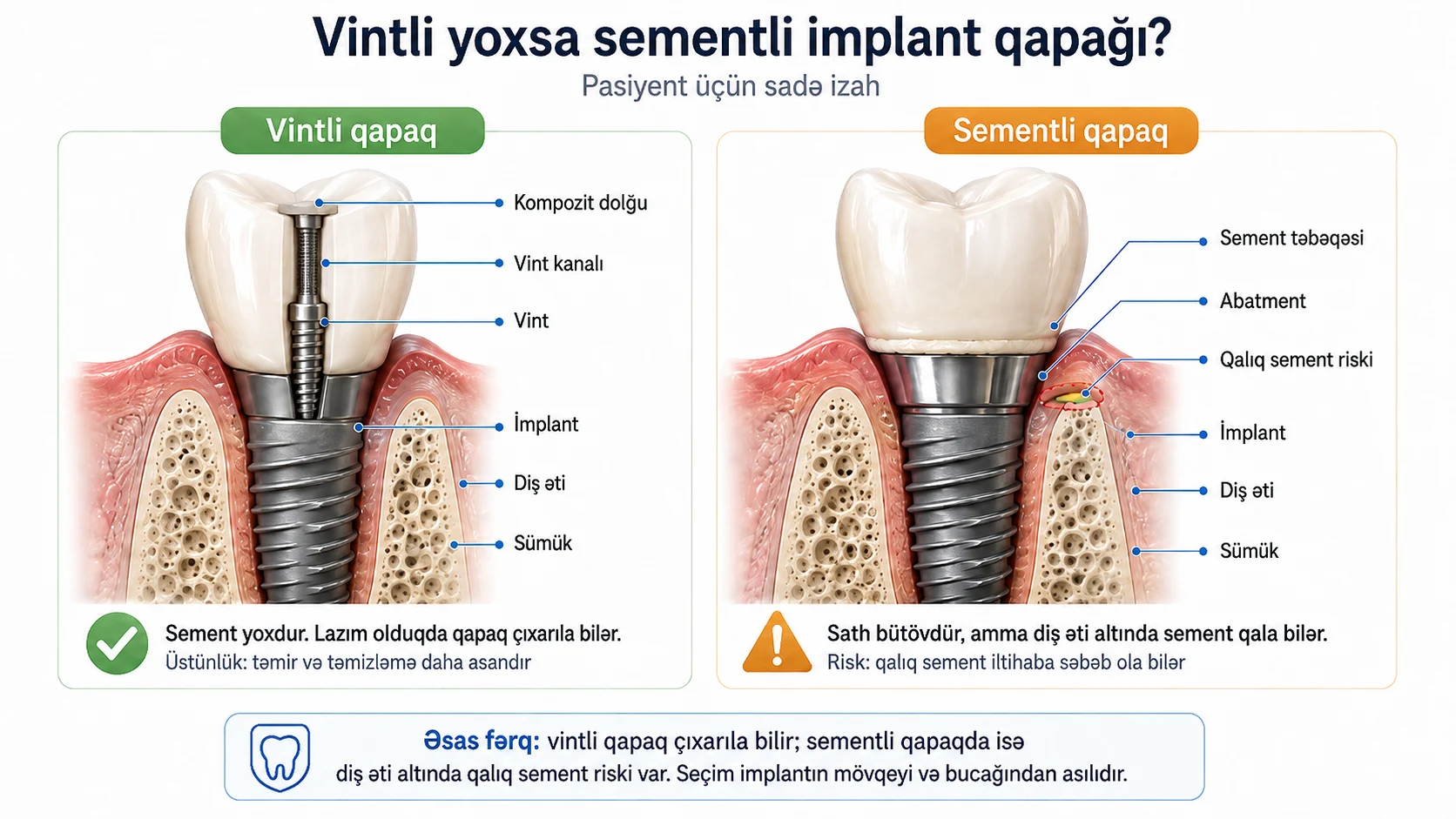 On the left, a screw-retained crown: the screw channel runs from the chewing surface down to the implant. On the right, a cement-retained crown: a cement layer on the abutment and the risk of residual cement beneath the gum.
What does the evidence say?
Two large systematic reviews have compared this question directly. In the 2012 review by Sailer and colleagues (Clinical Oral Implants Research), the estimated 5-year prosthesis survival for single crowns was 96.5% for cement-retained crowns and 89.3% for screw-retained crowns; however, the confidence interval for the screw-retained group is very wide (64.9–97.1%), meaning the figure rests on limited research. For partial bridges, 5-year survival was 96.9% for cement-retained and 98% for screw-retained restorations; for full-arch bridges, 5-year survival was complete in the cement-retained group (no losses recorded) and 95.8% in the screw-retained group. As a biological complication, bone loss of more than 2 mm over 5 years was recorded in 2.8% of cement-retained single crowns and 0% of screw-retained crowns.
In the 2014 review by Wittneben and colleagues (International Journal of Oral and Maxillofacial Implants), 5-year prosthesis survival was calculated as 96.03% for cement-retained restorations and 95.55% for screw-retained restorations — a difference that is not statistically significant. The same review showed that both technical and biological complications were statistically lower with screw-retained restorations.
When it comes to bone level, the picture is mixed. In the 2016 meta-analysis by Lemos and colleagues (Journal of Prosthetic Dentistry; 20 studies, 2139 patients, 8989 implants, mean follow-up 65 months), marginal bone loss around cement-retained prostheses was on average 0.19 mm less than around screw-retained prostheses, and implant survival was slightly higher in the cement-retained group; prosthetic complications were more frequent in the screw-retained group. In other words, there is no clear-cut conclusion such as “cement is bad, screws are good” — each design has its own weak point.
Residual cement: the main risk of a cement-retained crown
With a cement-retained crown, the most discussed problem is excess cement. When the margin of the abutment lies more than 1–2 mm below the gum, it is impossible to see and fully remove the excess cement. Bacterial biofilm accumulates on the surface of the remaining cement and inflammation begins.
Wilson’s 2009 prospective endoscopic study (Journal of Periodontology) demonstrated this directly: in 81% of implants with cement-retained crowns showing signs of peri-implant inflammation, excess cement was found with an endoscope; 30 days after the cement was removed, clinical and endoscopic signs of inflammation had disappeared in 74% of these sites. The EFP/AAP consensus report also lists cement left beneath the gum among the factors associated with peri-implantitis on limited evidence. The stages of the inflammation and its treatment are the subject of the article what is peri-implantitis.
There are ways to reduce the risk: placing the abutment margin at gum level or no deeper than 1 mm below it; using a small amount of cement and a type that is visible on X-ray; checking the crown on a replica of the abutment and removing the excess before placing it in the mouth; and taking a check X-ray after cementation. These steps reduce the risk, but do not bring it to zero.
The weak points of a screw-retained crown
A screw-retained crown is “clean”, but it has its own problems:
- The screw channel. In front teeth, if the implant is angled slightly towards the lip, the channel emerges on the visible surface of the tooth. This is either an aesthetic problem or it makes the screw-retained option impossible. Modern angled screw channel systems allow the channel to be redirected towards the palate, but not with every system and not at every angle.
- The bite. In a back tooth the channel falls in the middle of the chewing surface; the composite sealing the channel wears down over time and has to be replaced.
- Ceramic chipping. The channel can reduce the strength of the ceramic; with monolithic zirconia this problem is less pronounced.
- Screw loosening. In the Sailer review, technical complications over 5 years were recorded in 24.4% of screw-retained single crowns and 11.9% of cement-retained crowns — in the screw-retained group most of these complications were screw loosening and loss of the channel sealing material. However, these complications are simple to resolve: the crown is opened and the screw is retightened.
A correct implant position is a prerequisite for a screw-retained crown. That is why the question is in fact answered at the planning stage: with prosthetically driven planning, the implant is positioned so that the screw channel emerges in the centre of a back tooth and on the palatal side of a front tooth.
Comparison table
| Criterion | Screw-retained crown | Cement-retained crown |
|---|---|---|
| Retention | Screw directly into the implant / titanium base | Cement onto the abutment |
| Retrievability | Yes, the crown is not damaged | Usually the crown has to be cut off |
| Residual cement risk | None | Present, especially with a deep margin |
| 5-year prosthesis survival (Wittneben, 2014) | 95.55% | 96.03% |
| Biological complications | Fewer (Sailer 2012; Wittneben 2014) | More (related to residual cement) |
| Technical complications (screw loosening, channel material) | More | Fewer |
| Aesthetics (front teeth) | The position of the channel depends on the implant angle | The surface is uninterrupted |
| Passive fit (in bridges) | Requires precision | Cement compensates for small discrepancies |
| Tolerance of implant angulation | Low (moderate with an angled channel) | High |
| Deep margin beneath the gum | Not a problem | Increases the risk |
The hybrid option: a crown cemented in the laboratory and screwed in the mouth
In practice there is a third route, and it is the one most often chosen. The crown (usually monolithic zirconia or lithium disilicate) is cemented onto a titanium base in the laboratory — where the excess cement is completely removed. This single unit is then secured to the implant with a screw in the mouth. In this way no cement is left in the mouth, the crown remains retrievable, and the titanium base ensures the precision of the implant–abutment connection. The requirement for a suitable channel position still applies here as well.
Which one is chosen and when?
A simple guide:
- A single back tooth with a straight implant — screw-retained or hybrid. Repair is easy and there is no cement.
- A front tooth with the implant at an ideal angle — screw-retained or hybrid; the channel emerges on the palatal side.
- A front tooth with the implant angled towards the lip — screw-retained if an angled screw channel is possible; if not, cement-retained on a custom abutment with the margin close to the gum.
- A long bridge on multiple implants — most often screw-retained: passive fit is checked and segments can be removed when needed.
- Very thick gum, where the margin will lie deep — the cement-retained option is avoided as far as possible.
This decision is a shared discussion between the dentist and the patient, but above all it depends on the position of the implant. That is why, when dental implantation is planned, the 3D CBCT is used to assess not only the bone but also the shape of the future crown and the exit point of the screw channel. In the front region this is part of the plan explained in the article on implant placement in the aesthetic zone.
Frequently asked questions
Is the channel on the chewing surface visible on a screw-retained crown? In back teeth the channel is sealed with tooth-coloured composite and is not visible when you speak; on close inspection it may be noticeable as a small circle. The composite may need renewing every few years.
Can a cement-retained crown be removed later? If it was placed with temporary cement, sometimes yes. A crown placed with permanent cement is usually cut off and a new one is made; the abutment, however, is kept.
My crown is cement-retained and my gum is swollen and bleeding. Could cement be the cause? It could. An X-ray may not show the excess cement; sometimes the crown has to be removed to look. This is part of the examination described in the article what is peri-implantitis.
If the screw loosens, does that mean the implant is damaged? No. Screw loosening is a technical complication: the screw is retightened or replaced. However, if it happens repeatedly, the bite and the shape of the crown are reassessed.
Is there a difference in price? The type of design mainly affects the price through the components (titanium base, custom abutment); the prices of the implant systems used at the clinic are shown on the website, while the design of the crown is calculated individually at the planning stage.
Conclusion
According to the evidence, the 5-year survival of screw-retained and cement-retained implant crowns is similar; the difference lies in the type of complications. The main risk of a cement-retained crown is cement left beneath the gum, while the main limitation of a screw-retained crown is the position of the channel and screw loosening. The hybrid crown, cemented in the laboratory and screwed in the mouth, combines the advantages of both and is often the first choice when the implant is in the correct position. To assess your individual situation, the implant angle, gum thickness and bite are reviewed together at a consultation.
Sources
- Cemented and screw-retained implant reconstructions: a systematic review of the survival and complication rates — Clinical Oral Implants Research, 2012
- Clinical performance of screw- versus cement-retained fixed implant-supported reconstructions: a systematic review — International Journal of Oral and Maxillofacial Implants, 2014
- The positive relationship between excess cement and peri-implant disease: a prospective clinical endoscopic study — Journal of Periodontology, 2009
- Evaluation of cement-retained versus screw-retained implant-supported restorations for marginal bone loss: A systematic review and meta-analysis — Journal of Prosthetic Dentistry, 2016
This article is for general information only and does not replace an individual diagnosis, examination or treatment. Consult a doctor for a decision about your case.