

Aesthetic restoration of front teeth: which method for which problem?

There is not one but six main ways to improve the appearance of the front teeth: whitening, composite bonding, veneers, crowns, orthodontics and gum contouring. Which one suits you is decided by the type of problem — whitening if it is colour, composite if it is a small chip, a veneer if shape and colour are involved together, a crown if the tooth is badly damaged, orthodontics if it is a position problem. In many cases several methods are combined, and the order matters.
Key points
- First, a precise answer is found to the question «what is it that I do not like»: colour, shape, size, position, gum level, or a combination of these.
- The rule is to start with the least invasive option: whitening and composite are reversible or involve little tooth reduction, while veneers and crowns require the enamel to be reduced.
- Whitening only lightens the natural tooth; it does not change the colour of existing fillings, veneers or crowns — which is why whitening is done before any restoration.
- Position problems (crooked, crowded, protruding teeth) are solved with orthodontics, not with veneers; a veneer can only mask a small difference in position.
- In complex cases, all the steps are planned in advance within a single smile design.
Let us first name the problem
Patients usually come in saying «I do not like my teeth». The dentist's job is to break this down into specific problems, because each problem has its own solution:
- Colour: teeth are yellowish, grey, stained, or one tooth is darker than the rest.
- Shape and size: a chipped corner, a worn incisal edge, small («peg») lateral teeth, gaps between the teeth.
- Position: crooked, crowded, rotated, protruding or inward-tilted teeth.
- Gums: too much gum shows when smiling, the gum line is asymmetrical, the teeth look short.
- Old restorations: discoloured fillings, crowns with darkened margins.
Often several of these occur together — for example, a yellowish colour + a chip on one tooth + small lateral teeth. In such cases the methods are combined.
Problem → method table
| Problem | First choice | Alternative | When it is not suitable |
|---|---|---|---|
| General yellowish colour, healthy teeth | Whitening | Veneers (if the colour is very dark) | If there are many front fillings/crowns (their colour does not change) |
| One dark tooth (after root canal treatment) | Internal whitening | Veneer or crown | If the tooth is very weakened → crown |
| Small chip, loss of a corner | Composite bonding | Veneer (if several teeth are involved) | If the chip is large and under biting load |
| Worn incisal edges | Composite or veneer | Bite assessment + bruxism management | If bruxism is not under control (it wears down again) |
| Gaps between the teeth | Composite bonding or veneers | Orthodontics | If the gap is large, restoration alone will make the teeth look wide |
| Small lateral teeth | Veneer or composite | — | If there is not enough space, orthodontics first |
| Shape + colour together, 4–8 teeth | Ceramic veneers | Composite veneers | If there is little enamel, or bruxism is not under control |
| Large filling, crack, root canal treatment | Crown | — | On a healthy tooth, a crown is unnecessary tooth reduction |
| Crooked, crowded, rotated teeth | Orthodontics (braces/clear aligners) | Veneers afterwards if needed | «Correcting» with veneers alone requires a lot of tooth reduction |
| Too much gum showing, short teeth | Gum contouring (gingivoplasty) | Orthodontics/lip position assessment | If the cause is skeletal (the jaw) — separate planning |
The table is a guide, not a prescription. Different degrees of the same problem call for different solutions.
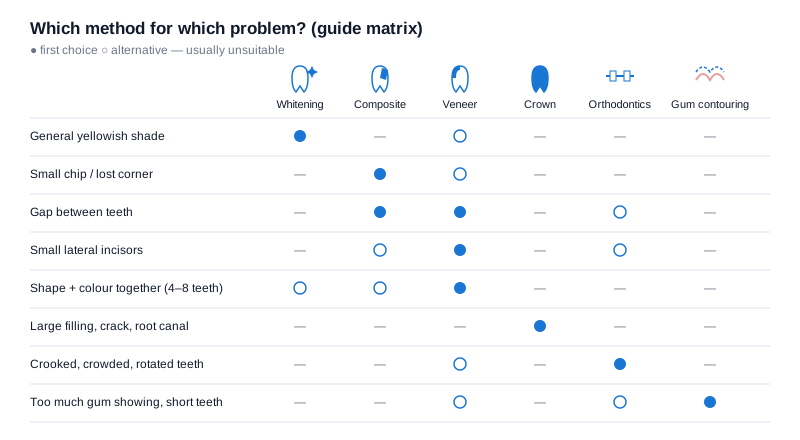 Matrix: problems in the left-hand column, methods along the top; a filled dot is the first choice, an empty dot is the alternative.
The methods in brief: what they do and what they do not do
Whitening
A peroxide-based gel lightens the pigments inside the tooth. According to the American Dental Association, whitening only affects the natural tooth — it does not change the colour of fillings, veneers or crowns. Brown stains (from fluorosis or tetracycline, for example) respond to a certain degree, while white spots often remain and simply become less noticeable as the background lightens. The most common side effect is temporary sensitivity. There is detailed information about safety and expectations in the article is teeth whitening safe; the types of stains and which of them can be whitened are covered in the article tooth discolouration and stains.
Composite bonding
Tooth-coloured filling material is applied directly to the tooth and shaped in the mouth. It is completed in a single appointment, usually requires no tooth reduction, and is easy to repair. Its weak points are colour stability and strength: in a 12-month comparative clinical study, direct composite veneers showed significantly more marginal discolouration and small fractures than ceramic veneers (12 months; marginal discolouration and fracture of the restoration). It is a good choice for small corrections, younger patients and temporary solutions.
Veneers
A thin ceramic (sometimes composite) layer bonded to the front surface of the tooth. It corrects shape, colour, size and small differences in position all at once. Preparation is usually within the enamel and minimal. According to a review of long-term studies, around 95% of ceramic veneers were still in place at 10-year follow-up (veneer survival; Alenezi et al., 2021). Who veneers are suitable for and why is explained in the article what is a veneer; at the clinic, veneer treatment begins with planning.
Crowns
A restoration that covers the whole tooth. If a tooth has a large filling, a crack, root canal treatment or extensive damage, there is not enough enamel for a veneer and a crown is more predictable. On a healthy tooth, however, a crown means unnecessary tooth reduction. This choice is explained according to the condition of the tooth in the article veneer or crown; for the types of crowns, you can read the article types of dental crowns.
Orthodontics
The real solution for crooked, crowded and rotated teeth is to change their position. Trying to «correct» them with veneers requires heavy reduction of the crooked tooth and leads to enamel loss. After orthodontics, veneers are often no longer needed, or very little intervention is enough. This route takes longer, but it protects the teeth.
Gum contouring
If too much gum shows when smiling, or the gum line is asymmetrical, the teeth look short and «square». A small correction of the gum contour (gingivoplasty) or, where necessary, a procedure that also involves the bone level reveals the true length of the tooth. It is usually done before veneers, so that the margin of the veneer matches the new gum line.
Why does the order matter?
When methods are combined, the sequence changes the result:
- Health first. Aesthetic restoration is not carried out until decay, gum inflammation and bite problems have been resolved; the American Dental Association notes that placing a veneer on an unhealthy tooth may make the existing problem worse.
- Position. If orthodontics is needed, it comes first.
- Gums. Contour correction is carried out before restoration, and healing is allowed to take place.
- Colour. Whitening is done before veneers and composite; the restorative material is then matched to the new shade.
- Restoration. Veneers, composite or crowns come last.
To see in advance how all these steps fit together, digital smile design is used: the future result is built on photographs and scans, and then a mock-up (a trial with temporary material) is done in the mouth.
Frequently asked questions
How much change can be achieved with the least intervention? For colour and small shape problems, whitening + composite on one or two teeth is often enough. If shape and colour need to be changed at the same time and across several teeth, veneers are more predictable.
Can veneers be placed on just the two front teeth? Yes, but the colour and shape must be matched to the neighbouring teeth. Sometimes all the teeth are whitened first, and then the two veneers are made to match the new shade.
Orthodontics takes a long time; could veneers be done instead? For small differences in position, yes. With significant crookedness and crowding, the tooth has to be reduced heavily for a veneer; in that case orthodontics is the option that protects the teeth.
If too much gum shows, is surgery always necessary? No. The cause may be incomplete eruption of the tooth, lip movement or jaw structure; each has a different solution, and this is determined at the examination.
Will my old fillings stand out after whitening? Yes, because a filling does not change colour. That is why fillings in the visible area are replaced a few weeks after whitening to match the new shade.
Conclusion
Aesthetic restoration of the front teeth is not a single method but a map of choices. Whitening for colour problems, composite for small defects, veneers when shape and colour change together, a crown for a damaged tooth, orthodontics for position problems, and contour correction when too much gum shows in the smile are the main routes. Starting with the least intervention and getting the order of the steps right makes the result both beautiful and long-lasting. To assess your individual situation, a consultation and a smile design stage give the clearest answer.
Sources
- Veneers — American Dental Association (MouthHealthy)
- Whitening (Oral Health Topics) — American Dental Association
- Clinical assessment of direct composite veneer and indirect veneers using a minimally invasive preparation technique — Journal of Conservative Dentistry and Endodontics, 2025
- Long-Term Survival and Complication Rates of Porcelain Laminate Veneers in Clinical Studies: A Systematic Review — Journal of Clinical Medicine, 2021
This article is for general information only and does not replace an individual diagnosis, examination or treatment. Consult a doctor for a decision about your case.