

Veneer or crown: which one should you choose for a front tooth?
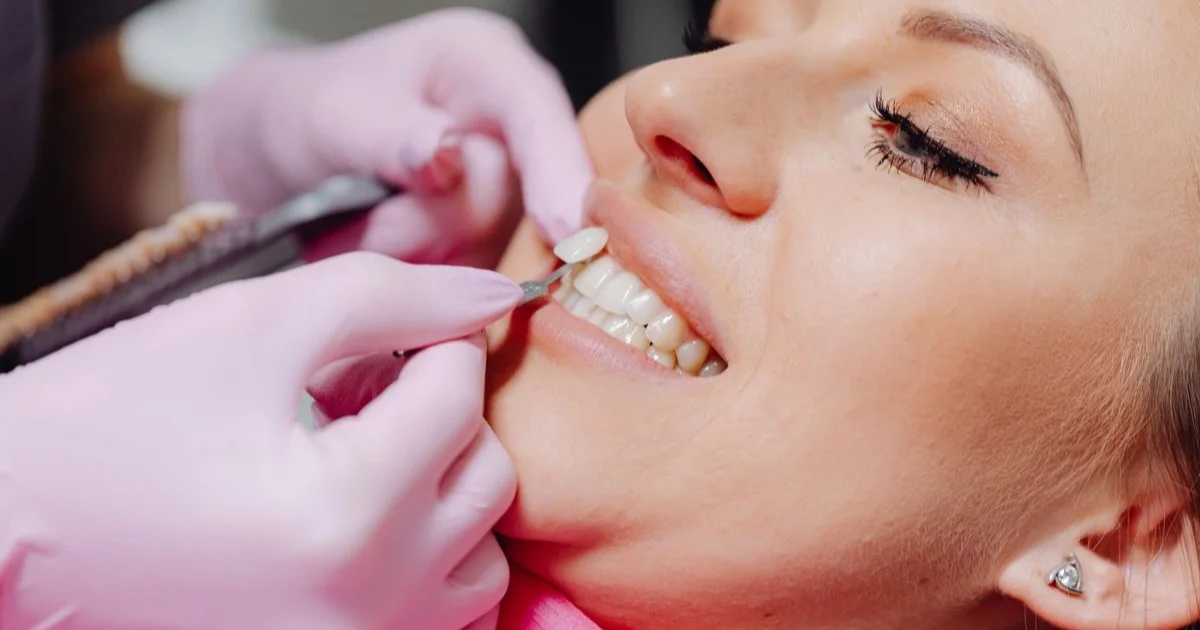
A veneer covers only the front surface of the tooth and requires very little enamel to be removed; a crown, on the other hand, surrounds the tooth on all sides and requires a considerable amount of the tooth to be prepared. That is why the choice mainly depends on how much healthy tooth structure is left. If a healthy tooth with few fillings has an aesthetic problem — a veneer; if the tooth has had root canal treatment, has a large filling, a crack or has broken down extensively — a crown is the more logical choice. In borderline cases, the dentist decides on the basis of an examination and X-rays.
Key points
- The main question is not «which one looks better» but «what is left of the tooth».
- A veneer works by being bonded to enamel; a crown protects the tooth by mechanically surrounding it.
- Root canal treatment, a large filling, a deep crack and extensive loss of structure usually speak in favour of a crown.
- Only colour, shape and minor defects in a healthy tooth can be resolved with a veneer.
- A tooth with a veneer can later be converted to a crown; the reverse is not possible.
What is the difference between the two restorations?
Imagine a front tooth as a box. A veneer is a thin plate bonded only to the front wall of this box. A crown, on the other hand, is a lid that covers the box entirely — the front, back and side surfaces and the incisal edge are all covered.
This difference has two consequences. First, the amount of preparation is different: for a veneer, around half a millimetre of enamel is removed from the front surface of the tooth, while for a crown one to two millimetres of tooth structure is prepared from every side. In a 2018 study carried out on digital 3D models of upper central incisors, veneer preparation removed approximately 28% of the volume of the tooth crown, while all-ceramic crown preparation removed approximately 57%. In other words, roughly twice as much tooth structure is lost for a crown.
Second, the retention mechanism is different. A veneer stays on the tooth only through the chemical-micromechanical bond between the luting cement and the enamel. That is why, if there is no enamel or very little of it, the foundation of the veneer becomes weaker. A crown, because it surrounds the tooth, both bonds and «grips» — it can work even when no enamel is left on the tooth.
You can read more about what a veneer is and about its types in the article what is a veneer, and about the types of crowns in the article types of dental crowns.
Comparison table
| Criterion | Veneer | Crown |
|---|---|---|
| Part of the tooth covered | Only the front surface (+ sometimes the incisal edge) | The whole crown: front, back, sides, edge |
| Tooth structure removed | Little; mainly within the enamel | A lot; prepared from every side |
| Retention mechanism | Adhesive bonding to enamel | Full coverage + cementation |
| Need for healthy enamel | Essential | Not essential |
| Tooth with root canal treatment | Usually not suitable | A typical indication |
| Large filling / extensive loss | Not suitable | Suitable |
| Correction of colour and shape | Good scope | Good scope |
| Bruxism and a deep bite | Requires caution | More durable, but there is still a risk |
| Reversibility | Irreversible, but it can later be converted to a crown | Irreversible |
| Materials | Ceramic (feldspathic, lithium disilicate), composite | Lithium disilicate, zirconia, metal-ceramic |
Making the decision according to the condition of the tooth
In the clinic, the choice in most cases comes down to these questions.
How much healthy tooth structure is left?
This is the first and most important question. If the front tooth is healthy or has only a small filling, there is enough enamel for a veneer. If the tooth has been filled several times, if the filling takes up more than a third of the tooth, or if the incisal edge has broken off completely, the bonding surface for a veneer is reduced and a crown becomes more reliable.
A 2023 review examining veneer bonding techniques states this directly: an insufficient amount of remaining enamel is one of the contraindications for a veneer, because bonding to enamel is more reliable than bonding to dentin.
Has the tooth had root canal treatment?
A tooth that has had root canal treatment (endodontic treatment) is usually more brittle and often changes colour. Such a tooth also has a large access filling on the back surface. Root canal treatment in a front tooth is not on its own an indication for a crown — if the tooth is intact and the colour problem is mild, whitening or a veneer is sometimes possible too. But if the tooth has had both root canal treatment and extensive filling work, a crown is the wiser choice.
Is there a crack or a fracture?
A small chip on the incisal edge is beautifully restored with a veneer. If the crack runs into the tooth, towards the gum, or if the tooth hurts under load, a veneer does not protect the tooth — a crown is needed, because a crown surrounds the tooth on all sides and prevents the crack from opening. The depth of a crack is difficult to determine by looking alone; examination, illumination and sometimes 3D X-rays (CBCT) help.
What is the problem: colour, shape or strength?
A simple rule: if the appearance of the tooth is the concern and the tooth itself is healthy, a veneer; if the strength and integrity of the tooth have been compromised, a crown. If the discolouration is very dark (for example, a greyish-black colour after root canal treatment), a thin veneer may not be able to mask it completely — in that case either a thicker, more opaque veneer or a crown is considered.
Bite and habits
Clenching, grinding at night and a deep bite repeatedly strike the margin of the veneer. The ADA patient material also lists these situations as ones that require caution with veneers. In such patients either a night guard is planned or a crown is chosen. But it is a mistake to think that a crown is unbreakable either: the choice of material plays a role here.
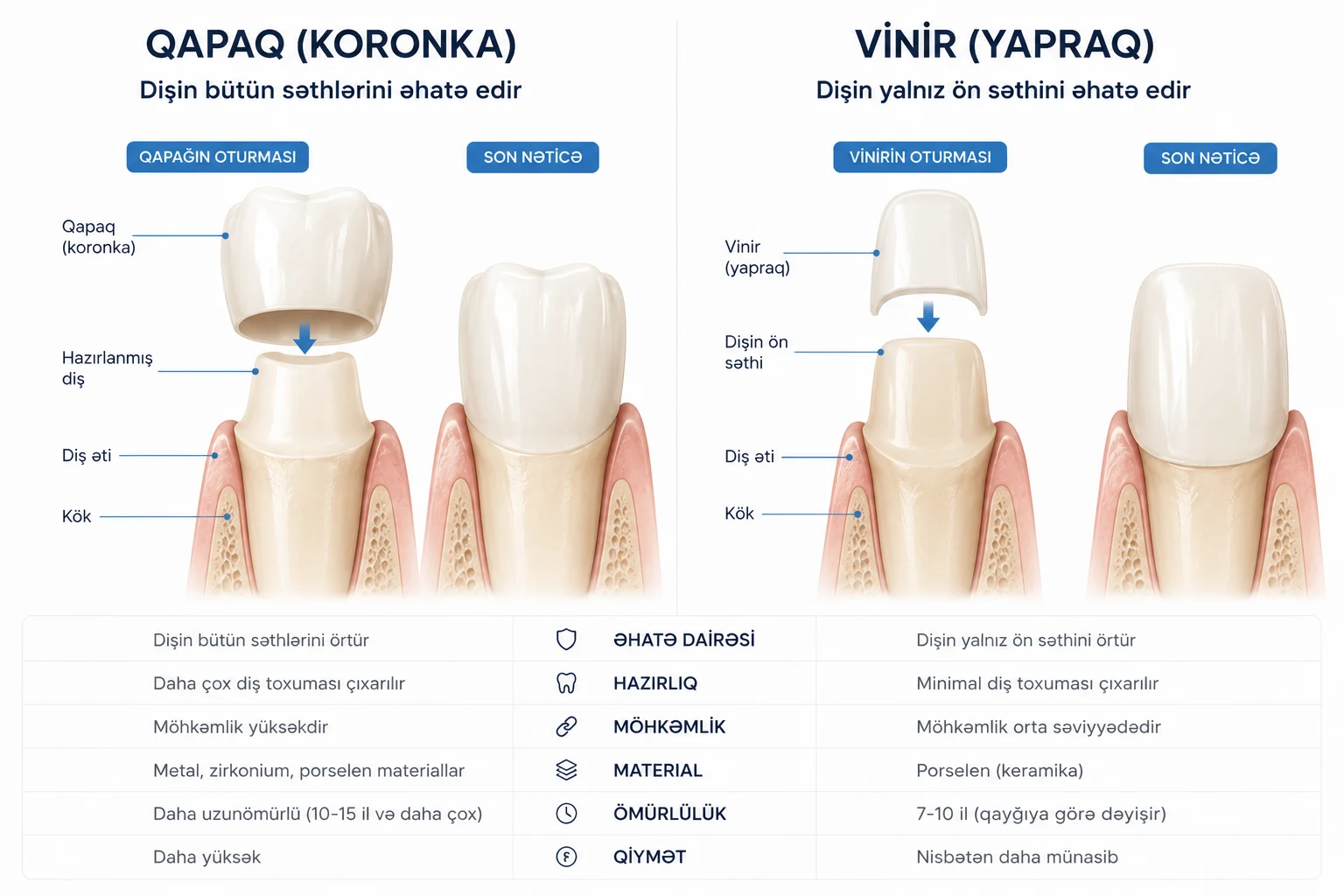 Left: veneer — only a thin layer is removed from the front surface. Right: crown — the tooth is prepared from every side. Below: the key questions that lead to the choice.
Strength and longevity
Two different things should not be confused here: the strength of the material and the survival of the restoration on the tooth.
A 2025 systematic review of ceramic veneers calculated the overall survival of veneers (the veneer staying in place) at approximately 96% over a follow-up of 7 years or longer (10.4 years on average). However, this is mainly the result in correctly selected teeth where the veneers were bonded to enamel. The same review also shows a difference according to material: over a 10-year follow-up, technical complications (fracture, cracking, debonding) were recorded considerably less often with lithium disilicate veneers than with feldspathic ceramic.
A 2023 meta-analysis of crowns compared CAD/CAM lithium disilicate and zirconia crowns: over follow-up periods ranging from 1 year to 9.3 years, the survival of zirconia-based restorations varied between studies starting from approximately 85%, and in some studies no failures were recorded during the follow-up period; technical complications were somewhat less frequent with lithium disilicate crowns. The most common problems with crowns were chipping of the veneering ceramic and debonding from the tooth.
The conclusion is this: with the right indication, both restorations work for a long time. A veneer quickly causes problems on a weak tooth; a crown, on the other hand, unnecessarily removes a lot of structure from a healthy tooth. That is why the right question is not «which is stronger» but «which one suits this tooth».
Is a zirconia crown the right choice for a front tooth?
Patients often ask about a «zirconia crown», because zirconia is known for its strength. In a front tooth, however, alongside strength, light transmission (translucency) also matters: a natural tooth transmits light to some extent, whereas an opaque material can look «artificial». Modern high-translucency zirconia has reduced this problem, but the comparison with lithium disilicate is still relevant. This choice of material is the subject of a separate article — E-max or zirconia.
The short answer: if a crown is needed on a front tooth, zirconia is one of the possible options, but not the only one; the colour of the tooth, the neighbouring teeth, the bite and the available thickness are all assessed together.
Can a veneer later be converted to a crown?
Yes. If the situation changes years later (for example, if root canal treatment becomes necessary or a large crack develops), a tooth with a veneer can be converted to a crown — because the back and side surfaces of the tooth have remained untouched. The opposite direction is not possible: a veneer cannot be placed on a tooth prepared for a crown, because the enamel has already been removed.
This is an important argument in favour of veneers: if the tooth is suitable for a veneer, a «reserve we can use in the future» remains. But if the tooth is not suitable for a veneer, forcing a veneer sooner or later leads to a second intervention.
Frequently asked questions
Does a front tooth that has had root canal treatment always need a crown? Not always. If the tooth has remained intact, the access filling is small and the biting load is normal, a veneer or even just a filling + whitening is possible. If the tooth has had both root canal treatment and extensive filling work, a crown is more reliable.
Is a veneer cheaper than a crown? The price depends on the clinic and the material; when the veneer and the crown are made of the same material, the price difference may not be large. The main difference here is not money but the amount of structure removed from the tooth.
Is it possible to place veneers on all the front teeth and a crown on one of them? It is, and this is often done: for example, veneers on four teeth and a crown of the same material on one tooth that has had root canal treatment. With good laboratory work, the difference is not noticeable to the eye.
Can a tooth with a crown still decay? Yes — at the margin of the crown, at the gum line. That is why teeth with crowns also need daily cleaning and regular check-ups. The same applies to veneers.
Who makes the decision — the patient or the dentist? The aesthetic expectation is yours; the biological condition of the tooth, however, is determined by examination and X-rays. The best decision comes from combining the two.
Conclusion
A veneer is a restoration that changes the appearance of a healthy tooth, while a crown is one that protects a weakened tooth. If there is enough enamel on the tooth and the problem is colour and shape, a veneer is the more conservative route; if there is root canal treatment, a large filling, a crack or extensive loss of structure, a crown is needed. The less healthy tooth structure is prepared away, the more options remain for the future. Which one is suitable for your tooth is determined on the basis of an examination and X-rays at a veneer treatment consultation.
Sources
- Three-dimensional analysis of the relationship between the structure of maxillary central incisor and the preparation of dental all-ceramic — PLoS One, 2018
- Veneers — American Dental Association, MouthHealthy
- Survival and Complication Rates of Feldspathic, Leucite-Reinforced, Lithium Disilicate and Zirconia Ceramic Laminate Veneers: A Systematic Review and Meta-Analysis — Journal of Esthetic and Restorative Dentistry, 2025
- Clinical Outcomes of CAD/CAM (Lithium disilicate and Zirconia) Based and Conventional Full Crowns and Fixed Partial Dentures: A Systematic Review and Meta-Analysis — Cureus, 2023
- Risk Factors with Porcelain Laminate Veneers Experienced during Cementation: A Review — Materials (Basel), 2023
This article is for general information only and does not replace an individual diagnosis, examination or treatment. Consult a doctor for a decision about your case.