

Does a tooth have to be trimmed for a veneer? No-prep, minimal and classic preparation

In most cases yes, but very little. For a ceramic veneer, usually only a few tenths of a millimetre of enamel is removed from the front surface of the tooth — the aim is to stop the veneer looking bulky and to let its edge sit smoothly. In some situations (small teeth, gaps, teeth tilted inwards) it is even possible without any trimming at all, that is, with the no-prep technique. Enamel that has been removed does not grow back, so the decision is made through planning.
Key points
- For a veneer (a thin ceramic or composite layer bonded to the front surface of the tooth), preparation (polishing the tooth to make room) is usually carried out within the enamel layer only.
- There are three approaches: no-prep (no trimming at all), minimal preparation (surface polishing) and classic preparation (more room is created).
- The depth of trimming is determined by the position and colour of the tooth and the expected change in shape — there is no one-size-fits-all figure.
- Bonding to enamel is more reliable than bonding to dentin (the softer layer beneath the enamel); this is why the dentist tries not to go into the dentin.
- Preparation is irreversible: once a tooth has been trimmed, it will need a veneer or another restoration for life.
Why is the tooth trimmed at all?
The question is a fair one: if a veneer is thin, why does the tooth need to be touched? The answer lies in the shape and the edges.
A veneer adds an extra layer on top of the tooth. If the tooth is not trimmed at all, this layer makes it look slightly more prominent and slightly thicker. On one or two teeth this difference may go unnoticed, but across all the front teeth it can create a bulky, horsey-teeth effect. And where the gum meets the veneer a small ledge remains — plaque builds up there and the gum becomes irritated.
Preparation solves both of these problems: the veneer sits in its own place, the contour of the tooth stays natural, and the edge blends smoothly with the gum. In other words, trimming is not done to weaken the tooth but so that the veneer looks natural and lasts a long time.
How much is removed? The figures
The depth of preparation differs across the various parts of the tooth. Systematic reviews give an overall range for classic veneer preparation of roughly 0.3–1.0 mm on the front surface, and 0.2–0.5 mm with a minimally invasive approach. Clinical studies describe the classic protocol like this: 0.1–0.2 mm at the neck of the tooth near the gum, 0.3–0.7 mm in the middle of the front surface, and 1–1.5 mm at the incisal edge.
Looking at these figures, you can see that we are talking about a layer only slightly thicker than a sheet of paper. In the middle of the front teeth the enamel is usually thicker than this, so a properly planned preparation stays within the enamel.
An important point: the depth of trimming is calculated in advance according to the desired result. If a very dark tooth needs to be brought to a lighter shade, the veneer has to be a little thicker — which means a little more room is created. If the tooth is already tilted inwards, almost no trimming is needed. That is why in the clinic the design is created first, and only then is the tooth touched.
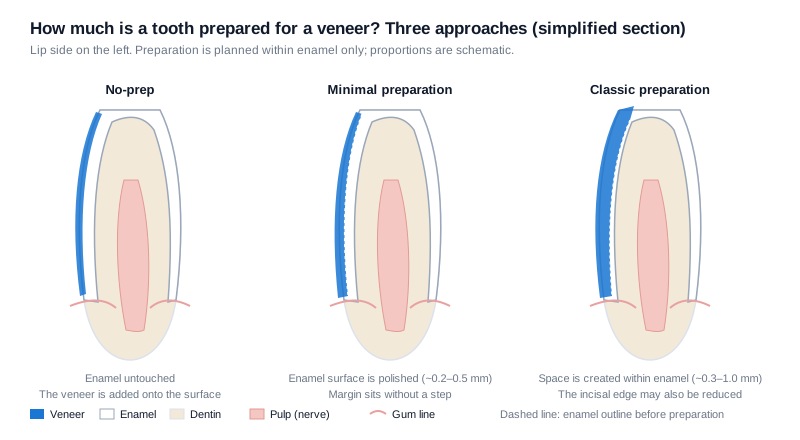 A simplified cross-section of the three approaches: with no-prep the enamel stays untouched, with minimal preparation only the surface is polished, and with the classic approach room for the veneer is created within the enamel.
No-prep veneers: when are they genuinely possible?
A no-prep (preparation-free) veneer is one that is bonded without touching the tooth at all, after simply cleaning the surface. This approach features heavily in advertising, but it is not suitable for every tooth. The sources describe the most suitable cases for no-prep as follows:
- Small or short teeth. If a tooth is already smaller than it should be, adding an extra layer on top brings it to a normal size.
- Gaps between the teeth (diastema). The veneer widens the tooth slightly in order to close the gap; here extra bulk is not a problem.
- Teeth tilted inwards (towards the palate). The veneer brings the tooth into line with the others.
- Sufficiently healthy enamel, with no wear, large fillings or cracks.
No-prep also has its difficulties: the edge of the veneer near the gum becomes very thin and the risk of fracture there is higher; and because a ledge remains at the margin, cleaning between the teeth becomes a little harder. If the tooth is protruding, crowded or its position needs to change significantly, a systematic review notes that orthodontic treatment may be needed first — a veneer cannot mask a positioning problem.
In the middle sits the most widely used option: minimal preparation. Near the gum and on the front surface the enamel is only smoothed so that the edge of the veneer sits without a ledge. This keeps the main body of the tooth untouched while reducing the marginal problems of no-prep.
Why is enamel so important?
A veneer is held on the tooth not mechanically but adhesively — with a special bonding agent. The structure of enamel suits this bond very well: it is a hard, homogeneous and relatively dry surface. Dentin, on the other hand, is moist and full of tubules, and the bond there is weaker and more variable. The authors of a comparative study with 9 years of follow-up state this directly: bonding to enamel results in less leakage, fewer debonds and fewer fractures.
A systematic review of long-term clinical studies points in the same direction: the larger the area of exposed dentin beneath the veneer, the higher the risk of failure under bending load. The practical conclusion is simple: the less the tooth is trimmed, the more the veneer holds onto enamel. So the idea that the tooth should be trimmed a lot so that the veneer sits firmly is not correct — it is the opposite.
Preparation is irreversible: know this in advance
The patient page of the American Dental Association states it plainly: because enamel is removed for a veneer, the treatment is considered irreversible. Enamel does not grow back. If a veneer fractures or has to be replaced years later, the tooth will again need a veneer or a crown.
This is not meant to frighten you; it is important information for making the right decision. What does it change in practice?
- If the problem is colour and the teeth are good in shape, it is worth first looking at reversible options such as teeth whitening.
- If the problem is a small chip on 1–2 teeth, a composite restoration (filling material applied directly to the tooth) is often done without any trimming at all.
- If shape, colour and symmetry all need to change together, a veneer gives a more predictable result and minimal trimming is an acceptable compromise.
The question of a veneer versus a crown, which covers more of the tooth (a restoration that fully covers the tooth), is a separate topic — the veneer or crown article explains the choice according to the condition of the tooth.
How does the process go and what does trimming feel like?
The typical sequence in the clinic is as follows:
- Planning. Photographs, an intraoral scan (a digital impression of the mouth) and the design. At this stage it is also decided how much each tooth will be trimmed.
- Mock-up (a trial of the future shape in the mouth using a temporary material). You see the result in advance.
- Preparation. Depth markers are placed through the mock-up so that only as much as necessary is trimmed. With minimal preparation, anaesthesia is often not even needed; with deeper preparation, local anaesthesia is used.
- Scan or impression, fabrication of the veneers in the laboratory or with CAD/CAM, with temporary coverage in between.
- Bonding. The enamel is conditioned with acid, the veneer is secured with adhesive cement and the edges are polished.
For a few days after trimming there may be sensitivity to cold; when the dentin has not been exposed, this is usually temporary.
Is the nerve of the tooth damaged during veneer preparation?
Preparation that stays within the enamel does not reach the nerve of the tooth (the pulp) — there is a distance between the enamel and the dentin. The risk increases when the tooth already has a large filling, cracks or heavy wear and deep room is created for the veneer. In such teeth the dentist will often suggest a different restoration instead of a veneer. In other words, protecting the nerve depends not on the depth of preparation but on choosing the right tooth.
Frequently asked questions
Can a no-prep veneer be removed later? In theory yes — if the tooth has not been trimmed, the enamel remains in place when the veneer is removed. In practice, because the veneer is bonded very firmly to the tooth, removing it also requires careful polishing and the surface may change somewhat.
Is the tooth trimmed for composite veneers too? Composite veneers are often done with no trimming or with very little polishing; they require less enamel than ceramic veneers, but colour stability and strength are different.
What should you do with a trimmed tooth during the temporary period? With minimal preparation, temporary coverage is often not even needed. With deeper preparation a temporary veneer is placed; during this period it is enough to avoid very cold and very hard foods.
Can you change your mind about a veneer after the tooth has been trimmed? A trimmed tooth cannot be left without a restoration — the surface becomes sensitive and changes colour. That is why the decision must be made before preparation, at the mock-up stage.
Is the same depth trimmed on all teeth? No. A dark or protruding tooth is trimmed more, an inward-tilted or small tooth less (sometimes not at all). The depth is calculated individually for each tooth.
Conclusion
A tooth is usually trimmed for a veneer, but we are talking about a thin layer of enamel, and the aim is for the veneer to sit naturally. No-prep is a real option on some teeth, while minimal preparation is the most widely applied middle path. Because enamel does not grow back, the amount of preparation is determined in advance through the design. To see which approach suits you, a consultation for veneer treatment and the mock-up stage give the clearest answer; you can read about the general types of veneers in the what a veneer is article.
Sources
- Conventional Versus Minimally Invasive Veneers: A Systematic Review — Cureus, 2023
- A prospective comparative analysis of the survival rates of conventional vs no-prep/minimally invasive veneers over a mean period of 9 years — Clinical Oral Investigations, 2021
- Long-Term Survival and Complication Rates of Porcelain Laminate Veneers in Clinical Studies: A Systematic Review — Journal of Clinical Medicine, 2021
- Veneers — American Dental Association (MouthHealthy)
This article is for general information only and does not replace an individual diagnosis, examination or treatment. Consult a doctor for a decision about your case.