

Veneers & Aesthetics
Ceramic veneers in Baku at Smile by Dr. Bakhtiyar are planned with digital smile design, so you see the result before treatment begins.
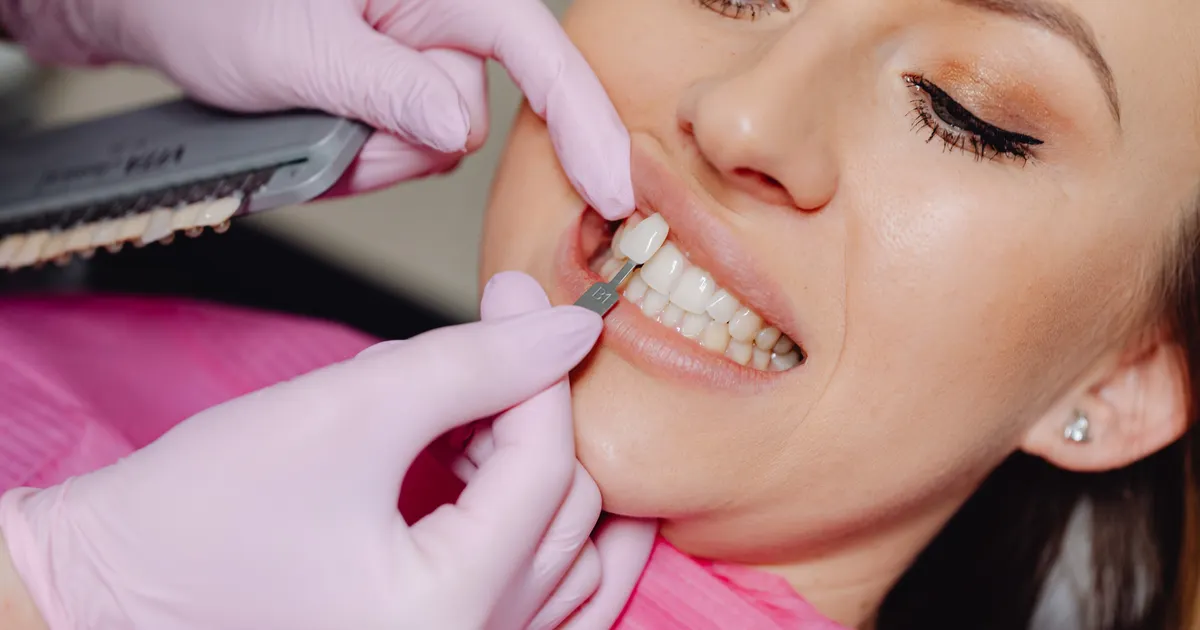
A veneer is a very thin ceramic shell bonded to the front surface of a tooth. At Smile by Dr. Bakhtiyar in Baku (Babek Avenue 1131, Babek Plaza), veneers are made with a digital scan and CAD/CAM technology. The digital smile design is prepared personally by the clinic's founder, Dr. Bakhtiyar Aliyev, so you see the planned result on screen.
Veneers are usually considered when tooth colour stays dark after tea, coffee or smoking, when there is a gap between the front teeth, when a corner of a tooth has chipped, when teeth look short or uneven, or when old fillings no longer match the tooth. Minor crowding can also be masked. For larger misalignment, orthodontist Dr. Meherrem Mammadov aligns the teeth first.
The process is calm and step by step. The first visit includes an examination, photos and a digital scan, plus a panoramic X-ray or 3D scan if needed. Then we agree on the design. Next, a very thin layer of enamel is smoothed and temporary shells are placed. The veneers are made in the lab. At the final visit we check shade and shape and bond them.
Mild sensitivity is possible in the first days and usually settles quickly. Ceramic does not stain and keeps its colour for years, but your own tooth at the edge and the gum still need care. Brush twice a day and use floss. Avoid cracking nuts, chewing ice or biting your nails. A professional cleaning (160 AZN) once or twice a year helps.
Pricing is transparent: an Empress veneer is 840 AZN and an E-max crown starts from 840 AZN. The first appointment with consultation and a personal treatment plan is 60 AZN. The final amount depends on how many teeth are treated and the starting condition of each tooth. Treatment usually takes 2–3 visits over a few weeks, confirmed in writing after your consultation.
What is a veneer?
A veneer is a ceramic shell 0.3–0.7 mm thick bonded to the front surface of a tooth. Unlike a crown, which covers the whole tooth, it changes only the visible surface and preserves most of the tooth's own tissue. Its purpose is to correct colour, shape, length and minor position defects — not to restore function. It is the least invasive fixed aesthetic option for front teeth, but it does not suit every tooth.
Who are veneers suitable for?
The general condition: the gums are healthy, decay has been treated and there is enough enamel to bond to. A veneer's longevity depends on bonding to enamel.
- Colour that does not respond to whitening: tetracycline staining, fluorosis, a tooth darkened after root canal treatment
- A gap between the front teeth (diastema) or small chips at the edges
- Worn, short-looking or uneven-edged teeth
- Old fillings that no longer match the tooth colour
- A slight position difference — one tooth set back or rotated
- Correcting symmetry and proportions in the smile zone
When are veneers not suitable?
- A large part of the tooth is missing or there is a large filling — a crown is more reliable
- Severe crowding and bite problems — orthodontics first, aesthetics after
- Uncontrolled clenching and grinding — high fracture risk; a splint first
- Untreated decay, gum inflammation or poor hygiene
- Very little or heavily worn enamel — the bonding prognosis weakens
- Healthy teeth with a colour problem only — whitening should be tried first
Is the tooth prepared for a veneer?
Yes, in most cases minimally — usually 0.3–0.7 mm of enamel. This is needed so the ceramic sits without changing the tooth's shape and with a natural contour. Classic laboratory measurements show veneer preparation removes roughly 3–30% of the coronal tooth structure, while full-crown preparation removes 63–72% — a substantial difference. If the colour change is large or the tooth protrudes, slightly more is prepared; if the tooth is set back or small, a no-prep option is sometimes possible. We do not promise “no drilling at all”: the amount is planned in advance from the digital design and explained to the patient.
Choosing the material
The clinic uses pressed glass-ceramic (IPS Empress) for veneers; the stronger material of the same family, lithium disilicate (E-max), is used more often for crowns. Feldspathic and glass-ceramic veneers show similarly high survival in systematic reviews; the choice depends on the tooth colour (a more masking ceramic on a dark tooth), thickness and the bite. Composite (direct) veneers are not offered as a core service — for small corrections an aesthetic restoration may be discussed.
How are shade and shape chosen?
The shade is chosen with the standard shade guide, digital photographs and comparison with the neighbouring teeth; if whitening is planned, the shade is finalised two weeks after it. The shape is designed according to the face type, lip line and tooth proportions — the goal is a natural result that suits the face, not “very white and very large”. The final shade is also adjusted through the colour of the bonding material, which is why the try-in stage matters.
Digital smile design
Dr. Bakhtiyar Aliyev personally builds the digital smile design in the clinic: from facial and smile photographs, an intraoral scan and video, the shape of the future teeth is modelled on screen and then tried in the mouth in a temporary material (mock-up). The patient sees the result before any preparation and can suggest changes; once approved, the same design guides the laboratory work. This is the key stage that narrows the gap between expectation and result.
Treatment stages
- 1
Consultation and examination
Expectations, gum and tooth condition, the bite, signs of clenching; an X-ray when needed. This is where suitability for veneers is decided.
- 2
Photos, scan and digital design
Facial and smile photographs and an intraoral scan; the future shape is designed in software and agreed with the patient.
- 3
Mock-up — trial in the mouth
The design is shown on the teeth in a temporary material; shape and length are checked live and adjusted.
- 4
Minimal preparation
Under local anaesthesia the necessary enamel is smoothed according to the mock-up; the impression is taken with a digital scanner.
- 5
Temporary veneers
The prepared surface is protected with temporary shells; sensitivity is prevented and the design is tested in daily life.
- 6
Laboratory and try-in
The ceramic veneers are made; shade, margin fit and shape are checked in the mouth before bonding.
- 7
Bonding
The enamel is acid-etched and the veneer is bonded with an adhesive system under moisture isolation; the bite is adjusted.
- 8
Review
After 1–2 weeks the bite and gums are checked; then professional hygiene and review once or twice a year.

How long veneers last
According to a 2016 systematic review and meta-analysis (International Journal of Prosthodontics), the estimated 10-year survival was about 94% for glass-ceramic veneers and about 87% for feldspathic veneers; individual long-term studies have documented veneers surviving up to 20–21 years. These are group averages, not an individual guarantee. Factors that extend the lifespan: bonding to enamel (not dentine), a correct bite, a night guard for clenchers, daily hygiene and regular review. The most common problems are debonding, marginal staining and small chips; most are repairable.
Risks and limitations
- Sensitivity — temporary after preparation; rarely persistent and needing treatment
- Debonding — especially when bonded to dentine or under high occlusal load
- Fractures and cracks — hard food, nail biting, uncontrolled bruxism
- Marginal staining — over time, depending on hygiene and habits
- Irreversibility — prepared enamel does not grow back; a veneer may need replacing in future
- Gum reaction — when the margin does not fit precisely; prevented by correct preparation and hygiene
Veneer or crown?
A veneer covers only the front surface of the tooth; a crown covers the whole tooth. If the tooth tissue is mostly healthy and the problem is aesthetic — a veneer; if a large part of the tooth is lost, there is a large filling, the tooth is root-treated and at risk of fracture — a crown (E-max or zirconia) is more reliable. Systematic reviews also report high 5-year survival for single ceramic crowns (above ~90%); the choice is made not by the “quality” of the material but by how much tooth structure has been lost. Crowns and bridges are explained on a separate service page.
Veneers or whitening?
If the shape is normal and the only problem is colour, the first step is whitening — a reversible and less invasive method. Whitening is often insufficient for tetracycline staining, severe fluorosis and a dark root-treated tooth; if shape defects, gaps or chips are present as well, veneers are more appropriate. If both are planned, whitening comes first and the veneer shade is chosen two weeks later.
What determines the price?
The price of an Empress veneer per tooth is fixed in the clinic, and the table below comes from the same source as the Prices section. The total depends on the number of teeth (a single tooth or the smile zone), the digital design and mock-up stage, any preliminary treatment (whitening, hygiene, minor orthodontics) and whether a protective splint is needed. A written plan and schedule of stages are given after the consultation.
| Initial visit, consultation and personalised treatment plan | $35 |
| Empress veneer | $495 |
| E-max crown | $495 |
Prices are set in Azerbaijani manat (AZN); US dollar amounts are approximate, converted at the exchange rate of 2026-10-27. The AZN amount is what is charged. Prices come from the same source as the Prices page; the final amount is set after your examination. Prosthodontics prices →
Why does the doctor's planning matter?
With veneers the result is determined by the plan, not the ceramic brand: how many teeth, how much preparation, which shape, how it fits the bite. At Smile by Dr. Bakhtiyar (Baku, Babek Avenue 1131) the digital smile design and the plan are built by Dr. Bakhtiyar Aliyev; preparation, try-in and bonding take place in the same clinic on the same design. If there is clenching or a bite problem, it is addressed beforehand together with the orthodontist-gnathologist — the lifespan of the veneers depends on it directly.
Sources
- Main Clinical Outcomes of Feldspathic Porcelain and Glass-Ceramic Laminate Veneers: A Systematic Review and Meta-Analysis of Survival and Complication Rates — International Journal of Prosthodontics, 2016
- The up to 21-year clinical outcome and survival of feldspathic porcelain veneers: accounting for clustering — International Journal of Prosthodontics, 2012
- Clinical performance of porcelain laminate veneers for up to 20 years — International Journal of Prosthodontics, 2012
- Tooth structure removal associated with various preparation designs for anterior teeth — Journal of Prosthetic Dentistry, 2002
- All-ceramic or metal-ceramic tooth-supported fixed dental prostheses (FDPs)? A systematic review of the survival and complication rates. Part I: Single crowns (SCs) — Dental Materials, 2015
If this sounds familiar
If you have one of these complaints, this service may be right for you:
- “There is a gap between my front teeth”
- “My teeth look dark and whitening barely helps”
- “The corner of my front tooth is chipped”
- “My teeth look short and uneven”
- “Old fillings do not match my tooth colour”
- “One tooth sits slightly behind the others”
- “I avoid smiling and hide my teeth in photos”
- “I want to improve my smile before my wedding”
Frequently asked questions
Who are veneers suitable for?
Veneers are considered when the colour of the front teeth does not respond to whitening, when there are gaps, small chips, short or uneven shapes, and the tooth's own tissue is mostly healthy. The decision is made after an examination, photographs and a digital scan.
How much tooth is removed for a veneer?
Usually 0.3–0.7 mm of enamel — a minimal preparation. If shape and colour change a lot, slightly more is removed; in some cases almost no preparation is needed. The amount is planned in advance from the digital design.
How long do veneers last?
Systematic reviews report high 10-year survival for ceramic veneers (roughly above 90%), and individual long-term studies have followed veneers for up to 20 years. Bonding to enamel, the bite, clenching and hygiene affect the result.
Will there be pain or sensitivity after veneers?
Preparation is done under local anaesthesia, so no pain is expected. After bonding, mild sensitivity to cold and heat is possible in the first days and usually settles on its own; if it persists, a review visit is needed.
Veneers or whitening — which should I choose?
If the only problem is colour and the shape is normal, whitening is tried first — it is less invasive. If the colour does not respond to whitening (tetracycline, fluorosis, a non-vital tooth) or the shape/gaps also need correcting, veneers are more suitable. If whitening is planned, it is done before veneers so the shade can be matched.
Do veneers stain or change colour?
The ceramic itself does not stain; colour change usually appears at the margin — in the bonding layer or on the neighbouring natural tooth. Professional hygiene and reducing staining habits keep this to a minimum.
What if a veneer chips or comes off?
Small chips can sometimes be polished; if a veneer debonds or fractures it is re-bonded or remade. If you clench or grind, a night guard protects the veneers — the most important protective measure after treatment.
Can I have just one veneer, or do I need several?
A single tooth can be restored with a veneer — this requires digital photography and individual shade selection. If the aim is to change the overall colour and shape, a symmetrical number of teeth in the smile zone (for example 6–8) is usually planned.

Doctor performing this treatment
Implantologist · Digital Dentistry · Founder of the clinic
Read more on this topic
- What is a veneer and when are veneers placed on teeth?
- What is E-max? The properties of lithium disilicate ceramic and when it is chosen
- How is tooth colour chosen? Shade matching for veneers and crowns
- Tooth proportions in a smile: the golden ratio myth and what dentists actually measure
- Why is dental photography important in treatment planning?
- Veneer or crown: which one should you choose for a front tooth?