

Tooth proportions in a smile: the golden ratio myth and what dentists actually measure

A beautiful smile is not created by a formula. When a dentist assesses the front teeth, they look at four key things: the width-to-length ratio of each tooth, the apparent width of the teeth relative to one another, how well the incisal edge (cutting edge) line matches the lip, and the midline. The famous golden ratio (1.618) is found in only a small proportion of natural smiles; research does not confirm it as a universal rule. This is why proportions are matched to the face, the lips and the tooth's own shape — not to a formula.
Key points
- A tooth looks balanced when the width of the upper central incisor is roughly 75–80% of its length; among dentists, 78% is the most commonly preferred ratio.
- The golden ratio is rarely found in natural teeth — population studies show it in only a small proportion of people.
- The apparent width of the teeth differs from their actual width: the curve of the arch makes the lateral teeth look narrower from the front.
- The incisal edge line should follow the curve of the lower lip, and the midline should be close to the midline of the face — small deviations are normal.
- These criteria are the starting point of the design; the final decision is made together with the face, the lips and the patient's wishes.
Why do proportions matter?
When we look at a smile, our brain reads shape and size balance before it reads the colour of the teeth. When one tooth is noticeably wider than another, or the incisal edges sit at different levels, the smile gives the impression that something is off, yet people often cannot say why. When veneers or crowns are planned, the dentist's job is precisely to design this balance in advance.
This article explains those criteria themselves. We have written separately about how the photographs, the scan and the mock-up (a trial model in the mouth) are carried out: what is smile design.
The central incisor: the width-to-length ratio
The stars of the smile are the two upper central incisors. Their shape defines the character of the whole smile. The most widely used criterion here is the ratio of the tooth's width to its length (width/length ratio).
According to Ward's review published in Dental Clinics of North America (2015), a central incisor with a width-to-length ratio of 78% is the one most preferred by dentists; the same review gives 75–80% as the accepted range. In simple terms: if the tooth is 10 mm long, its width should be roughly 7.5–8 mm. When the ratio is above 85% the tooth looks square and short, and when it is below 65% it looks narrow and long.
In practice this ratio is most often disrupted in worn teeth: the incisal edge wears down over the years, the tooth becomes shorter while the width stays the same. As a result the smile looks older. When the tooth is lengthened with a veneer, the ratio is brought back into the 75–80% range — this is one of the main aesthetic goals of veneer treatment.
Tooth widths relative to one another: the golden ratio, RED and the golden percentage
This is where most of the myths appear. There are three approaches:
The golden ratio (1.618:1). The claim goes like this: viewed from the front, the central incisor should appear 1.618 times wider than the lateral incisor, and the lateral incisor should be wider than the canine by the same ratio. The number is elegant, but it is rarely confirmed in natural teeth. A study published in the Journal of Conservative Dentistry (2008) measured the natural smiles of 56 young adults (aged 20–25): the golden ratio was found in only 14–25% of cases, depending on the pair of teeth. Another study, published in the Journal of Oral Biology and Craniofacial Research (2022), found the golden ratio between the central and lateral incisors in 6.7% of 106 young adults (aged 18–25), and across all six front teeth in only 3%. In other words, the great majority of people with healthy, beautiful smiles do not match this formula.
The RED proportion (Recurring Esthetic Dental proportion). This is Ward's proposal: moving from the central incisor towards the canine, the ratio of each tooth's apparent width to the previous one should stay constant, but the ratio itself is chosen between 62% and 80% according to the length of the teeth. In a web-based survey by Rosenstiel, Ward and Rashid published in the Journal of Prosthodontics (2000), 549 dentists assessed images of smiles created with different ratios: for short teeth the 80% ratio was preferred, while for very long teeth the option closer to the golden ratio (62%) was preferred. The conclusion is this: the correct ratio depends on the length of the tooth; there is no single number.
The golden percentage. This is Snow's proposal: the share each tooth takes of the total apparent width of the six front teeth — 25% for the central, 15% for the lateral, 10% for the canine. In the 2008 study the real measurements were somewhat different (22% central, 15% lateral, 13% canine), but the approach itself — checking symmetry by comparing right and left — is useful in the clinic.
In short: the dentist uses these ratios not as a law, but as a starting template. Ward himself wrote in 2001 that the final result rarely matches all the mathematical rules.
Why does the apparent width differ from the actual width?
The dental arch is curved. The lateral incisor and the canine turn backwards relative to the central teeth, so in a frontal photograph their width looks smaller than their actual size. All the proportion criteria refer to precisely this apparent width (frontal projection), not to the width measured across the tooth with a ruler. That is why the frontal photograph is the basis in smile design; the scan, meanwhile, gives the real measurements, and both are used together.
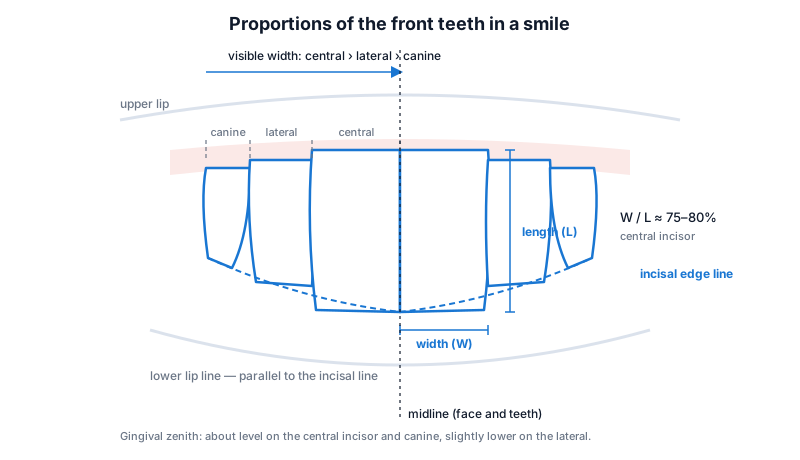 The width-to-length ratio of the central incisor, apparent widths decreasing towards the distal, the incisal edge line following the lower lip, and a comparison of the facial midline with the dental midline.
The incisal edge line and the lip line
The imaginary line connecting the incisal edges of the teeth is called the smile line. In a young, lively-looking smile this line is convexly curved: the central incisors are slightly longer than the lateral incisors, and the canines come down a little again. When this curve runs parallel to the curve of the upper border of the lower lip during smiling, the smile reads as harmonious. When the incisal edges lie along a straight line (usually as a result of wear), the smile looks flat and older; when the curve runs the other way, it looks artificial.
The lip line has a second meaning, related to the upper lip: in a full smile, how much of the gum does the upper lip reveal? When more than 2–3 mm of gum is visible it is called a gummy smile, and in the design the length of the teeth and the level of the gum margin are planned together. This is no longer a matter for veneers alone; sometimes it is resolved by reshaping the gum contour. We have mapped out the methods here: aesthetic restoration of front teeth.
There is also the rest position: when the lips are relaxed and slightly apart, 1–3 mm of the upper incisors should be visible (this decreases with age). When teeth are lengthened with veneers or crowns, the dentist also checks this display at rest — because a tooth that looks beautiful in a smile may look like too much when speaking.
The midline and symmetry
When the line between the two upper central incisors coincides with the midline of the face (from the tip of the nose to the middle of the chin), the smile looks orderly. But perfection is not required here either. In a survey by Rosenstiel and Rashid published in the Journal of Esthetic and Restorative Dentistry (2002), 1934 non-dentist participants from North America looked at altered smile images: people were most sensitive to diastema (a gap between the teeth) and to midline shift, and least sensitive to differences in tooth proportions. In other words, the patient's eye forgives small differences in ratio, but quickly picks up a slanted midline and a gap.
A practical rule: a midline shifted a few millimetres to the side while staying parallel usually goes unnoticed; a tilted (slanted) line, however, is seen more readily. And perfect symmetry does not exist in nature — small differences between the right and left teeth are what make a smile look alive.
In what order are these criteria applied?
In smile design the dentist usually works from the outside in:
- The face and the lips — the facial midline, the line of the eyes (the interpupillary line) as a horizontal reference, and the lip curve in a smile.
- The incisal edge line — the length of the central incisors is chosen according to their display at rest and in a smile; the incisal line is then matched to the lip.
- The shape of the central incisors — the width is set at 75–80% of the chosen length.
- The lateral teeth — the remaining space is distributed with a RED-type, gradually decreasing ratio.
- The gum margin — the gingival zeniths of the central incisor and the canine are at roughly the same level, with that of the lateral incisor slightly lower.
This sequence explains why the same ideal numbers give different results on two different faces: everything starts from the lips and the face. Shade selection is a separate stage and comes after shape; we have explained it here: choosing a tooth shade.
How are proportions corrected in real life?
The cause of a disturbed ratio varies, and the solution is chosen accordingly:
- Shortened teeth (wear) — the incisal edge is lengthened with a veneer or composite; if the back teeth are worn as well, the bite height is assessed first.
- Small lateral incisors (microdontia) — the apparent width of the lateral tooth is increased with a veneer so that the ratio with the central tooth is balanced.
- Diastema — the gap is shared between the two neighbouring teeth; widening only one tooth disrupts the proportion.
- Rotated or crowded teeth — orthodontics is often needed before or instead of veneers, because a veneer can change the apparent width of a tooth only to a limited extent.
- Gummy smile — this is corrected by the level of the gum margin, not by lengthening the teeth.
Veneers are one of these tools; for details on when they are suitable: veneer treatment.
Frequently asked questions
I would like teeth that follow the golden ratio — is that possible? Technically it is possible, but research shows that this ratio looks natural on very long teeth, while on normal and short teeth the lateral teeth come out excessively narrow. That is why the dentist usually chooses a ratio suited to the length of the tooth.
One of my central teeth is wider than the other — can this be corrected? If the difference is less than 0.5 mm it usually goes unnoticed. With a larger difference the widths are balanced with veneers; sometimes both teeth need to be treated in order to share the space evenly.
Too much of my gum shows when I smile — would veneers help? A veneer can lengthen the tooth, but it does not change the gum level. If more than 3 mm of gum is visible, the gum contour or other causes (lip mobility, delayed eruption of the teeth) are assessed first.
My midline is shifted 1–2 mm to the side — does it have to be corrected? A parallel shift of that size often goes unnoticed. A tilted (slanted) midline, however, is noticed more readily; photographic analysis will show which of the two applies to you.
Do tooth proportions change with age? Yes. As the incisal edge wears, the width-to-length ratio increases and the display of the upper teeth at rest decreases. Designing a young smile often consists of restoring precisely these two parameters.
Conclusion
Proportion in a smile is not a single number but the balance of several criteria: a 75–80% width-to-length ratio on the central tooth, apparent widths that decrease gradually towards the distal, an incisal edge line that follows the lip, and a midline that suits the face. The golden ratio can be one of these criteria, but the great majority of natural smiles do not match it. To assess your individual situation, these measurements are reviewed together at a consultation on the basis of photographs and a scan.
Sources
- Proportional Smile Design: Using the Recurring Esthetic Dental Proportion to Correlate Widths and Lengths — Dental Clinics of North America, 2015
- Dentists' preferences of anterior tooth proportion — a web-based study — Journal of Prosthodontics, 2000
- Public preferences for anterior tooth variations: a web-based study — Journal of Esthetic and Restorative Dentistry, 2002
- Evaluation of natural smile: Golden proportion, RED or Golden percentage — Journal of Conservative Dentistry, 2008
- Relevance of Recurring Esthetic Dental (RED) proportion and golden proportion among patients attending a tertiary care center at Kochi, Kerala — Journal of Oral Biology and Craniofacial Research, 2022
This article is for general information only and does not replace an individual diagnosis, examination or treatment. Consult a doctor for a decision about your case.