

What is E-max? The properties of lithium disilicate ceramic and when it is chosen
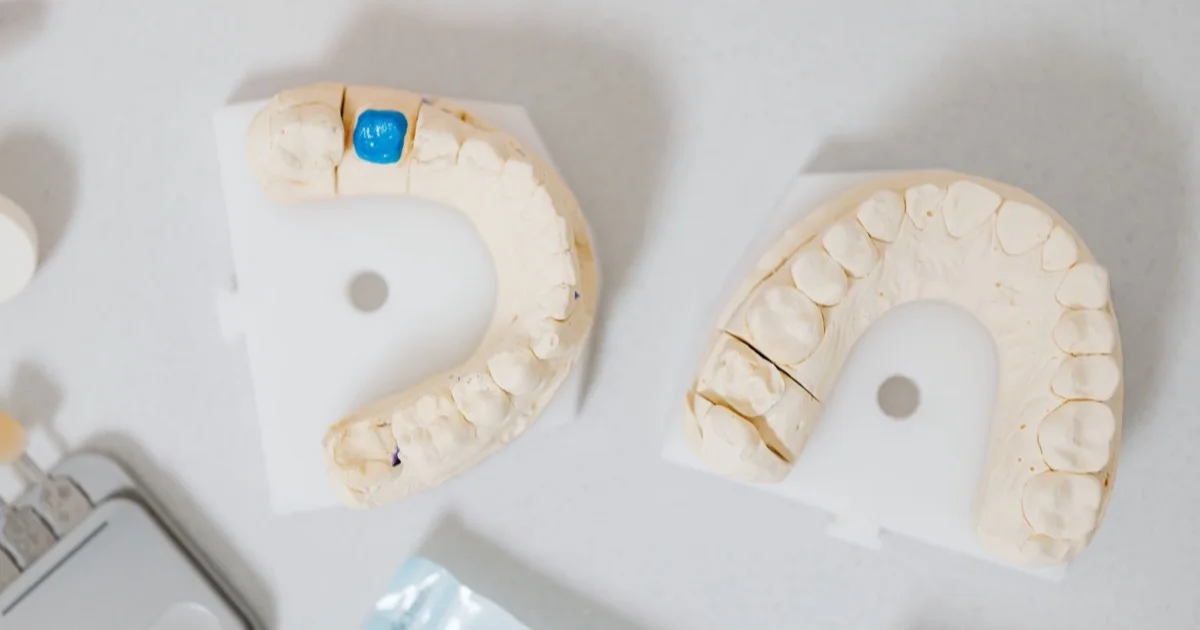
E-max is the trade name of a lithium disilicate glass-ceramic. This material transmits light in a way that is close to natural tooth enamel, which is why it is widely used for veneers, crowns and small filling-replacement restorations (inlays/onlays) on the front teeth. It is less strong than zirconia, but because it is chemically bonded to the tooth, it works reliably even in a thin layer. It has limitations in long bridges and in cases of heavy clenching; the choice is made according to the position of the tooth, the remaining tooth structure and the load.
Key points
- E-max is a brand name; the material itself is lithium disilicate (a glass-ceramic containing Li₂Si₂O₅ crystals).
- Its main advantages are light transmission and the possibility of adhesive (chemical) bonding.
- It is indicated for veneers, single crowns, inlays/onlays and short anterior bridges; it is not suitable for long posterior bridges.
- In a systematic review, single lithium disilicate crowns showed a survival rate of ~97.8% at 5 years and ~96.7% at 10 years.
- For a good result, the bonding protocol (acid etching, silane, resin cement) is just as important as the material itself.
What does the word E-max mean?
Patients often say E-max veneer or E-max crown. In fact, E-max (IPS e.max) is the name of one manufacturer's product family, while the material is lithium disilicate. The same material is also available on the market under other names. In this article we will use both terms, but it is important to know: the properties belong to the material, not to the brand.
Lithium disilicate is a glass-ceramic: within a glass matrix there are small, densely packed crystals. The crystals provide strength, while the glass transmits light. This balance is what makes the material both relatively durable and tooth-like.
Why does E-max look like a natural tooth?
A natural tooth does not reflect light completely; it lets part of it in and scatters it again. Enamel is translucent, while dentin (the yellowish layer beneath the enamel) is more opaque. Lithium disilicate can imitate this behaviour: light enters the ceramic, blends with the colour of the tooth underneath and creates a sense of depth. Opaque materials, by contrast, reflect light from the surface; the result can be a flat, painted-on appearance.
The material is produced in various degrees of light transmission: high translucency (HT), low translucency (LT) and more opaque (MO) blocks. The dentist chooses this degree according to the colour of the underlying tooth: if the tooth is light in colour, HT works beautifully for a thin veneer; if the tooth is dark, a more opaque option is needed, otherwise the dark background will show through the ceramic.
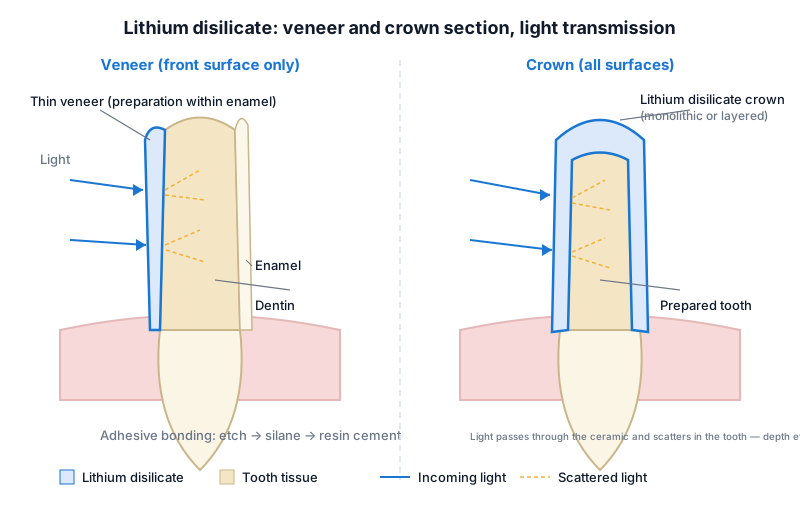 On the left, a thin lithium disilicate veneer; on the right, a full crown. The arrows show light passing through the ceramic and scattering in the tooth underneath.
Which restorations is E-max chosen for?
The material is shaped in two ways: pressing (hot ceramic pressed into a mould) and CAD/CAM (digital design and milling from a block). The same basic restorations are made with both methods.
Veneer
A thin shell bonded to the front surface of an anterior tooth. Lithium disilicate is one of the most widely used ceramics for veneers, because it transmits light correctly even in a thin layer and bonds adhesively to the tooth. We have discussed veneers themselves, their indications and the process in detail in our article on what a veneer is; how much the tooth is prepared is covered in the article does the tooth need to be prepared for a veneer.
Single crown
For front teeth and premolars, a lithium disilicate crown is one of the most frequently chosen options. It is also used on molars, but the load there is greater. In the 2019 study by Malament and colleagues (J Prosthet Dent), 1960 full lithium disilicate crowns in 556 patients were followed for more than 10 years; the annual failure risk was below 0.2%, and most of the failures (5 out of 7) occurred on molar teeth. In other words, the material is durable on posterior teeth too, but the highest risk is on molars. The general indications for crowns and other types are gathered in the article on aesthetic crown types.
Inlays and onlays
A ceramic filling that replaces part of the tooth. If not much of the tooth has been lost, but the cavity is too large for composite, a lithium disilicate inlay/onlay restores the tooth with less preparation than a full crown. Adhesive bonding is especially important here, because the restoration is held on the tooth chemically rather than mechanically.
Short bridge
A bridge made of lithium disilicate can only be produced in the anterior region, spanning three teeth (one abutment – one pontic – one abutment). In the systematic review by Pieger and colleagues (J Prosthet Dent, 2014), while single crowns showed a survival rate of ~97.8% at 5 years and ~96.7% at 10 years, lithium disilicate bridges showed ~78.1% at 5 years and ~70.9% at 10 years; most of the failures occurred in the posterior region. This difference clearly shows why the material is only recommended for bridges to a limited extent.
In which cases is E-max not suitable?
A clinical decision must answer the question of what should not be done just as much as what can be done:
- Long and posterior bridges. The figures above are the reason; here zirconia or a metal framework is chosen.
- Severe bruxism (clenching). Glass-ceramic can crack under fatigue loading. In a patient with bruxism, monolithic zirconia and a night guard are considered, or lithium disilicate is planned only on front teeth, in a thick layer.
- A very dark tooth or a thin veneer over a metal post. A translucent material cannot mask a dark background; a more opaque option or a thicker restoration is needed.
- Conditions that make adhesive bonding impossible. A deep subgingival margin, bleeding and the inability to isolate from saliva all weaken the bond.
- Cases with very little space. A crown requires a minimum thickness; if the tooth is very short and there is no room for preparation, another solution is sought.
Why is bonding so important?
A zirconia crown is attached to the tooth mainly by mechanical seating and cement. Lithium disilicate is different: the inner surface of the ceramic is etched with hydrofluoric acid (microscopic pores open up on the surface), silane (a chemical intermediary that joins ceramic and resin) is applied, and it is bonded to the tooth with resin cement. The tooth side is also prepared with acid. As a result, the ceramic and the tooth work as a single unit; this is what allows even a thin veneer to withstand chewing loads.
A review published in the British Dental Journal (2022) notes this protocol as a critical step for the longevity of the material. The practical conclusion: the same ceramic with different bonding means a different lifespan. That is why the bonding stage must never be rushed; the field is kept dry, and a rubber dam is often used.
When is E-max the first choice for a front tooth?
If several of the following conditions are present together, lithium disilicate will most likely be the first choice for a front tooth:
- The tooth is light or medium in colour, with no deep discolouration.
- Enough healthy enamel remains and adhesive bonding is possible.
- The restoration is a single tooth or at most a three-unit anterior bridge.
- The patient does not clench heavily, or the clenching is controlled with a night guard.
- Aesthetic demands are high: the light transmission must match the neighbouring natural teeth.
If there is a dark tooth, a posterior bridge or severe bruxism, the balance tips towards zirconia. We have given a head-to-head comparison of these two materials for front teeth, with a table, in the article E-max or zirconia; the choice between monolithic and layered within zirconia itself is covered in the article monolithic zirconia or layered zirconia.
Monolithic or layered E-max?
Lithium disilicate can also come in two forms. In the monolithic version, the restoration is milled from a single piece of ceramic and individualised with surface stains. In the layered (bilayer) version, a thin layer of aesthetic ceramic is added over a lithium disilicate framework; this gives a richer light effect at the incisal edge (the cutting edge of the tooth), but there is a risk of the outer layer chipping. In the 2026 meta-analysis by Pjetursson and colleagues (Int J Prosthodont), among 8051 all-ceramic single crowns, monolithic lithium disilicate showed a survival rate of ~98.5% over 5 years of follow-up, with significantly less ceramic chipping than the layered versions. In practice, monolithic is chosen for posterior teeth and moderate aesthetic demands, while layered or surface-individualised monolithic is chosen for front teeth with very high aesthetic demands.
How does the process work in the clinic?
- Examination, photographs and a digital scan; a digital smile design plan for the front teeth.
- Selection of the material and the degree of translucency — the colour of the underlying tooth is measured.
- Minimal preparation (with veneers, usually within the enamel) and a precise impression.
- Fabrication in the laboratory or with CAD/CAM; a temporary restoration.
- Try-in, shade check, then adhesive bonding and adjustment of the bite (the way the teeth meet).
At the clinic this workflow is carried out as part of veneer treatment. A consultation is needed to assess your individual situation.
Frequently asked questions
Do E-max veneers turn yellow over time? The ceramic itself does not change colour; glass-ceramic does not absorb stains. The cement line at the edge may pick up colour over the years, and this can usually be corrected with a professional cleaning.
Is the tooth under an E-max crown visible? Yes, and that is exactly why the material is chosen: light blends with the tooth underneath and gives natural depth. If the tooth is dark, this advantage can turn into a problem, so a more opaque option or a different material is chosen.
Can an E-max crown be placed on a back tooth? As a single crown, yes; long-term studies show it is durable on molars too, but most failures have been recorded precisely on molars. In cases of heavy clenching, monolithic zirconia is more often chosen.
Why are E-max bridges not recommended? In a systematic review, lithium disilicate bridges showed considerably lower survival rates than single crowns (~78% at 5 years, ~71% at 10 years). Only a three-unit bridge in the anterior region is considered.
Is there a difference between pressed E-max and CAD/CAM E-max? The material is the same; the shaping method is different. Both are reliable in clinical use; the choice depends on the laboratory's workflow and the type of restoration.
Conclusion
E-max, that is, lithium disilicate, is a glass-ceramic that transmits light in a way close to a natural tooth and is chemically bonded to it. There is a broad evidence base for veneers and single crowns on front teeth, and for inlays/onlays and single crowns on back teeth; long and posterior bridges, severe bruxism and very dark teeth are its limitations. The result this material delivers emerges from the right indication combined with a careful bonding protocol.
Sources
- Clinical outcomes of lithium disilicate single crowns and partial fixed dental prostheses: a systematic review — The Journal of Prosthetic Dentistry, 2014 (Pieger, Salman, Bidra)
- Ten-year survival of pressed, acid-etched e.max lithium disilicate monolithic and bilayered complete-coverage restorations — The Journal of Prosthetic Dentistry, 2019 (Malament et al.)
- Do you know your ceramics? Part 3: lithium disilicate — British Dental Journal, 2022 (Kaur, Talibi, Parmar)
- A Systematic Review and Meta-analysis Evaluating the Survival, Failure, and Complication Rates of Metal-Ceramic, Veneered, and Monolithic All-Ceramic Tooth-Supported Single Crowns — Part 1 — The International Journal of Prosthodontics, 2026 (Pjetursson et al.)
This article is for general information only and does not replace an individual diagnosis, examination or treatment. Consult a doctor for a decision about your case.