

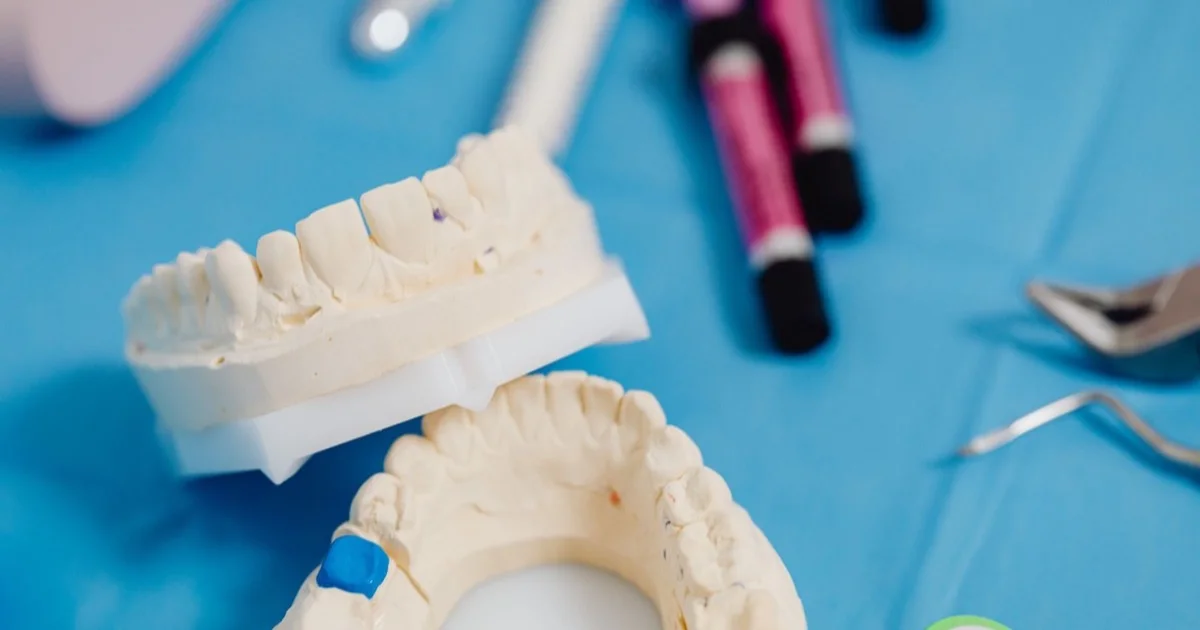
Full-mouth aesthetic rehabilitation is the rebuilding of all the teeth under a single design and a single plan, when most of the teeth are worn, decayed, patched up with old fillings and crowns, or partly missing. The difference is that each tooth is not repaired separately: first the final appearance of the smile and the bite is designed, then a suitable solution is chosen for each tooth — composite, veneer, crown, implant-supported crown — and applied in a particular sequence.
Key points
- The rehabilitation plan is built backwards from the final result: first the smile design, then the solution for each tooth.
- Not every tooth gets the same solution; the more healthy tooth structure there is, the less invasive the chosen intervention.
- The choice of material depends on the position of the tooth, the remaining structure and any clenching habit; ceramics and composite can be combined within one plan.
- The sequence matters: infection and gums → design and trial → surgery → back teeth → front teeth → protection.
- Bite height and jaw relationship are the functional foundation of rehabilitation; this part is explained in a separate article.
Who needs it and when is it not needed?
The typical patient is someone who has teeth, but whose overall dental condition cannot be solved by fixing two or three teeth: front teeth worn down and shortened by years of clenching; flattened back teeth; fillings and crowns placed at different times that do not match one another; gaps where several teeth have been extracted; as a result, both the smile and chewing are affected.
But rehabilitation is not an automatic answer. The European consensus published in the Journal of Adhesive Dentistry in 2017 (Loomans and colleagues) recommends that, in severe tooth wear, one should first distinguish whether the wear is physiological (age-appropriate) or pathological, find the cause, and intervene as late as possible and as minimally invasively as possible. In other words, if the teeth are worn but function and aesthetics are not troubling the patient, monitoring and protecting is also a correct plan.
The plan for patients who have lost all their teeth is different — there the question becomes how many implants and which prosthesis: implant planning for a fully edentulous jaw.
How does aesthetic rehabilitation differ from simply crowning everything?
The old approach was this: prepare all the teeth and cover them with crowns. It looks quick, but it loses a great deal of tooth tissue and reduces the possibility of repair years later. Modern aesthetic rehabilitation thinks in the opposite direction:
- The final result is designed in advance. Based on photographs of the face, lips and smile and an intraoral scan, the shape, length and alignment of the new teeth are built on the computer, then tried out in the mouth with a temporary material. We have explained the process itself here: what is smile design.
- Each tooth is assessed individually. The design shows the final shape of the tooth; the dentist then asks of each tooth: how much material do I need to add and how much do I need to prepare in order to reach this shape?
- The least invasive solution is chosen. For some teeth only composite is added, for others a veneer, for root-canal-treated teeth and teeth with large fillings a crown, and an implant in the place of extracted teeth.
The condition of each tooth: how is the decision made?
In a rehabilitation plan, the main question for every tooth is how much healthy structure remains. The simplified logic:
- There is wear, but the tooth is intact — composite added to the enamel and dentin surface, or a thin ceramic veneer/onlay (a piece of ceramic covering the chewing surface of a back tooth). Preparation is minimal.
- A large old filling, a crack, root canal treatment — the tooth can no longer support itself; a full ceramic crown is more reliable. About the types of crowns: what is an aesthetic crown and its types.
- A tooth with a diseased root, cracked or with bone loss — if it cannot be saved, it is extracted and replaced with an implant.
- Gum problems (periodontitis) — treated before any prosthetic work; without healthy gums an aesthetic result does not last.
This assessment requires a panoramic X-ray, 3D CBCT if needed, and a separate clinical examination of every tooth. It is not completed in one visit.
Choosing materials: what goes where?
The material is chosen by the indication, not by marketing. Three groups are often combined in rehabilitation:
Composite (direct, in the mouth). The least invasive, repairable and inexpensive; over time it loses colour and shine, and small defects appear at the margins. The study by Tauböck and colleagues published in the Journal of Clinical Medicine (2021) followed posterior composite restorations placed with an increase in bite height in severely worn teeth: over a mean follow-up of 10.7 years, 78% of 59 restorations remained without any correction, and when repairs were taken into account functional survival was 94.9%; in the second group (105 restorations, mean 5.2 years) survival without correction was 78.1% and functional survival 100%, with all defects resolved by repair. In other words, composite is not temporary, but you need to be prepared for minor repairs over the years.
Lithium disilicate (E-max) ceramic. It is the main choice for veneers and crowns on front teeth: it transmits light close to a natural tooth, is bonded to enamel and can be made thin. In patients with severe clenching it is used with caution on back teeth.
Zirconia. It is chosen for back teeth and implant-supported crowns because of its strength; on front teeth the layered version provides aesthetics. The difference between monolithic and layered is here: monolithic or layered zirconia.
A typical combination: composite or monolithic zirconia on the back teeth, E-max veneers/crowns on the front teeth, implant-supported zirconia crowns where teeth have been extracted. The shade is selected using the same reference for all materials, so that there are no two-toned teeth in the mouth.
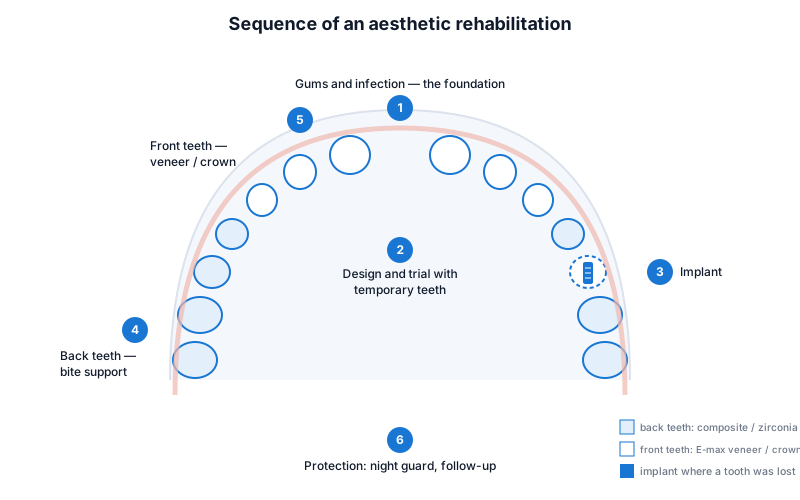 The typical sequence of stages along the dental arch: foundation (gums, infection) → design and trial → surgery → bite support on the back teeth → aesthetics on the front teeth → protection.
Bite height and jaw relationship: a brief note
When teeth are worn there is often no room left for restoration, and the dentist has to raise the bite height (the vertical dimension). This is the functional foundation of rehabilitation: the new height, the reference position of the jaw and the way the front teeth guide one another are first tested with temporary teeth, then transferred to the definitive work. The systematic review by Chantler and colleagues published in the Journal of Esthetic and Restorative Dentistry (2024) shows that an increase in height can be successful both with and without a trial phase; the trial phase is more useful for managing expectations and planning the sequence, and if a trial is carried out, fixed, tooth-coloured temporary teeth are preferable to a removable clear appliance — aesthetics can only be checked with the former. We have written separately about how the occlusion is built, how the vertical dimension is chosen and about the occlusal scheme: occlusion in full-mouth rehabilitation.
Sequence: which stage and when?
Every mouth is different, but the logic is similar:
Stage 0 — Cause and protection. Reflux, clenching, the habit of acidic drinks, hygiene. If the cause remains, the new teeth will wear in the same way.
Stage 1 — Foundation. Cleaning out decay, root canal treatments, periodontal treatment, extraction of teeth that cannot be saved. It does not look aesthetic, but everything rests on it.
Stage 2 — Design and trial. Digital smile design, modelling of the new bite height, a trial in the mouth with temporary teeth (composite build-ups or CAD/CAM PMMA crowns). The patient lives with this for a few weeks or months; changes are easy at this stage.
Stage 3 — Surgery. Implants, bone grafting if needed, gum contouring (crown lengthening, correction of a gummy smile). The healing time determines the length of the plan.
Stage 4 — Back teeth. The definitive restorations are placed on the back teeth first, so that the bite settles onto a stable support.
Stage 5 — Front teeth. The front veneers and crowns are made on this stable posterior support; the shape approved on the temporary teeth is transferred digitally to the definitive work.
Stage 6 — Protection. A night guard (especially with clenching), review appointments, professional cleaning.
The link with smile design: from temporary to definitive
This is the key point of aesthetic rehabilitation: the definitive teeth are not made from scratch, they are made as a copy of the temporary teeth approved during the trial. The temporary teeth are scanned and the definitive ceramic is milled in the same shape; the only difference is the material. This gives a concrete answer to the patient question: will I get what I saw? At the clinic, the digital smile design is created personally by Dr. Bakhtiyar; planning is carried out with CBCT and an intraoral scan.
Duration, budget, expectations
A composite-based rehabilitation without implants is completed within a few months, while a plan involving implants and bone grafting often takes close to a year. It is planned and paid for in stages. An honest expectation: adapting to the new bite takes time, the composite parts will need repair years later, and if clenching continues a night guard becomes a permanent companion. All of this is part of the plan. More about the prosthetic stage: prosthodontic treatment.
Frequently asked questions
Will all the teeth need crowns? Usually not. Teeth with plenty of healthy structure get composite or a veneer, damaged teeth get a crown, and missing teeth are replaced with implants. The aim is as little preparation as possible on every tooth.
Can the front teeth not be done first? They bother me more. The front teeth come last, because their length and shape depend on the bite support provided by the back teeth. Front veneers placed without posterior support fracture sooner.
Can composite and ceramic be mixed in the same mouth? Yes, this is a frequently used combination. What matters is that the shade is selected using the same reference and that each material is used in its proper place.
What do the temporary teeth look like during the trial stage? They are tooth-coloured, fixed temporary teeth; they make it possible to check the smile and speech in real conditions. A removable clear appliance does not show the aesthetics and is poorly received by patients.
How many years after rehabilitation will something need to be changed? For composite restorations, studies with follow-up of close to 10 years show that most restorations remain in function with repairs; ceramics need fewer repairs, but they also require monitoring. Clenching and hygiene are the factors that most affect longevity.
Conclusion
Full-mouth aesthetic rehabilitation is a staged plan built backwards from the final result, giving each tooth its own solution and choosing materials according to the indication. The design comes first, then the trial, and the definitive work comes as a copy of the trial; the functional foundation — bite height and occlusion — is built separately and with care. To assess your individual situation, a plan is prepared together at a consultation on the basis of photographs, scans and X-rays.
Sources
- Severe tooth wear: European consensus statement on management guidelines — Journal of Adhesive Dentistry, 2017
- Importance of an Evaluation Phase When Increasing the Occlusal Vertical Dimension: A Systematic Review — Journal of Esthetic and Restorative Dentistry, 2024
- Vertical Bite Rehabilitation of Severely Worn Dentitions with Direct Composite Restorations: Clinical Performance up to 11 Years — Journal of Clinical Medicine, 2021
This article is for general information only and does not replace an individual diagnosis, examination or treatment. Consult a doctor for a decision about your case.