

How is the bite built in full-mouth rehabilitation?
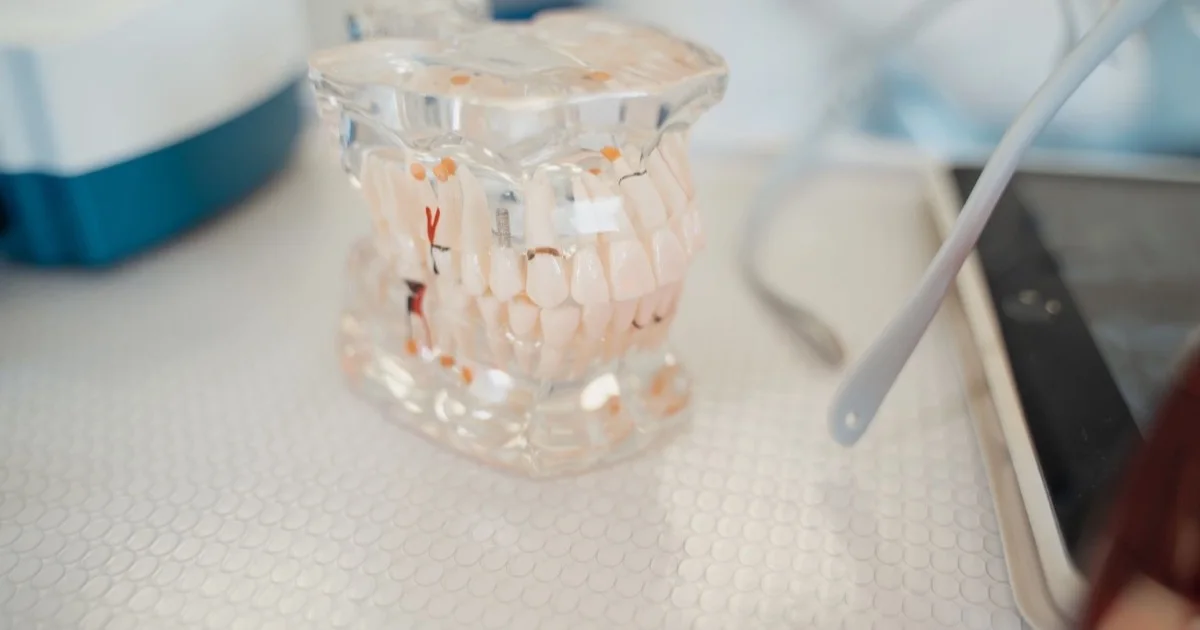
In full-mouth rehabilitation (restoring all the teeth together), the bite is built on four decisions: which jaw position will serve as the reference (usually centric relation), whether the facial height — the vertical dimension — will be maintained or increased, which teeth will carry the load when the jaw moves sideways and forwards (anterior guidance or group function), and how all of this will be tested on a temporary restoration before the definitive work. The bite is not a one-off 'formula' but a plan that is confirmed through step-by-step testing.
Key points:
- The occlusal plan is drawn up before any tooth is prepared, on models and in digital design; it is then checked in the mouth on temporary restorations.
- Centric relation (CR) is used as a repeatable starting point — not as the 'ideal', but as a 'reliable reference'.
- According to reviews, increasing the vertical dimension is considered safe when it is assessed correctly; any complaints that arise are usually temporary.
- Neither anterior guidance nor group function is the 'superior' scheme; the choice is made according to the condition of the teeth and the existing function.
- Changing the bite is not a treatment for TMD or bruxism; that is discussed separately.
Why is the bite planned separately?
When one or two crowns are made, the neighbouring teeth 'remember' the bite: the new crown is matched to the existing teeth. In full-mouth rehabilitation, however, there is no reference left to match — all the occlusal surfaces change at the same time. That is why the jaw position, the facial height and the contacts during movement have to be decided in advance and then tested.
This article covers only the functional and occlusal side. The aesthetic and prosthetic part — the colour and shape of the teeth, smile design and material choice — is covered separately in the article on full-mouth aesthetic rehabilitation.
Decision 1: in which position is the jaw recorded?
When the teeth are complete and healthy, the jaw's 'home' is the maximum intercuspal position (MIP — the position in which the teeth meet most fully). But if the teeth are worn, many of them are missing or they have been replaced with old prostheses, this position is no longer reliable: the teeth do not 'create' it; there is simply a habitual position on what remains.
For this reason, centric relation (CR) is taken as the reference in a full-mouth plan — the repeatable position of the condyle (the head of the jaw) in the joint socket, independent of the muscles. What CR is, how it is recorded and the debates around it are explained in the article what is centric relation. The practical point here is this: CR is chosen because there is no other position that is independent of the teeth and can be found in the same way again and again.
The recording process is usually as follows:
- The jaw muscles are relaxed (sometimes a stabilisation splint is worn for several weeks beforehand).
- A small stop between the front teeth (a deprogrammer) switches off the 'memory' of the back teeth.
- The position is recorded with wax or silicone, or with a digital scan, and transferred to an articulator (a device that simulates jaw movements).
- When an individual measurement of the condylar movements is needed, axiography is added — there is an article on this: what is axiography.
Let us be clear about one thing: CR does not mean a 'pain-free and healthy' position; it is simply a reliable starting point. A 2017 systematic review (Journal of Prosthetic Dentistry) reminds us that prosthetic changes to the bite are not accepted as a strategy for resolving TMD symptoms or stopping bruxism. In other words, a bite built in CR does not 'treat' the joint; it is needed so that the new teeth work in a functional and predictable way.
Decision 2: is the vertical dimension maintained or increased?
Occlusal vertical dimension (VDO) is the height of the lower third of the face when the teeth are together. In worn teeth this dimension often looks reduced, but that is not always the case: as the teeth wear, the alveolar bone compensates by 'pushing the teeth further out', and the height is partly preserved. A detailed explanation can be found in the article what is vertical dimension.
There are two main reasons for increasing the VDO in a full-mouth plan:
- To create space for the material. Thickness is needed for a crown or a veneer without preparing the worn teeth any further.
- To restore the proportions and the guidance of the front teeth. In shortened front teeth, the correct length can only be achieved at a new height.
The 2012 review by Abduo and Lyons (Australian Dental Journal) summarises the literature as follows: a permanent increase in the VDO is safe; the signs and symptoms that arise (muscle fatigue, changes in speech, chewing discomfort) are usually temporary in nature. The review considers an increase of up to 5 mm justified for material space and anterior aesthetics, and recommends making the increase with fixed restorations rather than with a removable appliance — because adaptation is more predictable. There is one exception: in patients with TMD complaints, the VDO should first be tested with a removable appliance, and the irreversible step taken only once the symptoms are under control.
The American College of Prosthodontists' 2021 'Best Evidence' consensus document (Journal of Prosthodontics) points in the same direction: when the diagnosis and planning are carried out correctly, the VDO can be restored successfully; the consensus also notes that the freeway space between the teeth (the 'interocclusal rest space') can differ considerably from the traditional average of 3 mm, so it is not right to be tied to a single figure.
A clinical example: in a retrospective study published in 2022 (Journal of Clinical Medicine), the VDO was increased by 2–7 mm (mean 3.3 mm) in 16 patients with bruxism during full-mouth rehabilitation with monolithic zirconia; over 1–8 years of follow-up (mean approximately 59 months), the survival of 381 restorations was 97.6% and the survival of 88 implants was 97.7%. This is a small selected group and cannot be generalised, but it does show the real clinical outcome of a controlled increase in the VDO.
Decision 3: which teeth work during movement?
When the jaw closes straight, all the teeth should meet at the same time — this is the principle of 'even contacts'. But which teeth touch and which separate when the jaw moves sideways and forwards is a separate decision. There are two main schemes here:
Anterior guidance (mutually protected occlusion). When the jaw moves forwards the front incisors slide against the opposing teeth, and when it moves sideways the canine does, while the back teeth separate immediately. As a result, the back crowns take only vertical load and are protected from lateral forces; the front teeth, in turn, are protected by the back teeth during chewing. This scheme requires healthy canines, sufficient anterior overlap and teeth that are not mobile.
Group function. During lateral movement the load is distributed not to the canine alone but to several back teeth on that side. When the canine is weak, has a short root or reduced periodontal support, or when the anterior overlap is small (for example, an edge-to-edge bite), this scheme is more suitable.
| Criterion | Anterior guidance | Group function |
|---|---|---|
| Carries the load in lateral movement | The canine (and the incisors) | Several back teeth on that side |
| Lateral load on the back teeth | Minimal | Distributed, but present |
| Requirement | A healthy canine, sufficient overlap | When the canine is weak or the overlap is small |
| Risk of ceramic chipping | Lower on the back teeth | Distributed across several teeth |
| In implant-supported prostheses | Preferred when a natural canine is present | Often chosen when an implant is in the canine position |
There is no strong clinical evidence that one scheme is superior to the other; the choice is made according to the condition of the teeth, the patient's existing functional habits and the material. In a patient with bruxism, protecting the back teeth from lateral load becomes more important — there is more on this in the article planning tooth restoration in bruxism.
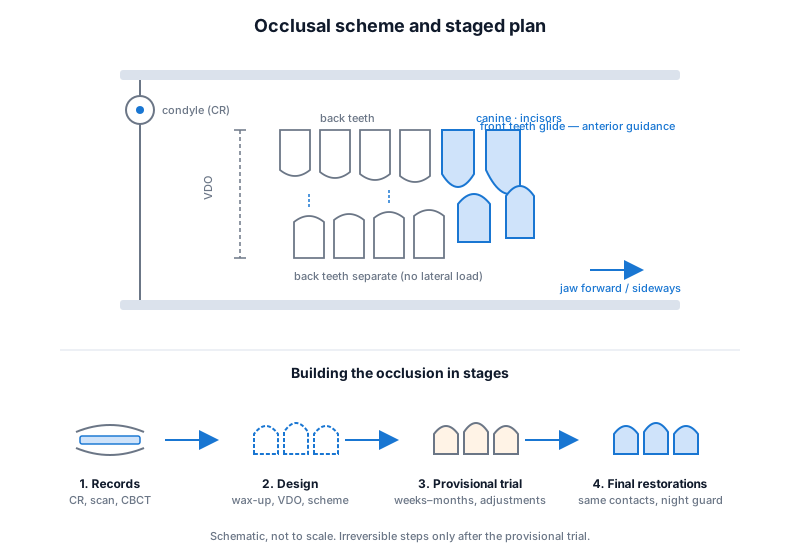 Above: when the jaw moves forwards, the front teeth slide and the back teeth separate (anterior guidance). Below: building the bite step by step — record, design, temporary trial, definitive work.
Decision 4: how is the plan tested in the mouth?
The most important safeguard in full-mouth rehabilitation is the temporary stage. The sequence is usually as follows:
Stage 1 — records and diagnostics. Photographs, an intraoral scan, 3D CBCT, a CR record and, when necessary, axiography. The cause of the tooth wear (clenching, acid, mechanical) is identified; the European consensus (Loomans et al., 2017) requires precisely this — without knowing the cause, a restoration may end in repeated wear.
Stage 2 — design (wax-up). The shape of the new teeth, the VDO and the occlusal scheme are built on an articulator or in a digital environment. At this stage no tooth has been prepared.
Stage 3 — temporary trial. The design is transferred to the mouth with plastic (PMMA) or composite temporary restorations. The patient lives with the new height and contacts, usually for anywhere from a few weeks to a few months. During this period speech, chewing, muscle comfort and the working of the anterior guidance are checked; the temporary surfaces are adjusted when needed. In the 2022 study mentioned above, when the new VDO did not fit within the freeway space, the authors carried out a two-month trial with a removable appliance before the definitive work — this coincides with Abduo and Lyons' recommendation for patients with TMD complaints.
Stage 4 — definitive restoration. The bite confirmed at the temporary stage is 'copied' into the definitive material (monolithic zirconia, lithium disilicate, composite): the temporaries are scanned and the definitive work is made with the same contacts. Once the definitive work has been fitted, the bite is checked again, the adjusted areas are polished, and if there is bruxism a night guard is made.
The logic of this sequence is simple: the irreversible decision (preparing the teeth, the definitive material) is only taken once the reversible trial (the temporary) has been passed successfully.
Does every worn tooth need a full rehabilitation?
No. In severe wear, the European consensus recommends delaying restoration as long as possible and starting with protection, monitoring and advice; and when restoration is needed, a minimally invasive, adhesive approach is preferred. In practice this often means thin composite or ceramic restorations on selected teeth instead of a 'full-mouth' case. A full rehabilitation is planned only when function, aesthetics or dental health require it. At a TMJ and gnathology consultation this choice is discussed with measurements (the degree of wear, the VDO, the existing contacts).
Factors that affect the outcome
- Controlling the cause of the wear. A night guard if bruxism continues; the question of diet and reflux if there is acid erosion.
- A long enough temporary stage. A trial that is rushed leads to adjustments in the definitive work.
- Matching the material to the load. Monolithic materials in bruxism; a layered-monolithic compromise in the aesthetic zone.
- Follow-up. Checking the occlusal contacts and the condition of the night guard during the first year after the definitive work.
Frequently asked questions
Will my face change after the vertical dimension is increased? An increase of a few millimetres can slightly change the lip support and the appearance of the lower part of the face; this is visible in advance at the temporary stage and is assessed together with the patient.
How long does it take to get used to the new height? According to reviews, muscle fatigue and small changes in speech are usually temporary. The individual time varies; that is why the temporary stage is kept before the definitive work.
Does centric relation correct a painful joint? No. CR is only a reliable reference position. If there are TMD complaints, they are first brought under control with conservative methods, and only then is irreversible restoration planned.
Anterior guidance or group function — which lasts longer? There is no strong evidence showing that one scheme lasts longer than the other. The choice is made according to the condition of the canines, the anterior overlap and the material.
Can the temporary stage be skipped and the definitive work done straight away? With small changes this is sometimes possible; in full-mouth cases, when the VDO or the jaw position changes, the temporary trial is not skipped.
Conclusion
In full-mouth rehabilitation the bite is a sequence of four decisions: a reliable jaw position, a justified vertical dimension, a movement scheme suited to the condition of the teeth, and a temporary stage that tests everything. Reviews consider a properly planned increase in the VDO to be safe, but they do not support changing the bite as a treatment for TMD or bruxism. To assess your individual situation, the records, the models and the temporary trial plan are discussed together at a consultation.
Sources
- Clinical considerations for increasing occlusal vertical dimension: a review — Australian Dental Journal, 2012
- Occlusal Vertical Dimension: Best Evidence Consensus Statement — Journal of Prosthodontics, 2021
- Retrospective 1- to 8-Year Follow-Up Study of Complete Oral Rehabilitation Using Monolithic Zirconia Restorations with Increased Vertical Dimension of Occlusion in Patients with Bruxism — Journal of Clinical Medicine, 2022
- Severe Tooth Wear: European Consensus Statement on Management Guidelines — Journal of Adhesive Dentistry, 2017
- Prosthodontic planning in patients with temporomandibular disorders and/or bruxism: A systematic review — Journal of Prosthetic Dentistry, 2017
This article is for general information only and does not replace an individual diagnosis, examination or treatment. Consult a doctor for a decision about your case.