

What is vertical dimension (VDO) and why does it matter in worn teeth?
Occlusal vertical dimension (VDO) is the height of the lower third of the face when the teeth are together — put simply, the distance from the base of the nose to the tip of the chin. This measurement depends on the height of the teeth, but it does not necessarily decrease when teeth wear down: the jawbone and the teeth can compensate for the wear and preserve the height. That is why the decision to increase VDO in worn teeth is based not on the measurement itself, but on the space needed for restoration and on aesthetic need. Studies show that a moderate increase is usually well tolerated.
Key points
- VDO is the height of the lower part of the face with the teeth in contact; it is assessed together with the freeway space between the teeth.
- Wear and a reduction in VDO are not the same thing: in many cases, as the teeth wear down they slowly erupt further and the height is preserved.
- Assessment is carried out using clinical measurement, photographs, speech and rest position, models and sometimes axiography; there is no single gold standard method.
- Increasing VDO is mainly needed to create space for restoration and to correct aesthetics; according to the available reviews, a moderate increase (up to 5 mm) can be justified.
- Temporary discomfort may occur after an increase; the evidence indicates that this usually resolves on its own and does not cause long-term joint problems.
What vertical dimension is — in plain language
When you look in the mirror, you can divide your face into three parts: the forehead, the nose and the lower part. The lower part — from the base of the nose to the tip of the chin — is shaped by the height of your teeth. When you close your teeth in the usual way, this distance is called the occlusal vertical dimension (in English, occlusal vertical dimension, abbreviated VDO or OVD). The Glossary of Prosthodontic Terms (2017) defines it as the distance between two points when the teeth or occlusal surfaces are in contact.
There is also the vertical dimension at rest: the height of the face when the muscles are relaxed, the lips are closed and the teeth are not touching each other. The difference between these two measurements is the freeway space — normally a small distance. When a dentist assesses VDO, they also look at this space.
Why does it matter? Because VDO affects the appearance of the face, lip support, speech sounds and the working pattern of the chewing muscles. What is more, when a denture or a crown is being made, the space the teeth need is determined precisely by this measurement.
Why does VDO not always decrease with wear?
This is the most commonly misunderstood point. The logic seems to be: if the teeth have worn down and become shorter, then the height of the face should decrease too. But the body does not work like that.
When teeth wear down slowly (over years), the jawbone and the teeth undergo a process called dentoalveolar compensation: the tooth gradually erupts further together with its socket (the alveolar bone and the tooth move coronally together), restoring the lost height. As a result, even though the teeth look short, the lower facial height is often preserved and the freeway space remains normal.
What does this mean clinically?
- Not every patient with worn teeth has lost VDO. It is not correct to say that VDO has been lost without measuring it.
- If VDO has been preserved, there is no space to restore the worn teeth — the teeth are already in contact with each other. In this case, VDO needs to be increased in order to create space; this is done not to correct the measurement, but to create space for restoration.
- With rapid wear (severe acid erosion, for example), compensation may not keep up and the height may genuinely decrease.
The types of wear — friction (attrition), acid (erosion) and mechanical (abrasion) — and their relationship with the temporomandibular joint are explained in the article tooth wear and the TMJ; on erosion itself there is the article enamel erosion.
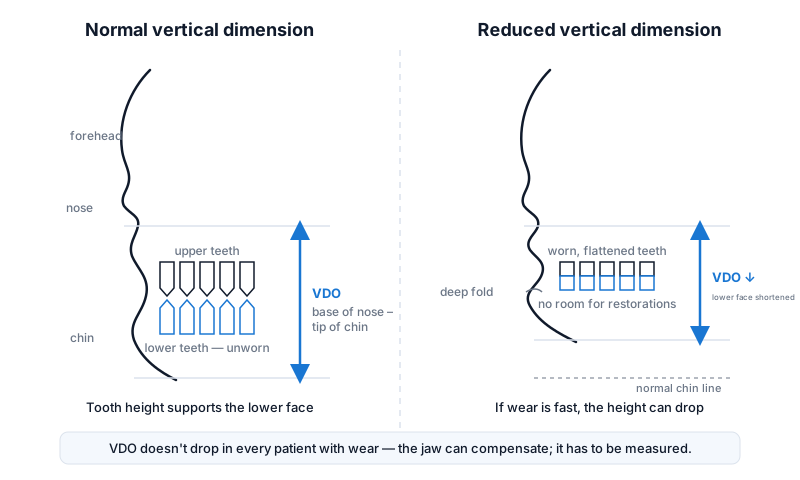 On the left, normal VDO: the distance from the base of the nose to the tip of the chin is maintained by the height of the teeth. On the right, reduced VDO: the teeth are worn, the lower face is shortened and the corners of the lips are drawn inwards. But not every patient with wear has a reduced height — this needs to be measured.
How is VDO assessed?
There is no single, completely precise method — the 2012 review by Abduo and Lyons (Australian Dental Journal) notes that the available measurement methods are limited in terms of consistency and reliability. That is why a dentist uses several methods together:
1. Facial measurements and freeway space. Two points are marked, one at the base of the nose and one at the tip of the chin; the distance is measured with the teeth together and with the muscles relaxed. If the difference (the freeway space) is large, VDO may be reduced.
2. Speech test. When you say the sound S, there is a small gap between the teeth (the closest speaking space). If this gap is too large, the height may be reduced; if the teeth touch each other when saying s, VDO may have been increased too much. The test is particularly useful with trial dentures.
3. Appearance and photographs. Lip support, deepened creases at the corners of the mouth, a collapsed lower face — these are all clues, though they can be confused with age-related and skin changes.
4. Tooth height and aesthetic criteria. The visible height of the front teeth, their relationship to the lip line, how much of the teeth show when smiling. In worn teeth, these criteria indicate the height at which the restoration should be built.
5. Models and articulator. Dental models are mounted in the joint position — centric relation — on a device that mimics jaw movements (an articulator); a change in VDO is first tested on the models and on a wax-up. What this position is is explained in the article centric relation.
6. Old photographs. Photographs of the patient from 10–20 years ago can show whether the lower facial height has changed — a simple but useful method.
When is it necessary to increase VDO?
There are two main indications here, and both come not from a claim that the measurement has decreased, but from need:
- Space is needed for restoration. Placing a crown, veneer or composite restoration on worn teeth requires a certain thickness of material. If the teeth are already in contact, space is created either by preparing the teeth (with a loss of healthy tissue) or by increasing VDO. The European consensus statement (Loomans and colleagues, 2017) recommends precisely a conservative, minimally invasive, adhesive approach in severe wear and delaying restoration for as long as possible — increasing VDO can be part of this approach, because it allows space to be created without preparing the teeth.
- Aesthetic and functional need. The facial height has genuinely decreased, the lips are left without support, the front teeth do not show when smiling.
The review by Abduo and Lyons (2012) contains two practical conclusions: the amount of the VDO increase should be determined by the restorative need and the aesthetic requirements; an increase of up to 5 mm can be justified in order to create sufficient space and improve appearance. An increase beyond that requires separate consideration and a staged approach.
In the following situations, increasing VDO is not necessary:
- There is wear, but VDO has been preserved and no restoration is required (monitoring and preventive measures only).
- Individual teeth are worn while the remaining teeth are healthy — a local restoration is enough.
- There is TMJ pain and the aim is to correct the joint — as explained below, this is not an evidence-based indication for increasing VDO.
Does increasing VDO harm the TMJ?
This is the question that worries patients most. The 2015 literature review by Moreno-Hay and Okeson (Journal of Oral Rehabilitation) looked at precisely this question. The conclusion: the available evidence is weak, but the chewing system can adapt rapidly to moderate changes in VDO; mild, temporary symptoms (muscle fatigue, a feeling that the teeth are high, changes in speech) may occur, but these usually resolve on their own, and the authors found no indication that a permanent change in VDO causes long-term TMD symptoms. At the same time, the review notes the shortage of well-designed studies — that is, this does not mean there is no risk at all, but that a significant risk has not been proven.
Abduo and Lyons also write that side effects are mainly temporary in nature, and they give two practical recommendations: fixed restorations (crowns, composites) provide a more predictable adaptation than removable appliances; and in patients with an existing TMJ problem, a trial stage with a removable appliance (an occlusal splint) is advisable before taking an irreversible step.
The question is also asked in the opposite direction: does a reduced VDO cause TMJ problems? The evidence for this is not strong either; TMJ problems are multifactorial, and the relationship with occlusal parameters is at the level of association. This topic is discussed separately in the article bite and the TMJ.
How is the increase carried out in practice?
The general principle is to start with staged and reversible steps:
- Assessment and planning. Measurements, photographs, models, examination of the joint and muscles. The cause of the wear (acid, clenching, hard food) is identified — if the cause is not removed, the restoration will wear down too.
- Trial stage. The new height is first tested with a removable splint, or more often with temporary composite or PMMA (temporary acrylic) restorations bonded directly to the teeth. The patient lives at this height for several weeks or months: chewing, speech and muscle comfort are assessed.
- Permanent restoration. If the trial has been comfortable, permanent restorations (composite, ceramic crowns or onlays) are made at the same height. The sequence in full-mouth rehabilitation and the setting up of the occlusal scheme are described in the articles occlusion in full-mouth rehabilitation and full-mouth rehabilitation.
- Protection. If there is clenching, a night guard to protect the restorations; if there is erosion, control of diet and reflux.
At the clinic, this process begins with a TMJ and gnathology assessment and is planned together with the prosthodontist.
Frequently asked questions
My teeth are worn, but I have no complaints. Should I have my VDO checked? If there are no complaints, there is no urgent intervention needed. However, it is useful to identify the cause of the wear and to monitor its progression (photographs, models) — the European consensus places precisely this monitoring and these preventive measures first in severe wear.
How long can discomfort last after VDO is increased? According to the reviews, signs of adaptation are usually temporary and most of them subside within the first few weeks. If the discomfort persists, the height or the occlusal contacts should be checked again — this can be resolved by adjusting the restorations.
Is it possible to increase VDO by restoring only the front teeth? Usually not: VDO is the height of the whole dental arch, and if you lengthen the front teeth without changing the back teeth, the back teeth will not be in contact. Sometimes a local solution is possible with an orthodontic approach (for example, the Dahl principle — placing a temporary stop on the front teeth and waiting for the back teeth to erupt again); the dentist assesses this individually.
Does increasing VDO make the face look younger? If the lower face has genuinely become shorter, an appropriate increase can improve lip support and facial proportions. But this is not a cosmetic procedure, and increasing the height more than necessary for the sake of aesthetics can disrupt chewing and speech.
Is there a VDO in removable dentures too? Yes, in complete removable dentures VDO is established from scratch and is determined using the same methods (freeway space, speech test, aesthetics).
Conclusion
Vertical dimension is the height of the lower part of the face with the teeth in contact. Worn teeth do not automatically mean a reduced VDO — the jaw often compensates for the loss. The decision to increase VDO is based not on the measurement, but on the space needed for restoration and on genuine aesthetic need; according to the available reviews, a moderate increase is well tolerated and is not linked to long-term joint problems, but a trial stage and a staged approach are essential. To have your individual situation assessed, you can discuss the measurement and planning steps with your dentist during a consultation.
Sources
- The Glossary of Prosthodontic Terms: Ninth Edition — The Journal of Prosthetic Dentistry, 2017;117(5S):e1-e105
- Clinical considerations for increasing occlusal vertical dimension: a review — Australian Dental Journal, 2012 (Abduo, Lyons)
- Does altering the occlusal vertical dimension produce temporomandibular disorders? A literature review — Journal of Oral Rehabilitation, 2015 (Moreno-Hay, Okeson)
- Severe Tooth Wear: European Consensus Statement on Management Guidelines — Journal of Adhesive Dentistry, 2017 (Loomans et al.)
This article is for general information only and does not replace an individual diagnosis, examination or treatment. Consult a doctor for a decision about your case.