

What is centric relation and how does it differ from maximum intercuspation?
Centric relation (CR) is a joint-based position of the lower jaw that is independent of the teeth: both condyles (the heads of the temporomandibular joint), together with their discs, sit in the most stable, anterior-superior position within the joint socket. Maximum intercuspation (MIP), on the other hand, is the tooth-guided position in which the teeth fit together most tightly. In most people these two positions do not quite coincide. Because CR is a repeatable starting point, it is used as a reference in extensive prosthodontic and occlusal treatment plans; but it is not a measure of ‘disease’ or ‘health’.
Key points
- CR is a joint position, MIP is a tooth position — one starts from the condyle, the other from the way the teeth fit together.
- A small slide between CR and MIP occurs in healthy people too; on its own this does not mean there is a problem.
- CR is mainly needed when many teeth are being restored, or when the existing bite cannot be relied upon.
- The definition of CR has changed over time and remains debated; modern research does not find a strong causal link between occlusion and TMJ problems.
- The recording method (manual guidance, an anterior stop, wax or a digital record) varies according to the dentist’s choice and the situation.
What is centric relation in simple terms?
Picture the temporomandibular joint: there is a small socket in the skull (the articular fossa), the head of the lower jaw (the condyle) sits in that socket, and a thin cartilage disc lies between them. In this joint the lower jaw both rotates and slides forward.
Centric relation — centric relation, or CR for short — is the position of the lower jaw in which the condyle rests on the thinnest, avascular part of the disc and sits anteriorly and superiorly against the slope of the articular eminence. In this position it makes no difference whether the teeth touch each other or not. In other words, CR is a position that is independent of the teeth. The ninth edition of the Glossary of Prosthodontic Terms (2017) describes CR in exactly this way — as a joint-based, repeatable reference position.
Why is this position of interest? Because teeth can change: they wear down, they can be extracted, and they can be rebuilt with fillings or crowns. The stable position of the joint, however, does not depend on the teeth. When the dentist needs a stable ‘zero point’ outside the teeth, they turn to CR.
What is maximum intercuspation (MIP)?
Maximum intercuspation — maximal intercuspal position, MIP — is the position in which your teeth touch at the greatest number of points and ‘sit’ most comfortably when you close in the usual way. This position comes not from the condyle but from how the cusps and fossae of the teeth fit together. In everyday life, when you chew, swallow or clench, the lower jaw usually comes into MIP.
So the difference can be put in a single sentence: CR is determined by the joint, MIP by the teeth.
Why do CR and MIP not coincide?
In most people the lower jaw slides slightly forward or to the side from the CR position to reach MIP. This ‘CR–MIP slide’ is usually small — on the order of a millimetre; sometimes less, sometimes a little more. The dental arch takes shape over the years through wear, fillings, extracted teeth and orthodontic movement; the joint, meanwhile, maintains its own position separately. The two systems are not expected to coincide exactly.
This slide is not in itself considered a problem. In a systematic review published in the Journal of Oral Rehabilitation in 2017 (Manfredini and colleagues; 25 association studies, 10 of them with multivariate analysis), only two occlusal features — the CR–MIP slide and mediotrusive contacts (contacts on the opposite side during chewing) — showed a relatively consistent association with TMJ problems. The authors assess this not as a disease-specific relationship but as a weak and non-specific one, and call on clinicians to move away from the old ‘correct the bite and the joint will heal’ paradigm. Association does not mean causation: the same slide is present in thousands of people who have no pain.
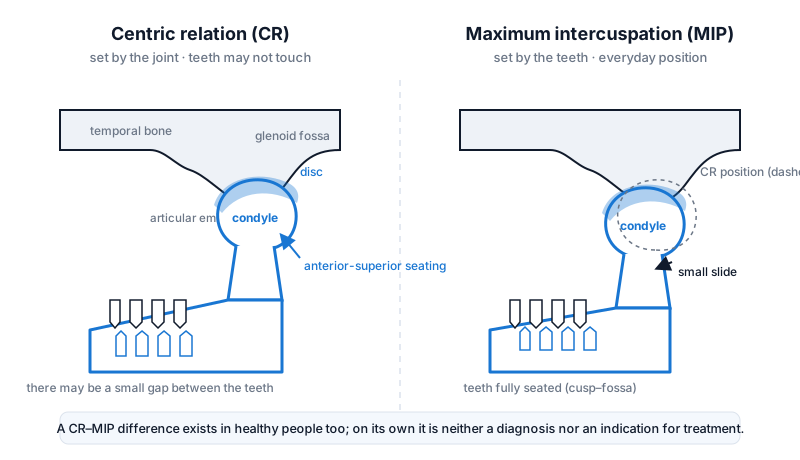 On the left, CR: the condyle and disc are seated anteriorly and superiorly on the slope of the articular eminence, and the teeth are not yet in full contact. On the right, MIP: the teeth are tightly interlocked, while the condyle is in a slightly different place. The difference between the two occurs in healthy people as well.
Why is CR used in prosthodontic and occlusal planning?
The answer to this question is simple: the dentist needs a position they can rely on.
When a crown is being made for one or two teeth, the existing bite (MIP) is enough: the remaining teeth show the way and the technician fits the new crown to them. In some situations, however, MIP cannot be relied upon:
- When many teeth are restored at the same time. In full-mouth rehabilitation the old bite is ‘erased’ — in which position should the new bite be built? This is where CR comes in as a stable starting point; a detailed explanation is given in the article on occlusion in full-mouth rehabilitation.
- When the vertical dimension is changed. When face height is increased in worn teeth, the teeth no longer indicate the position; the joint position is taken as the basis. This topic is explained separately in the article what is vertical dimension.
- When the back teeth are missing. Without support, MIP is not stable and the jaw ‘wanders’.
- In orthodontic and orthognathic planning. Mounting the models in CR on an articulator (a device that simulates jaw movements) makes it possible to see the true position of the teeth in relation to the joint. There is an article on recording condylar movements, axiography.
In other words, CR is not an everyday tool; it plays the role of a ‘compass’ before extensive and irreversible work.
How is CR recorded?
To record CR, the lower jaw has to be brought into the joint position without muscle tension and without the teeth touching. In practice there are several methods:
- Bimanual guidance. The patient lies comfortably while the dentist gently holds and guides the lower jaw with both hands; the aim is to seat the condyles anteriorly and superiorly. It does not work when the muscles are tense — they need to relax first.
- An anterior stop (deprogrammer, anterior jig or plate). A small stop is placed between the front teeth; when the back teeth do not touch, the jaw muscles come out of their ‘memory’ and the joint settles into its own place. Sometimes the patient wears an occlusal splint at night for a few days or weeks so that the muscles calm down.
- Recording material. Once the position has been found, hard wax or a silicone registration material is placed between the teeth and the lower jaw is closed gently in that position. In a digital workflow this position can also be recorded with an intraoral scanner.
- Verification. A good CR record must be repeatable: taking the record several times should give the same result.
All of these methods are painless and non-invasive; the procedure usually takes a few minutes. Which method is chosen depends on the patient’s muscle condition, the number of teeth and the planned work.
Points of debate: the nuances you should know
There has been debate around CR for decades and there is still no complete consensus. A few important points:
The definition has changed. A review published in the Journal of Indian Prosthodontic Society in 2013 (Palaskar and colleagues) examined the many definitions of CR from 1929 to 2010: earlier, the ‘posterior-superior’ position of the condyle was taken as the basis, later the ‘anterior-superior’ one. The authors note that although the definition has changed, the recording methods have remained almost the same and there is no full consensus on any single definition. Their conclusion expresses the value of CR well: CR is ‘the only clinically repeatable jaw relationship’ — that is, its usefulness lies in its consistency, not in its being the ‘correct’ or ‘healthy’ position.
CR is not a diagnostic criterion. The international diagnostic criteria for temporomandibular disorders (DC/TMD, 2014) are based on pain and on examination of the muscles and the joint; occlusal tests have not contributed to the accuracy of any TMD diagnosis. In other words, the presence of a CR–MIP difference does not give you a diagnosis; the diagnosis is made by clinical examination. This is discussed in more detail in the article dental occlusion and the TMJ.
The claim that ‘restoring in CR cures TMD’ has not been proven. A bite built in CR is a reliable starting point for extensive prosthodontic work; but presenting this as a treatment for joint pain does not correspond to the available evidence. For a painful joint, diagnosis comes first, followed by reversible approaches (information, exercises and, if needed, a splint); an irreversible change to the bite should not be the first step.
What does CR mean when the disc is displaced? If the disc is not in its proper place, the definition ‘the condyle sits on the disc’ does not apply literally. In such cases the dentist takes an adapted, stable and pain-free position as the basis. For clicking and disc displacement, you can read the article clicking and noises in the TMJ.
What does this mean in practice for the patient?
- If one or two crowns or fillings are being made for you, a CR record will most likely not be needed; your existing bite is enough.
- If a multi-tooth restoration, the restoration of worn teeth or a rebuild of the bite is planned, it is normal and expected for the dentist to take a CR record.
- If you feel pain while your jaw is being guided during the CR record, say so straight away — a record cannot be taken correctly on a painful joint, and the joint needs to settle first.
- When you hear the statement ‘your bite is not in CR, that is why your joint hurts’, ask further questions: which examination is the diagnosis based on, and which reversible steps will be tried first?
At the clinic, gnathological assessment is carried out within the TMJ and gnathology service; where necessary, the CR record, articulator analysis and recording of joint movements are planned together.
Frequently asked questions
Is taking a CR record painful? No. The lower jaw is guided gently and wax or silicone is placed between the teeth. If the joint is inflamed, guidance may be uncomfortable; in that case the record is postponed.
I have a small slide between CR and MIP — does this require treatment? Not on its own. Such a slide is also widespread among people who have no pain. The treatment decision is made according to the symptoms (pain, limited opening, impaired function) and the restorative work planned, not according to a number.
Does wearing a splint help to ‘find’ CR? In some cases, yes: a few weeks with a stabilisation splint relaxes the muscles and allows a more repeatable record of the joint position. However, a splint is not necessary for everyone, and as a treatment method in its own right it has its own separate indications.
Is it possible to record CR with a digital scanner? Yes, the guided position between the teeth can be recorded with an intraoral scanner. Finding the position, however, still depends on the dentist’s clinical skill; the scanner only documents the position once it has been found.
Why is CR needed before orthodontic treatment? To see the models in their true position in relation to the joint. Sometimes the teeth look ‘straight’ in MIP, but in the joint position the bite turns out to be different; this can be important for the plan.
Conclusion
Centric relation is a joint-based, repeatable position of the lower jaw that is independent of the teeth; maximum intercuspation, on the other hand, is the everyday position guided by the teeth. A small difference between the two is normal. The value of CR lies in its being a stable reference point — it is useful in extensive prosthodontic treatment, in restoring worn teeth and in rebuilding the bite. It is right to understand it as a planning tool, not as the cause or the diagnosis of TMJ problems. To have your individual situation assessed, you can discuss this topic with your dentist during a consultation.
Sources
- The Glossary of Prosthodontic Terms: Ninth Edition — The Journal of Prosthetic Dentistry, 2017;117(5S):e1-e105
- Centric relation definition: a historical and contemporary prosthodontic perspective — Journal of Indian Prosthodontic Society, 2013 (Palaskar, Murali, Bansal)
- Temporomandibular disorders and dental occlusion. A systematic review of association studies: end of an era? — Journal of Oral Rehabilitation, 2017 (Manfredini, Lombardo, Siciliani)
- Diagnostic Criteria for Temporomandibular Disorders (DC/TMD) for Clinical and Research Applications — Journal of Oral & Facial Pain and Headache, 2014 (Schiffman et al.)
This article is for general information only and does not replace an individual diagnosis, examination or treatment. Consult a doctor for a decision about your case.