

Clicking and popping in the jaw joint: what does it mean and when should you worry?
Clicking in the jaw joint is most often caused by the articular disc (the cartilage cushion between the condyle and the temporal bone) slipping slightly forward and then snapping back into place as you open your mouth; this is called disc displacement with reduction. Painless clicking is very common, is not considered a disease and usually needs no treatment. There is real reason for concern when the sound comes with pain, when mouth opening becomes limited, when the jaw locks, or when the character of the sound changes to a grating noise (crepitus). In such cases an examination by a gnathologist is needed.
Key points
- Clicking is the disc slipping forward and returning as the mouth opens; grating is the joint surfaces rubbing against each other.
- A significant proportion of people with no complaints show disc displacement on MRI; a sound on its own is not a diagnosis.
- In follow-up studies, displacement with reduction remains stable for years in most cases, and progression to locking is uncommon.
- Sound + pain, sound + limited opening, a sound that suddenly stops + inability to open — these are reasons to see a dentist.
- Surgery purely to eliminate the sound is a very rare indication; the first step is usually conservative.
Where does the sound come from? The structure of the joint in simple terms
The jaw joint has three main elements: the condyle (the joint head), which is the upper end of the lower jaw; the joint socket in the temporal bone of the skull and the articular eminence in front of it; and the articular disc positioned between the two. The disc works like a soft shock absorber: when the mouth is closed it sits on top of the condyle, and when you open your mouth it slides forward together with the condyle onto the eminence.
In a healthy joint the disc and the condyle move together throughout the whole range of motion — which is why no sound is produced. A sound appears when this partnership between the disc and the condyle is disrupted.
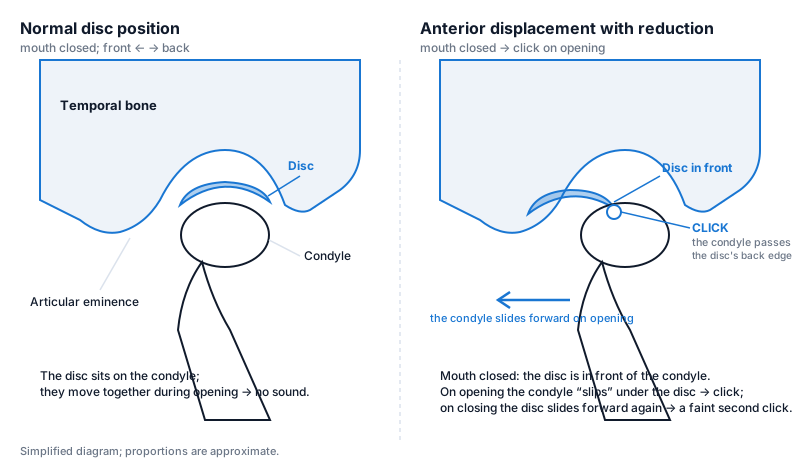 Left: in a healthy joint the disc sits on top of the condyle. Right: the disc has slipped forward; as the mouth opens the condyle passes over the thickened posterior edge of the disc and moves underneath it — the click is heard at that moment.
Clicking: disc displacement with reduction
The most common cause is disc displacement with reduction. The word reduction means that the disc returns to its place. The mechanism works like this:
- When the mouth is closed, the disc sits not on top of the condyle but slightly in front of it.
- As you start to open your mouth, the condyle moves forward, reaches the thick posterior edge of the disc, passes over it and moves underneath the disc. At this moment of transition the opening click is heard.
- With the mouth open, the disc and the condyle are in the correct position.
- As you close your mouth the condyle moves back and the disc slips forward again — this time producing the usually quieter closing click. The two sounds together are called reciprocal clicking.
According to a review published in the Journal of Applied Oral Science in 2019, this condition is based on stretching of the ligaments behind the disc and thinning of the posterior edge of the disc; the earlier theory that the lateral pterygoid muscle pulls the disc forward has not been confirmed in recent research. In other words, clicking is not a muscle spasm but a gradual change in the soft tissues of the joint.
Does clicking cause pain?
In most cases, no. The same review emphasises that most cases of displacement with reduction are symptom-free and the only complaint is the sound itself. Pain is added when inflammation develops around the disc (joint pain — arthralgia) or when the muscles are overloaded. Painful clicking and painless clicking are two different clinical situations.
Grating (crepitus): a different sound
A click is a short, single, sharp sound. Grating, on the other hand, is a drawn-out noise resembling sand rubbing together or paper tearing. It usually occurs when the disc no longer acts as a shock absorber between the condyle and the bone, and the joint surfaces rub against each other. In the DC/TMD criteria, grating is listed as one of the clinical signs of degenerative joint disease, but imaging is required for an accurate diagnosis. Grating does not always mean a serious problem, but if it comes with pain or a change in function it must be assessed.
Disc displacement without reduction: when the sound stops
Sometimes a joint that has clicked for years suddenly goes quiet — and the patient is pleased about it. But if at the same time mouth opening has sharply decreased and the jaw deviates towards that side when opening, it means the disc is no longer returning to its place. The condyle stays behind the disc and cannot pass over it; this is called disc displacement without reduction, or locking in everyday language.
According to the DC/TMD, displacement without reduction with limited opening is a diagnosis that can be identified reasonably reliably by clinical examination (in the validation study, sensitivity 0.80, specificity 0.97 — clinical examination compared with MRI). Acute locking should not be left untreated: at an early stage it is easier to restore opening with jaw manipulation, exercises and an appliance.
Does clicking get worse over time?
This is the question patients ask most often, and the evidence-based answer is generally reassuring. The follow-up data collected in the 2019 review:
- In an MRI follow-up of 92 joints over approximately 9 months, 93.5% of displacements with reduction remained in the same state and 6.5% progressed to the form without reduction (change of diagnosis).
- Over an approximately 8-year follow-up, 88.4% of the diagnoses of normal, indeterminate and displacement with reduction remained unchanged (diagnostic stability).
- In an approximately 2-year follow-up of 24 untreated patients, clicking did not progress to locking in most cases.
- In an older 3-year follow-up, clicking remained unchanged in 71% of cases and locking developed in only 9% (clinical course).
These figures tell us that the joint often adapts to the new position of the disc. But most is not all; that is why it is important to monitor the symptoms and seek advice if anything changes.
When should you worry and see a dentist?
The table below helps to sort the sounds into a monitor group and a seek-advice group.
| Situation | What to do |
|---|---|
| Painless clicking, mouth opens fully, chewing is comfortable | No treatment required; watch your habits, monitor |
| Clicking + pain when chewing or opening | Examination by a gnathologist |
| Clicking + reduced mouth opening or the jaw deviates | Get examined, do not delay |
| The sound suddenly stopped and the mouth will not open (locking) | Seek advice quickly — early on it is easier to resolve |
| Grating (crepitus), especially with pain | Examination, probably imaging |
| The jaw stays open and will not close | Emergency care |
The short summary from the NIDCR agrees with this table: painless clicking and popping are considered normal, while pain and impaired function are grounds for an examination.
What happens at the examination?
The dentist first assesses the type of sound (click/grating), the moment at which it occurs (at the beginning, middle or end of opening), its relationship to pain, and the range of opening. The validation study of the DC/TMD criteria contains an interesting finding: disc displacement with reduction is difficult to identify by clinical examination alone (sensitivity 0.34, specificity 0.92 — compared with MRI). This leads to two practical conclusions. First, not hearing the sound during a single appointment does not mean there is no problem. Second, when the exact position of the disc is needed, MRI is the reference method; to see the bone surfaces, CBCT can be used. Imaging is only ordered if the result will change the treatment decision.
The pain and muscle component is also checked separately, because night-time clenching often accompanies a clicking joint — we discuss this in detail in our article on bruxism and the TMJ. For a list of the general signs you can read the article on the signs of a TMJ problem.
Can clicking be treated?
The 2019 review distinguishes three scenarios, and this division is the clearest road map for the patient:
- An incidental finding with no complaints — treatment is not recommended. Explanation and monitoring are enough for the patient.
- The sound is the main complaint (it is bothersome or embarrassing) — a conservative approach: explanation, jaw exercises, relaxation and, if needed, an occlusal splint. The review notes that supervised jaw exercises and splint treatment resulted in a reduction or disappearance of clicking at 6-month follow-up in a number of studies (clinical assessment of clicking); the outcome varies from person to person, and the sound does not disappear completely in every patient.
- Sound + joint pain — the aim is to reduce the pain, not the sound. Measures that reduce loading, a splint and, if necessary, short-term medication.
Surgery (arthrocentesis, arthroscopy) is discussed very rarely in this group, in painful or locked joints that do not respond to conservative treatment. The types of appliance and how they work are explained in the article on TMJ splint treatment.
At our clinic, jaw joint complaints are managed within the field of TMJ and gnathology; the plan is drawn up individually after an examination.
Frequently asked questions
My jaw clicks on one side only. Is that normal? Yes, disc displacement is often one-sided. If there is no pain or restriction, monitoring is enough; being two-sided is also not in itself a sign of severity.
Can I move my jaw around to put the click back in place myself? Deliberately moving your jaw from side to side to make the sound puts extra load on the joint and can loosen the ligaments further. Avoid this habit; if the sound bothers you, the exercises should be shown to you by a dentist.
I have had the clicking for years, but now the area in front of my ear has started to hurt. What has changed? Even though the sound itself has not changed, inflammation around the joint or muscle overload has been added. This is grounds for an examination: painful clicking is managed differently from painless clicking.
What if a child or teenager has clicking? Displacement with reduction also occurs in teenagers, and the course is usually similar. Assessment is needed if there is pain, limited opening or facial asymmetry; a painless sound alone is not a reason for treatment.
Is orthodontic treatment possible with a clicking joint? Yes, in most cases it is. Before treatment the condition of the joint is recorded, and if there is pain it is settled first; the orthodontic plan is then drawn up taking the joint into account.
Conclusion
Clicking in the jaw joint is most often caused by the disc slipping forward and returning as the mouth opens. This condition is widespread, painless in most cases and, according to follow-up studies, remains stable for years. The main reason for concern is the sound combined with pain, limited opening, locking or grating. A consultation with a gnathologist is enough to assess your individual situation; and if treatment is needed, it usually starts conservatively.
Sources
- Temporomandibular joint disc displacement with reduction: a review of mechanisms and clinical presentation — Journal of Applied Oral Science, 2019
- Diagnostic Criteria for Temporomandibular Disorders (DC/TMD) for Clinical and Research Applications: Recommendations of the International RDC/TMD Consortium Network and Orofacial Pain Special Interest Group — Journal of Oral & Facial Pain and Headache, 2014
- TMD (Temporomandibular Disorders) — National Institute of Dental and Craniofacial Research (NIDCR), NIH
This article is for general information only and does not replace an individual diagnosis, examination or treatment. Consult a doctor for a decision about your case.