

Jaw joint problems (TMD): symptoms, causes and when to see a dentist
A jaw joint problem — known medically as temporomandibular disorder (TMD) — is pain and impaired function arising in the jaw joint itself, in the muscles that move it, or in both. The main symptoms are pain in the jaw and face, difficulty or restriction when opening the mouth, sounds from the joint, and sometimes ear and temple pain. The cause is often not a single one; stress, muscle tension, clenching, trauma and individual pain sensitivity can all play a part together. If the pain lasts more than one or two weeks, or if the mouth will not open, an examination by a gnathologist is needed.
Key points
- TMD is not a single disease but the collective name for a group of disorders of joint and muscle origin.
- A painless click on its own is not considered a disease; the problem begins when pain and function are affected.
- In most cases the cause is a combination of several factors, and a bad bite alone has not been proven to be a cause.
- The first approach is usually conservative: rest, exercises, an appliance, habit modification.
- An inability to open the mouth, swelling on one side of the face or locking of the joint are situations that should not be delayed.
How the jaw joint works and what TMD is
The jaw joint (the temporomandibular joint, TMJ for short) is a paired joint that connects the lower jaw to the temporal bone of the skull. It sits on both sides, immediately in front of the ear. The upper end of the lower jaw — the condyle (joint head) — rests in a hollow in the temporal bone (the joint socket); between the two there is a thin cartilage disc. This disc works like a shock absorber and slides forward together with the condyle when the mouth opens.
Any part of this mechanism — the joint surfaces, the disc, the ligaments or the chewing muscles — can cause discomfort. NIDCR (the US National Institute of Dental and Craniofacial Research) describes TMD as a group of more than 30 conditions that cause pain and impaired function in the jaw joint and in the muscles that move the jaw. In the international diagnostic criteria (DC/TMD, 2014) these disorders are divided into two large groups:
- Pain-related TMD: muscle pain (myalgia), joint pain (arthralgia) and headache attributed to the jaw.
- Intra-articular disorders: disc displacement (with and without reduction), degenerative joint disease, dislocations.
For the patient the meaning of this division is simple: the pain can come from the muscle as well as from the joint, and treatment differs accordingly.
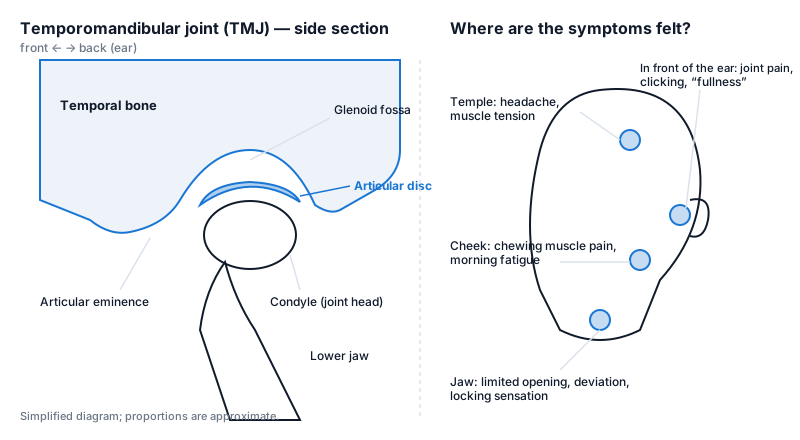 Left: the temporal bone, the articular eminence, the articular disc and the condyle of the lower jaw. Right: the areas where the most common symptoms of TMD are felt.
Main symptoms: what to look out for
TMD symptoms resemble one another and are sometimes confused with toothache, earache or headache. The following are the most common.
Jaw and facial pain
The pain is usually felt in front of the ear, in the cheek, in the temple or below the angle of the jaw. It increases when chewing, yawning or talking for a long time. A feeling of tiredness in the jaw on waking in the morning is often linked to night-time clenching — we discuss this separately in the article on bruxism and the jaw joint.
Limited mouth opening or locking
Normally a person can comfortably open their mouth to the width of three fingers. If opening decreases, if the jaw deviates to one side while opening or if it briefly catches, this may indicate an intra-articular problem. A sudden inability to open the mouth (locking) requires separate assessment.
Sounds from the joint: clicking, popping, grating
A clicking sound from the joint when opening and closing the mouth is very common. An important point emphasised by NIDCR: a painless click is considered normal and does not require treatment. If the sound is combined with pain, restriction or locking, the picture changes. There is a detailed explanation of the types of sound and what they mean in the article on jaw joint sounds and clicking.
Earache, fullness in the ear, headache
Because the joint sits immediately in front of the ear, TMD pain is often referred to the ear. Patients first go to an ENT doctor, and no problem is found in the ear. A headache felt in the temple that increases with jaw movement is also recognised as a separate diagnosis in the DC/TMD criteria.
Other symptoms
- Pain or tension when pressing on the chewing muscles.
- A feeling that the teeth no longer meet as they used to (a change in the bite).
- Jaw pain that goes together with neck and shoulder tension.
Causes: why me?
The honest answer is this: in most cases it is not possible to point to one exact cause. According to NIDCR, research shows that factors such as genetic predisposition, psychological and life stress, and how a person perceives pain all play a part together. In practice, the most common contributing factors are these:
- Overloading of the chewing muscles — clenching and grinding (bruxism), chewing gum, nail biting, the habit of resting the jaw on the hand.
- Stress and tension — this raises muscle tone and lowers the pain threshold.
- Trauma — a blow to the jaw, a dental procedure with the mouth held open for a long time, a sudden wide yawn.
- Intra-articular changes — disc displacement, loosening of the ligaments, age-related changes to the joint surfaces.
- General conditions — some connective tissue diseases, arthritis, sleep disorders.
A separate word is needed about the bite. For many years an incorrect bite was considered the main cause of TMD. Today's evidence is not that simple: NIDCR states openly that research does not support the idea that a bad bite or orthodontic treatment causes TMD. This does not mean that the bite is of no importance — in some cases it can be one of the factors that increases the load. But grinding down teeth or carrying out irreversible interventions purely in order to correct the bite is no longer recommended. We cover this topic in a balanced way in the article on bite and the jaw joint.
How common is this problem?
According to NIDCR, about 5% of the adult population in the USA currently has symptoms of TMD (prevalence figure), and it occurs about twice as often in women as in men, particularly between the ages of 35 and 44. Clicking is even more widespread: a 2019 review on disc displacement with reduction notes that disc displacement is visible on MRI in about one third of people who have no complaints at all (an imaging finding in people without symptoms). In other words, seeing something less than ideal in the joint does not yet mean there is a disease.
When should you see a dentist?
Some jaw pain goes away on its own within a few days — for example after a long dental appointment or after chewing hard food. But do not wait in the following situations:
- The pain lasts more than 1–2 weeks or is gradually getting worse.
- The mouth will not open, or opening has decreased noticeably.
- The jaw locks in an open or closed position.
- The sound comes together with pain or interferes with chewing.
- The bite has suddenly changed (my teeth no longer meet as they used to).
- There is swelling, redness or heat on one side of the face.
The patient information of the American Academy of Orofacial Pain (AAOP) emphasises that the complaints referred to as TMJ do not arise from a single condition; for this reason the true source of the pain — muscle, joint, nerve or another cause — must be identified before treatment. That is exactly why the first step is diagnosis.
What happens at the appointment?
At an appointment with a gnathologist (a dentist specialising in the jaw joint and the bite) the following usually take place:
- Conversation: where the pain is, when it started, what makes it worse, sleep, stress, habits.
- Clinical examination: measuring the range of mouth opening, the movement path of the jaw, feeling the joint and the muscles (palpation), assessing the sounds. According to the DC/TMD criteria, the basis for a diagnosis of muscle and joint pain is reproducing the patient's familiar pain during the examination.
- Imaging — when needed: not every patient needs an X-ray. Most painful TMD is diagnosed by clinical examination. Imaging is considered when there is a suspicion of changes in the joint surface, trauma or an unusual course; the article on when a TMJ X-ray is needed offers guidance on this.
After the examination the dentist explains whether the problem is mainly of muscle, joint or mixed origin, and draws up a plan.
Briefly about treatment: what can you expect?
The subject of this article is symptoms and causes, but it is reassuring to know one general principle: the great majority of TMD is managed without irreversible intervention. Typical conservative steps:
- Rest for the jaw: soft food, staying away from chewing gum, limiting wide yawning.
- Warm/cold compresses, simple jaw exercises, muscle relaxation.
- Habit modification: noticing daytime clenching and releasing it, managing stress.
- Where necessary, an occlusal splint (night guard) — to reduce the load on the joint and muscles.
- Painkillers or muscle relaxants — only as prescribed by a doctor and for a short period.
The AAOP approach is conservative, targeted and individual treatment, so that unnecessary and irreversible procedures are avoided. Surgery is discussed only very rarely, when there is a specific intra-articular indication.
At our clinic, jaw joint and bite complaints are seen under TMJ and gnathology; where necessary, the movement of the joint is recorded with axiography.
Frequently asked questions
My jaw hurts but there is no sound — can this still be TMD? Yes. TMD of muscle origin (myalgia) often produces no sound at all; the pain is felt in the cheek and the temple and increases with chewing. Sound appears only in intra-articular disorders.
I have earache and the ENT doctor found nothing. Could it be related to the jaw joint? It could be. The joint sits immediately in front of the ear, and joint or muscle pain is often referred to the ear. If the ear examination is clear, the next step is an examination by a gnathologist.
Does TMD go away on its own? Mild, short-lived episodes often settle with rest and a change of habits. But complaints that last more than one or two weeks, that are increasing or that impair function should be assessed; early intervention is usually simpler.
Can stress really cause jaw pain? Yes. Stress raises the tone of the chewing muscles, increases clenching both during the day and at night, and lowers the pain threshold. That is why behavioural and stress management is often part of the plan in TMD treatment.
If I straighten my teeth (orthodontics), will the jaw joint pain go away? That cannot be promised. The current evidence shows that the bite is not the main cause of TMD; orthodontic treatment is planned on its own indications, not with the aim of treating TMD. The bite and the joint are assessed together.
Conclusion
A jaw joint problem (TMD) is a group of conditions of muscle or joint origin that show themselves through symptoms such as pain, limited opening, sounds and ear and head pain. The cause is usually a combination of several factors, and a bad bite alone has not been proven to be a cause. A painless click is normal; pain, restriction and locking, however, call for an examination. A consultation with a gnathologist is the first and most important step in assessing your individual situation.
Sources
- TMD (Temporomandibular Disorders) — National Institute of Dental and Craniofacial Research (NIDCR), NIH
- Diagnostic Criteria for Temporomandibular Disorders (DC/TMD) for Clinical and Research Applications: Recommendations of the International RDC/TMD Consortium Network and Orofacial Pain Special Interest Group — Journal of Oral & Facial Pain and Headache, 2014
- Orofacial Pain Patient Resources — Symptoms & FAQs — American Academy of Orofacial Pain (AAOP)
- Temporomandibular joint disc displacement with reduction: a review of mechanisms and clinical presentation — Journal of Applied Oral Science, 2019
This article is for general information only and does not replace an individual diagnosis, examination or treatment. Consult a doctor for a decision about your case.