

How are crowns, veneers and dentures planned in bruxism?
In a patient who clenches or grinds their teeth, the restorative plan differs from the usual: the load on the teeth is greater and more frequent. That is why a stronger material is chosen (in most cases monolithic zirconia), the crown thickness and the shape of the biting surface are designed to distribute the load, and on the front teeth a more durable solution is preferred over a thin veneer. Once the work is complete, a night guard protects the restoration. Bruxism does not rule out restorative treatment, but it changes the plan, the expectations and the review schedule.
Key points:
- Bruxism increases the risk of restoration failure; according to research, the exception is monolithic zirconia.
- Design matters as much as material: sufficient thickness, a smooth (polished) biting surface, avoiding sharp cusps.
- On the front teeth a thin ceramic veneer is the weakest link in bruxism — here the choice is more cautious.
- After restorative work a night guard is not optional, it is part of the plan.
- It is not possible to treat bruxism with crowns or a change in the bite — a restoration protects the tooth, it does not stop the habit.
Why is bruxism a different matter for restorative work?
We have written separately about bruxism (clenching and grinding the teeth during sleep or in the daytime) in our bruxism and night guard article. Here only one question concerns us: what changes when we make a crown, veneer or bridge for such a patient?
In normal chewing the teeth touch each other for only a few minutes over the course of the day. In bruxism, however, clenching episodes are repeated many times during sleep and the force can exceed that of chewing. A restoration on the tooth is exposed to this load every night. As a result, three types of problem appear frequently: cracking or chipping of the ceramic, the crown debonding from the cement, and fracture of the tooth itself.
A scoping review published in 2025 covering 46 studies (Journal of Dentistry) notes bruxism as a risk factor for the failure of both direct (fillings) and indirect (crowns, veneers, inlays) restorations. The same review points to one exception: monolithic zirconia restorations. This is the starting point for planning.
First: is restorative treatment really needed?
Most patients with bruxism come to us with worn, shortened teeth. There is no rushing here. The European consensus document (Loomans et al., 2017) recommends postponing restorative treatment as long as possible in severe tooth wear, first understanding the cause, protecting and monitoring. When restorative work is needed, a minimally invasive, adhesive (bonded) approach is preferred.
In practice this looks like the following:
- If the wear is slow, the tooth is not sensitive and the aesthetics are satisfactory — first a night guard and monitoring (photographs, comparison with digital scans).
- If the wear is rapid, the enamel layer has been lost completely in places, or chewing or aesthetics are compromised — a staged restorative plan.
This decision is usually made with a plan built on 3D CBCT and an intraoral scan; the volume of remaining tooth tissue, the condition of the roots and the bite relationship are assessed together.
Choice of material: why does monolithic zirconia stand out?
In bruxism two things are expected of a material: that it withstands the load and that it does not wear the opposing tooth excessively.
Monolithic zirconia (solid zirconia with no ceramic layer applied over it) meets both requirements better. A retrospective study published in 2022 (Materials) followed 331 monolithic zirconia restorations in 15 patients with bruxism for about 5 years (mean 58.7 months): restoration survival was 99.2%, while in the group without bruxism (306 restorations, mean 54.1 months) not a single restoration was lost. The difference is not statistically significant. However, in the same study, ceramic chipping (10 cases versus 3) and tooth fracture (3 cases versus 0) were recorded more often in the bruxism group. In other words, the material holds up, but the surrounding risk does not disappear.
Layered (ceramic-veneered) zirconia and metal-ceramic have a weak point in bruxism: the outer ceramic layer can chip off. That is why on the back teeth, if aesthetics allow, the monolithic option is chosen instead of the layered one; on the front teeth, a partially layered design — layered only on the lip side, with a monolithic biting surface — can be a compromise.
Lithium disilicate (E-max) gives beautiful translucency, but is less strong than zirconia. In bruxism an E-max crown on the back teeth is considered with caution and only when sufficient thickness can be ensured. For a detailed comparison of materials, see the E-max or zirconia article.
Composite (direct or indirect) — easy to repair and inexpensive, but more prone to wear and chipping. In bruxism it is often used for a temporary or transitional stage, and sometimes to test the vertical dimension.
| Criterion | Monolithic zirconia | Layered zirconia / metal-ceramic | E-max | Composite |
|---|---|---|---|---|
| Risk of chipping (in bruxism) | Low | High (outer layer) | Moderate | Moderate to high |
| Wear of the opposing tooth (polished surface) | Low | Moderate to high (ceramic) | Low to moderate | Low |
| Aesthetics | Good (newer generations) | Very good | Very good | Good |
| Thickness required | Relatively little | A lot | Moderate | Little |
| Repairability | Limited | Limited | Limited | Easy |
Does zirconia not wear down the opposing teeth?
This is one of the questions patients ask most often. A 2020 systematic review and meta-analysis (Journal of Clinical Medicine) measured wear on the natural teeth opposing monolithic zirconia crowns: mean maximum enamel wear was about 95 µm, while on the zirconia crown itself it was about 58 µm; wear on the opposing tooth increased at a rate of approximately 6 µm per month. The authors concluded that well-polished monolithic zirconia does not cause accelerated wear of the opposing enamel; the key condition is that the surface be polished, because the glaze layer wears away over time and creates rough areas.
In bruxism this matters even more: the crown must come from the laboratory polished, and after the bite is adjusted in the mouth that area must be polished again.
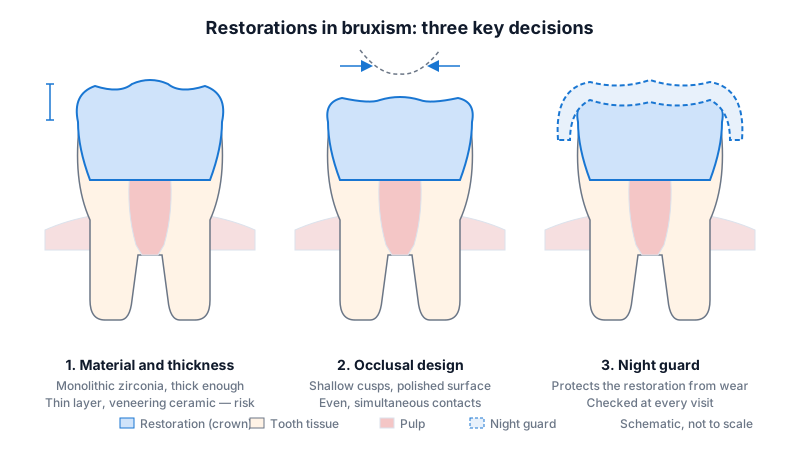 Three decisions for bruxism shown on tooth cross-sections: a sufficiently thick monolithic material, a smooth and shallow biting surface, and a night guard covering the restoration.
Bite design: form is no less important than material
A strong material in the wrong shape breaks quickly. There are several principles when planning the biting surface in bruxism:
- Even, simultaneous contacts. If one tooth touches before the others, the whole load falls on it. Digital occlusal analysis and an articulator (a device that simulates jaw movement) help to establish this balance.
- Shallow cusps, wide grooves. Sharp, high cusps catch during lateral movements and crack. In bruxism the surface is made shallower with smoother transitions.
- Anterior guidance. When the jaw moves sideways and forwards, the back teeth separating and the load transferring to the front teeth protects the back crowns. But if the front teeth themselves are worn, this guidance has to be rebuilt — and here the question of vertical dimension arises; in detail in the what is vertical dimension article.
- Room for thickness. Monolithic zirconia can be relatively thin, but working with minimum thickness in bruxism is a risk. If there is no room, either the tooth is prepared a little more, or the vertical dimension is increased in a controlled way.
Let us state one point clearly: bite design protects the restoration, it does not stop bruxism. A 2017 systematic review (Journal of Prosthetic Dentistry) found no randomised studies on this topic and concludes that prosthetic changes to the bite cannot be accepted as a strategy for resolving TMJ symptoms or stopping bruxism. That is why we do not tell patients that once crowns are placed, the clenching will go away.
Front teeth: are veneers possible in bruxism?
They are possible, but with conditions. A ceramic veneer (a thin shell bonded to the front surface of the tooth) is long-lasting when the bonding area is enamel. In bruxism there are two problems: the incisal edge is under load during clenching, and the enamel of the front teeth is often already worn. Our article on how many years do veneers last covers overall lifespan and risk factors.
In a patient with bruxism the approach for the front teeth is as follows:
- If the wear is minimal and the enamel is preserved — a veneer is possible, but with a design that covers (wraps around) the incisal edge, and with a night guard.
- If the incisal edge has shortened significantly — a partial crown covering more surface, or a full crown (monolithic or partially layered zirconia, sometimes E-max), is considered more reliable.
- In lateral movements the canines carry the load; their restoration must be especially durable.
Night guard: insurance for the restoration
The night guard made after the restorative work is complete (a rigid clear plate covering the teeth) does not remove the clenching force from the restoration, but it reduces the teeth rubbing against each other and distributes the load. In the 2022 study mentioned above, ceramic chipping of monolithic zirconia restorations was more common in the bruxism group — the guard is intended precisely to reduce this type of complication. The guard is made from a rigid material, adapted to the bite of the restorations, and is checked at every review visit; when it wears through it is replaced.
Expectations matter here: if the guard is not worn, the restorative plan is considered incomplete. This is explained to the patient at the first consultation.
What changes if there are implants?
In a patient with bruxism, mechanical complications such as screw loosening and ceramic chipping on the prosthesis over the implant are discussed more often; the implant itself does not cushion the load the way a natural tooth does. This topic is covered separately in the bruxism and implants article. Here let us only note that when natural teeth and implants are in the same mouth, the bite design must take both into account.
Realistic expectations and the review schedule
When we present a prosthodontic treatment plan to a patient with bruxism, we say three things openly:
- Some complications are minor and can be corrected. Small chips on ceramic can often be polished in the mouth; loosening in screw-retained constructions is retightened.
- Reviews are more frequent. In bruxism, reviews every 6 months for the first year and then annually, checking the bite contacts and the guard each time, are appropriate. This is a general clinical approach; the interval varies according to the individual situation.
- Bruxism itself is monitored separately. Stress, sleep quality, daytime clenching habits — these are managed not with a prosthesis, but through behaviour and, when necessary, with the relevant specialists.
Frequently asked questions
I have bruxism — does every crown have to be zirconia? It is not compulsory, but research points to monolithic zirconia as the option with the fewest complications in bruxism. If the aesthetic demand on the front teeth is high, partially layered zirconia or, in selected cases, E-max can also be planned.
Will a zirconia crown wear down my opposing tooth? For well-polished monolithic zirconia, studies have not shown accelerated wear of the opposing enamel. The key condition is that the surface be polished rather than glazed, and that it be polished again after the bite is adjusted.
For how many years do I have to wear the night guard after restorative work? For as long as the bruxism continues. The guard is the means of protecting the restoration; it is usually checked at every review and replaced when it wears.
Will my clenching stop once the crowns are placed? No, it is not right to expect that. Systematic reviews do not show that changing the bite stops bruxism. A restoration protects the teeth; the habit has to be managed separately.
Should I have my worn teeth restored now, or wait? According to the European consensus, if the wear is slow and symptom-free, restorative treatment can be postponed and continued with protection and monitoring. If the wear is rapid, the tooth is sensitive or function is compromised, a staged plan is drawn up.
Conclusion
Bruxism is not an obstacle to restorative treatment, but it makes the plan more demanding: a strong and polished material, sufficient thickness, an even and shallow biting surface, a cautious approach to veneers on the front teeth, and a night guard after the work is complete. All of this protects the teeth and the work itself; bruxism as such is monitored separately. To assess your individual situation, a plan based on 3D imaging and a scan is discussed at a consultation.
Sources
- Bruxism and direct and indirect restorations failure: A scoping review — Journal of Dentistry, 2025
- Survival and Success Rates of Monolithic Zirconia Restorations Supported by Teeth and Implants in Bruxer versus Non-Bruxer Patients: A Retrospective Study — Materials (Basel), 2022
- Wear in Antagonist Teeth Produced by Monolithic Zirconia Crowns: A Systematic Review and Meta-Analysis — Journal of Clinical Medicine, 2020
- Severe Tooth Wear: European Consensus Statement on Management Guidelines — Journal of Adhesive Dentistry, 2017
- Prosthodontic planning in patients with temporomandibular disorders and/or bruxism: A systematic review — Journal of Prosthetic Dentistry, 2017
This article is for general information only and does not replace an individual diagnosis, examination or treatment. Consult a doctor for a decision about your case.