

Bruxism and dental implants: how clenching loads the implant and the restoration on top of it
Bruxism (clenching and grinding the teeth during sleep or in the daytime) is not a contraindication to implant placement, but it is a significant factor that increases risk. Unlike a natural tooth, an implant has no periodontal ligament around it to cushion the load; the force is transferred directly to the screw, the abutment and the bone. Systematic reviews show that implant loss, and particularly mechanical complications — screw loosening, ceramic chipping, screw or implant fracture — occur more often in patients with bruxism. This risk is managed through planning: the number and position of the implants, the material and shape of the restoration, and a night guard.
Key points
- There is no shock-absorbing periodontal ligament around an implant — the force generated during clenching goes straight into the restoration.
- The most common problems are not biological but mechanical: screw loosening, ceramic chipping, abutment and screw fracture.
- Bruxism calls for more implants, shorter bridge spans, a cantilever-free design and a choice of durable materials.
- A night guard is a protective measure for the implant and the restoration, but it does not treat bruxism.
- Bruxism itself, its types and its diagnosis are a separate topic — this article focuses only on its relationship with implants.
Why do a natural tooth and an implant respond differently to load?
The root of a natural tooth is not directly attached to the bone. In between there is the periodontal ligament (a thin fibrous tissue connecting the root to the bone). This ligament does two things: it allows the tooth to move at a microscopic level (cushioning the load) and it sends the brain a signal that you are biting too hard. That is why a healthy tooth sinks slightly during clenching and the force is reduced by reflex.
An implant has no such mechanism. Osseointegration (the direct union of the implant with the bone) locks the implant rigidly in place: there is neither cushioning nor a sensory signal. As a result, the force generated during bruxism — especially lateral force that is not along the long axis — goes directly to three places:
- The occlusal surface of the crown — the ceramic layer may crack or chip.
- The abutment and the screw — the screw loses its initial tightening (preload), works loose and may fracture through long-term fatigue.
- The bone at the implant neck — persistent overloading is regarded as one of the factors that accelerates marginal bone loss; we have explained this topic separately in our article on bone loss around implants.
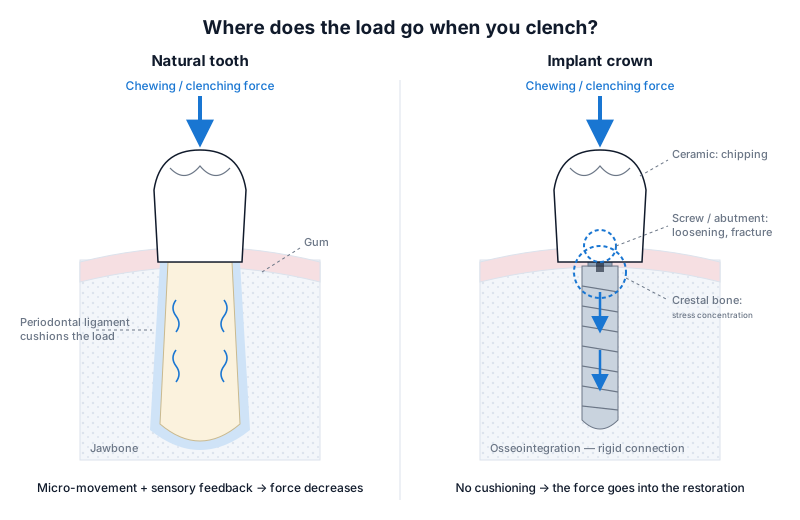 On the left, a natural tooth: the periodontal ligament cushions the load. On the right, an implant: because of the rigid connection, the force is transferred directly to the screw, the abutment and the bone at the neck.
How much does bruxism increase the risk of losing an implant?
The figures here need to be read with care, because in most studies bruxism was identified through questionnaires and examination (probable bruxism) rather than by polysomnography (recording in a sleep laboratory).
- A meta-analysis published in the Journal of Oral Rehabilitation in 2024 (Häggman-Henrikson et al.) combined 27 studies: 2105 implants in patients with probable bruxism and 10264 implants in those without. In the bruxism group the likelihood of implant loss (removal or loss of the implant) was roughly 2.2 times higher (OR 2.19); the length of follow-up did not change this difference.
- Another meta-analysis published in the Dentistry Journal in 2024 (Ionfrida et al.) analysed 15 studies covering 27803 implants in 8692 patients with 3–16 years of follow-up: in people with bruxism the likelihood of implant loss was calculated to be roughly 4.7 times higher (OR 4.68). The authors note that a link between bruxism and implant complications was found in 12 of the 15 studies.
It is normal for the two figures to differ: the selection of studies and the definition of bruxism are different. The shared conclusion, however, is the same — the risk increases, but implant placement is not ruled out. When this combines with other risk factors such as smoking and diabetes, even more careful planning is required.
Which complications are seen most often?
In bruxism it is the restoration on top rather than the implant itself that suffers most. A meta-analysis published in the Journal of Prosthodontics in 2025 (Vidal et al.; 20 studies in the systematic review, 13 in the meta-analysis) calculated the likelihood of each type of mechanical complication in implant-supported restorations in patients with bruxism:
| Complication | Increase in likelihood in people with bruxism (OR) | What the patient feels |
|---|---|---|
| Screw loosening | ~3.4 times | The crown wobbles, food gets caught between the teeth |
| Ceramic crack / chipping | ~4.4 times | Roughness on the surface, a broken edge |
| Prosthetic screw fracture | ~7.1 times | The crown suddenly comes loose, removal becomes difficult |
| Abutment fracture | ~13.9 times | The crown comes out of place |
| Implant fracture | ~16.1 times | Rare, but the most serious — the implant has to be removed |
OR (odds ratio) — the ratio of likelihood; a comparison of how often the complication occurs in groups with and without bruxism. These figures are drawn from studies with various follow-up periods included in the review (implant-supported restorations followed over years); individual risk depends greatly on the design of the restoration.
The figures show that the major complications (screw, abutment and implant fracture) increase the most in relative terms — and these are precisely the result of repeated loading over a long period, that is, of fatigue. Screw loosening is the earliest sign to appear; for that reason, a wobbling crown in a patient with bruxism should never be left to wait and must be checked immediately.
Planning: implant number, position and restoration design
The main principle in bruxism is simple — distribute the force over as many supports as possible and as much as possible along the long axis. A review published in BMC Oral Health in 2025 (Shafiee and Nourizadeh) has systematised these measures; the clinical reasoning is as follows:
Number and size of implants. Even for the same gap, more implants and, where possible, longer and wider-diameter implants are planned in a patient with bruxism. For example, for a three-tooth gap in the posterior jaw, three implants or a wider diameter are considered instead of a bridge on two implants. If the bone volume does not allow this, the bone issue is addressed first. This is measured in advance during 3D CBCT planning.
Position and axis. The implant is placed so that the chewing force falls along the long axis of the implant. Angled placement and a crown that overhangs beyond the implant increase lateral force.
No cantilever, or a minimal one. A cantilever — the unsupported, overhanging part of a restoration — becomes a lever in bruxism and greatly increases the load on the screw.
Joined (splinted) crowns. Making the crowns of neighbouring implants as a single block distributes the load; in reviews this design is associated with less bone loss and fewer mechanical complications. We compare the choice between single and joined restorations in detail in our article on a single implant or multiple implants.
Occlusal surface design. A narrow chewing surface, low and gentle cusps, and taking the implant crown out of contact during lateral movements (anterior guidance) — these are standard approaches used to direct force away from the implant.
Screw-retained construction. Since screw loosening and ceramic chipping are more likely in bruxism, being able to remove and repair the crown without damaging it is valuable; you can find a comparison of screw-retained and cement-retained options in our article on screw-retained or cement-retained implant restorations.
Choice of material: where ceramic, where metal?
The weakest point in bruxism is layered ceramic — the aesthetic layer built up by hand over the framework. In meta-analyses, most of the complication described as ceramic cracking occurs in exactly this layer. That is why the choices change as follows in a patient with bruxism:
- Monolithic (solid) zirconia — since there is no layered ceramic, the risk of chipping is lower; it is widely used in the back teeth.
- Metal occlusal surface — in posterior, non-visible teeth, having a metal chewing surface is noted in reviews as an advantage in bruxism; aesthetically, not everyone wants this.
- Layered ceramic — it is kept where it is needed for aesthetics in the front zone, but the chewing contact is placed on the framework or on the monolithic part.
The hardness of the material also affects the patient's own teeth: monolithic zirconia can wear the opposing natural tooth, so the opposing jaw is assessed as well. Restoring natural teeth in bruxism — the choice of veneers and crowns — is the subject of a separate article: planning tooth restoration in bruxism.
Night guards: they protect the implant, but do not eliminate bruxism
An occlusal night guard (a hard plate worn over the teeth) is the simplest protective measure for an implant-supported restoration. The reasoning is this: during clenching in sleep, the force falls on the plate rather than directly on the ceramic and is distributed over a wider area. In the biomechanical models cited in the BMC Oral Health review, the appliance reduced stress concentration around the implant by roughly 33–73% depending on the strength of the load — this is a laboratory model, not a clinical figure for a reduction in loss.
A few practical notes:
- The appliance has to be remade after the implant-supported restoration is fitted — an old appliance may not fit the new crowns.
- The appliance must be hard; soft boxer-style guards can increase clenching.
- The appliance does not address the cause of bruxism (sleep disorder, stress, medication); this part is explained in our article on bruxism and night guards.
- An appliance does not help with daytime bruxism — here behavioural control is the mainstay.
What to look out for after the implant is placed
In a patient with bruxism the review schedule is tighter than for an ordinary patient. The things checked clinically are:
- Screw tightness — some time after the restoration is fitted and at every check-up; if loosening is caught early it is simply retightened, if caught late the screw may fracture.
- The ceramic surface — small cracks are polished, large chips require repair or replacement.
- X-rays — the bone level at the implant neck is compared year on year.
- The condition of the appliance — a perforated, thinned appliance does not protect.
- Wear on the opposing teeth — the effect of a hard material on the opposing tooth.
The patient, for their part, should pay attention to two things: a feeling that the crown is wobbling, and new pain on chewing. Both are reasons for an unscheduled visit. This review schedule is discussed in advance as part of the dental implantation plan.
Frequently asked questions
I have bruxism — can I still have an implant? Yes, bruxism is not a contraindication. The difference lies in the planning: with more supports, a cantilever-free design, suitable materials and a night guard, the risk is reduced, though it does not fall to zero.
How long after the implant is placed is the night guard made? Usually as soon as the definitive restoration is fitted, because the appliance is made to the shape of the final crowns. A protective option can also be discussed during the temporary restoration stage.
Do zirconia crowns break in bruxism? Monolithic zirconia itself is very strong; the risk of chipping lies more in the layered ceramic built up over it. That is why a layered surface is avoided on the chewing surface.
If a screw has loosened once, will it loosen again? A single episode of loosening can be repaired, but the cause must be investigated: the occlusion of the crown, a cantilever, whether the appliance is being used. If the cause remains, recurrence is likely.
In bruxism, is a single implant crown or a bridge more reliable? A restoration joining neighbouring implants distributes the load and is associated with fewer mechanical complications in reviews; however, the decision depends on the site of the gap and on the bone.
Conclusion
Bruxism does not rule out implants, but because there is no periodontal ligament around the implant to cushion the load, all the force falls on the restoration. Scientific reviews show an increase both in implant loss and — to a greater extent — in mechanical complications. This risk is managed through planning made in advance: the number of implants, placement along the long axis, a cantilever-free and splinted design, durable materials, a screw-retained construction and a hard night guard. A consultation and 3D planning are the first step in assessing your individual situation.
Sources
- Bruxism and dental implants: A systematic review and meta-analysis — Journal of Oral Rehabilitation, 2024
- Dental Implant Failure Risk in Patients with Bruxism — A Systematic Review and Meta-Analysis of the Literature — Dentistry Journal (Basel), 2024
- Relationship between bruxism and different types of mechanical complications in implant-supported prosthesis: A systematic review with meta-analysis — Journal of Prosthodontics, 2025
- Bruxism in implant-supported rehabilitations: a narrative review of clinical complications and management strategies — BMC Oral Health, 2025
This article is for general information only and does not replace an individual diagnosis, examination or treatment. Consult a doctor for a decision about your case.