

One implant per tooth or multiple implants: how to choose a strategy when several teeth are missing
When two, three or four adjacent teeth are missing, there are two routes: one implant in each gap with its own separate crown, or a bridge supported by fewer implants. There is no universally correct answer — the choice is determined by bone volume, the location of the gap (front or back), the condition of the opposing teeth, any clenching habit, how well you can clean the area, and your budget. Systematic reviews link the restoration of adjacent implants with splinted crowns to fewer mechanical complications, and single crowns to easier cleaning and repair. The smart approach is to plan the restoration first, not the number of implants.
Key points
- One implant per tooth is comfortable in aesthetic and hygiene terms, but it requires space and bone and costs more.
- A bridge on two implants (for 3 teeth) is the classic solution: less surgery, load sharing, a lower price.
- Splinting the crowns of adjacent implants reduces mechanical complications in the back teeth; no difference has been found in biological complications.
- A cantilever (a suspended tooth without support) is possible, but a long cantilever leads to more technical problems.
- The decision is built backwards from how the finished restoration should look, not from the implant.
When does this choice come up?
Losing a single tooth is straightforward: one implant, one crown. The question arises when two or more adjacent teeth are missing. Typical situations:
- Three back teeth are missing (for example, two molars and one premolar in the lower jaw) — the most widely discussed situation.
- Two front teeth are missing — here aesthetics and the gum papilla change the decision.
- Four or more teeth are missing, but the jaw is not fully edentulous — here the number and position of the implants matter even more.
This article deals only with partial tooth loss. If the jaw is completely edentulous, the logic is different — we explain that in the article on implant planning in a fully edentulous jaw. A comparison between an implant and a bridge supported by natural teeth can be found in the article implant or bridge.
Three options: single crowns, splinted crowns, a bridge
Using the example of a three-tooth gap, the options are as follows:
- Three implants + three separate crowns. Each tooth is independent; replacing one does not affect the others. Dental floss passes through just as it does between ordinary teeth.
- Three implants + three splinted crowns. The number of implants is the same, but the crowns form a single block — the load is shared across all three supports.
- Two implants + a three-unit bridge. Implants are placed in the two outer positions and the middle tooth is suspended (a pontic). One implant fewer, one surgical site fewer.
Sometimes there is a fourth option: two implants + a cantilever — two implants side by side, with the third tooth suspended at the end. This is used when support dimensions and space are limited, but it creates a lever effect.
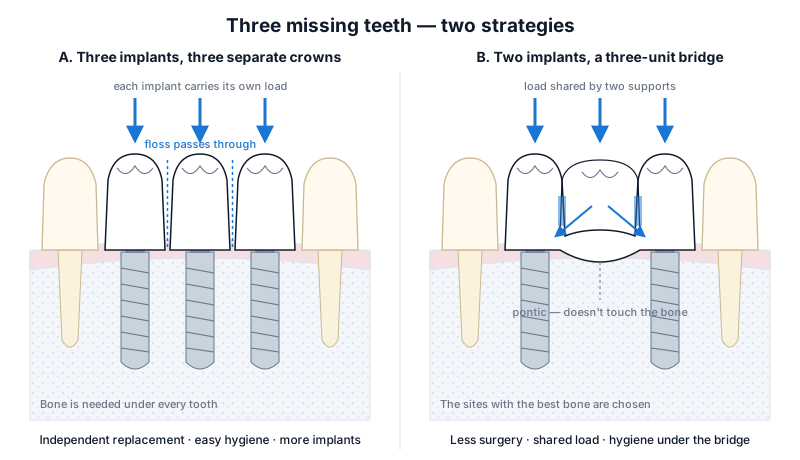 On the left, three independent implant crowns; on the right, a three-unit bridge supported by two implants — the middle tooth does not touch the bone.
What the research says: to splint or to separate?
The most extensively studied part of this question is whether the crowns of adjacent implants should be splinted. Three systematic reviews complement one another:
- The Journal of Prosthetic Dentistry, 2019 (de Souza Batista et al.): 19 studies, 4215 implants in 2185 patients, mean follow-up of approximately 88 months (7.3 years). Implant survival was 99.1% with splinted crowns and 96.5% with separate crowns (the implant remaining in place over the follow-up period). No statistical difference was found in marginal bone loss or prosthetic complications.
- The Journal of the Indian Prosthodontic Society, 2022 (Shah et al.): a review of similar size (3682 implants, mean follow-up 87.8 months) found statistically less bone loss with splinted crowns, but the authors emphasise that the clinical significance of this difference is small; there is no difference in prosthetic complications. The difference was more noticeable in back teeth and with short implants.
- The Journal of Prosthetic Dentistry, 2025 (Pascoal et al.): 17 studies covering only adjacent posterior implants and internal-connection systems, 2085 implants in 1027 patients, follow-up from 5 months to 16 years. There was no difference in biological complications (inflammation, bone loss), but mechanical complications (screw loosening, ceramic issues, loss of retention) were significantly more frequent with separate crowns than with splinted crowns.
In summary: splinting neither helps nor harms biologically; mechanically, it offers an advantage in the back teeth. Separate crowns have their own advantages — hygiene, individual replacement, aesthetics.
How reliable is a cantilever bridge?
Sometimes there is no space or bone for a third implant, and suspending one tooth at the end of two implants is proposed. A systematic review published in the journal Materials in 2025 (Vieira et al.) analysed 11 clinical studies covering 291 cantilevered and 78 non-cantilevered posterior restorations in 360 patients, with a mean follow-up of 56 months (range 2-19 years): implant loss and prosthesis loss were both approximately 1%; however, technical complications (problems with the prosthesis and abutment) were recorded in approximately 14% of cases and loss of retention in approximately 13%. Cantilevers longer than 7 mm had more complications than short ones.
The practical conclusion: a short cantilever is a workable option when it is planned; a long cantilever, or a cantilever in a patient with bruxism, is replaced with an additional implant wherever possible.
Comparison table
| Criterion | One implant per tooth (separate crowns) | Fewer implants + bridge (splinted) |
|---|---|---|
| Number of implants (for 3 teeth) | 3 | 2 (sometimes 3, with splinted crowns) |
| Extent of surgery | More — bone is needed in every site | Less — the sites with the best bone are chosen |
| Bone requirement | Sufficient bone beneath every tooth | The middle gap may have little bone |
| Load sharing | Each implant carries its own load | The load is shared across the supports |
| Mechanical complications (posterior) | More in the reviews | Fewer in the reviews |
| Biological complications | No difference found | No difference found |
| Hygiene | Ordinary dental floss passes through | Special floss / a water flosser is needed under the bridge |
| Repair | A single crown is replaced on its own | The whole block has to be removed |
| Aesthetics (front zone) | Easier to shape the papilla | Gum design beneath the pontic is required |
| Price | Higher (depending on the number of implants) | Lower |
| Who it suits | Sufficient bone, good hygiene, front zone | Limited bone, bruxism, short implants, budget |
What determines the decision?
Space (mesio-distal distance). A minimum amount of bone must remain around each implant and between the implants so that the blood supply and the gum papilla are preserved. A three-tooth gap is sometimes simply too narrow for three implants — in that case two implants and a bridge give a healthier result. These dimensions are checked in advance on the CBCT and in the digital plan; we explain the rules in the article on the 3D position of the implant.
Bone volume and quality. In the back of the upper jaw the sinus limits the bone, and in the lower jaw the nerve canal does. If the bone is good at the edges and weak in the middle, a bridge makes sense.
The location of the gap. In the front zone aesthetics favours separate crowns, because it is difficult to maintain the gum papilla between two implants; for that reason a design with two implants + a pontic is sometimes deliberately chosen in the front zone. At the back, functional load and mechanical reliability come to the fore.
Opposing teeth and clenching habits. If there are natural teeth or implants opposite, or if there is a clenching habit, a splinted design that shares the load gains the advantage.
Hygiene and readiness for follow-up. For a patient who is not prepared to clean beneath a bridge, separate crowns make long-term care easier.
Budget and staged treatment. The number of implants is the main part of the price. Sometimes it is a realistic strategy to start with a bridge on two implants and, years later, plan an additional implant if it becomes necessary. Whether the construction is screw-retained or cement-retained also affects how easily it can be repaired — screw-retained or cement-retained implant restorations.
Why is planning backwards from the restoration important?
The ITI consensus report of 2018 (Morton et al.) emphasises that the prosthetic plan comes before the surgical plan: the material of the restoration, whether it is one piece or segmented, the condition of the opposing teeth, the space available for the restoration, the anatomy of the dental arch, the planned implant distribution and cantilever length, and the space for hygiene — all of these determine the number and position of the implants. In other words, the question is not how many implants, but which restoration, carrying which load, on which supports.
In practice it looks like this: first the digital design of the teeth (or a wax-up) is prepared, then the CBCT is used to see at which points beneath those teeth there is bone for an implant, and only after that is the number of implants chosen. At our clinic, the dental implantation plan is built in exactly this sequence.
Frequently asked questions
Is restoring three teeth with two implants not too few? A three-unit bridge on two implants in the back of the jaw is a design that has been used for many years; in the reviews, implant survival with splinted constructions is high. The condition is that the implants are of a suitable length and in the correct position.
Is it right to place two implants for the two front teeth? It is possible, but it is difficult to maintain the gum papilla between two implants. In some cases one implant + a suspended tooth is more predictable aesthetically; the decision is made according to the gum biotype and the bone.
Can splinted crowns be separated later? The construction is a single block; separating it means new crowns have to be made. That is why the design is decided in advance.
How do I clean under the bridge? With a special dental floss that passes under the bridge (superfloss), interdental brushes or a water flosser. This should be demonstrated in practice when the restoration is fitted.
How many implants are needed if four teeth are missing? Usually 2-3; it depends on the space, the bone and the opposing teeth. Adding a middle support in a long-span bridge reduces the load.
Conclusion
When several teeth are missing, one implant per tooth is not automatically better, and fewer implants is not automatically the cheaper, riskier option. Separate crowns are superior in terms of hygiene, repair and aesthetics in the front zone; splinted crowns and bridges share the load in the back teeth and are linked in the reviews to fewer mechanical complications. A short cantilever works when it is planned; a long cantilever increases technical problems. The decision is made backwards from the design of the finished restoration, taking into account space, bone, the opposing teeth and the patient's habits. A consultation and 3D planning are the first step in assessing your individual situation.
Sources
- Should the restoration of adjacent implants be splinted or nonsplinted? A systematic review and meta-analysis — The Journal of Prosthetic Dentistry, 2019
- Impact of splinting implant-supported crowns on the performance of adjacent posterior implants: A systematic review and meta-analysis — The Journal of Prosthetic Dentistry, 2025
- A comparison of marginal bone loss, survival rate, and prosthetic complications in implant-supported splinted and nonsplinted restorations: A systematic review and metaanalysis — The Journal of the Indian Prosthodontic Society, 2022
- Implant-Supported Cantilever Fixed Partial Dentures in the Posterior Region: A Systematic Review and Meta-Analysis on Survival Outcomes — Materials (Basel), 2025
- Group 2 ITI Consensus Report: Prosthodontics and implant dentistry — Clinical Oral Implants Research, 2018
This article is for general information only and does not replace an individual diagnosis, examination or treatment. Consult a doctor for a decision about your case.