

Implant or bridge? Which option suits which situation
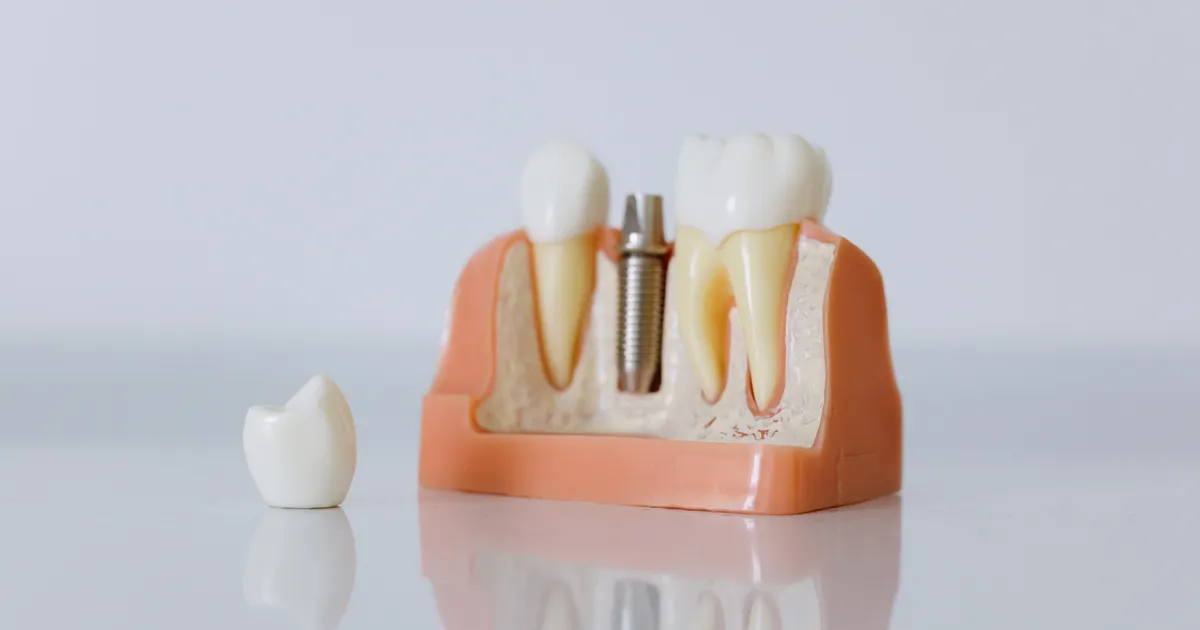
An implant replaces the root of the lost tooth in the jawbone and does not touch the neighbouring teeth. A bridge, on the other hand, is fitted over the teeth on either side of the gap after they have been prepared. If the adjacent teeth are healthy and there is enough bone, an implant is usually the option discussed. If those teeth need crowns anyway, if there is too little bone or if there is a contraindication to surgery, a bridge is a reasonable choice. The final decision is made after an examination and 3D imaging.
Key points
- The difference is not in the artificial tooth but in the support: with an implant the support is an artificial root in the bone, with a bridge it is the neighbouring natural teeth.
- Preparing the adjacent teeth for a bridge is an irreversible step. Those teeth then carry an additional risk of decay and nerve problems.
- An implant requires a surgical stage and time for integration with the bone; a bridge is usually completed sooner.
- The lifespan of both solutions depends on daily hygiene, the bite and regular check-ups.
- It is not correct to say that one is always better. The choice is made according to the particular gap, the neighbouring teeth and general health.
What is the main difference between the two methods?
A dental implant is a titanium screw placed in the jawbone that replaces the root of the tooth. Once integration with the bone (osseointegration) is complete, an individual crown is made on top of it. The structure and stages of an implant are explained in detail in the article what is a dental implant.
A conventional bridge involves no surgery. The teeth on either side of the gap are prepared to serve as abutments, crowns are placed over them and a suspended tooth (pontic) fills the gap in between. The whole construction is cemented as a single piece. In other words, a bridge rests not on bone but on the neighbouring teeth.
This difference in structure gives rise to all the other differences: who carries the load, which tissue pays the price, and what problems can be expected in the future.
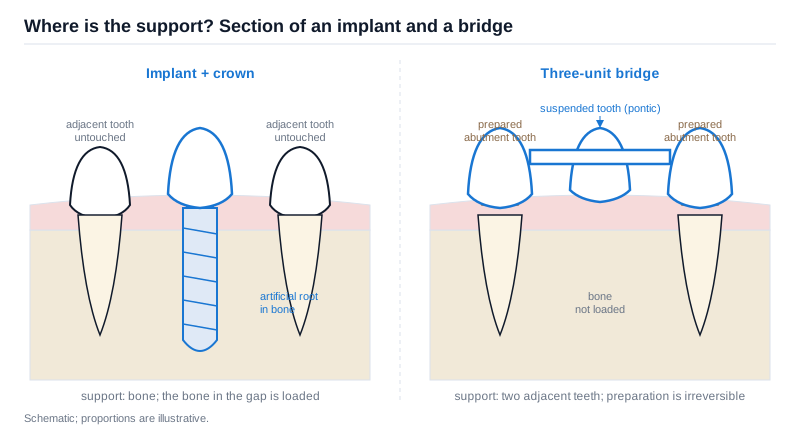 On the left, the implant creates its own support in the bone and the neighbouring teeth remain untouched. On the right, the bridge sits on two prepared teeth and the bone in the gap is not loaded. Proportions are schematic.
Comparison table
| Criterion | Implant + crown | Conventional bridge |
|---|---|---|
| Support | Artificial root in the bone | Natural teeth on either side |
| Effect on neighbouring teeth | Not prepared, remain untouched | The enamel layer is prepared and covered with a crown |
| Surgical stage | Yes (under local anaesthesia) | No |
| Bone requirement | Sufficient volume and quality needed | Possible even when bone is limited |
| Treatment time | Longer (integration with the bone is awaited) | Usually shorter |
| Bone in the gap | Receives the chewing load | Not loaded directly |
| Typical future problems | Screw loosening, chipping of the veneering material, inflammation around the implant | Decay in the abutment teeth, death of the nerve, loosening of the cement |
| Cleaning | Each tooth separately; interdental brush/irrigator | Under the bridge with special floss or a brush |
| Reversibility | The neighbouring teeth remain untouched | The prepared tissue cannot be restored |
The table is general guidance. The option suitable for your case is determined by examination and imaging.
What does the scientific literature say?
Both methods have been studied for decades and both give predictable results. The difference lies more in what pays the price and which complications can be expected.
A systematic review of conventional bridges (Pjetursson et al., 2004) found that at 10 years of follow-up about 89% of bridges were still in place — this is bridge survival, meaning the bridge remained in the mouth without being removed; it does not mean it was free of complications. In the same review, the most common biological problems were decay in the abutment teeth and death of the nerve in an abutment tooth, while the most common technical problem was loosening of the cement. Put simply: the lifespan of a bridge depends on the lifespan of the teeth that carry it.
A review of single crowns on implants (Jung et al., 2008) found that at 5 years of follow-up about 97% of implants were still in place (implant survival). However, within those same 5 years complications such as loosening of the screw or abutment, loss of cement, and inflammation of the gum and around the implant were also recorded. A review of bridges on several implants (2012) gives a similar picture: at 5 years of follow-up implant survival is high, but a considerable proportion of patients experienced one or another biological or technical complication during that period.
These figures are averages across different patient groups and should not be read as a personal prognosis. The practical conclusion is simple: neither implant nor bridge is a fit-and-forget solution — both require care and monitoring.
In which cases is an implant more suitable?
- The neighbouring teeth are healthy and untouched. Preparing two healthy teeth because of one gap is a biologically costly decision.
- The abutment teeth are weak — for example, gum support has decreased and they cannot carry the extra load.
- The last tooth at the back has been lost, and there is no abutment tooth behind the gap. A classic bridge cannot be built.
- There is enough bone or it can be augmented. See the article if there is not enough bone for an implant on this.
- You are ready for the surgical stage and the waiting period, and your hygiene habits are consistent.
In which cases is a bridge a sensible choice?
- The neighbouring teeth need crowns anyway — large fillings, teeth weakened after root canal treatment, replacement of old crowns. In this case preparation is not an additional loss.
- There is a medical contraindication to surgery or you firmly decline a surgical procedure.
- Bone is seriously limited and bone grafting is not wanted or not appropriate.
- Time is critical — if it is important that the restoration is completed quickly.
- Growth is not yet complete (young age). An implant waits until bone growth is finished; a bridge can be discussed as a temporary solution.
A removable denture is also a separate option, especially when many teeth have been lost. That comparison is in the article removable denture or implant.
How is the decision made, step by step?
Clinical assessment usually follows this sequence:
- Examination: the size of the gap, the condition and mobility of the neighbouring teeth, gum health, the bite and any clenching habit.
- Imaging: a panoramic X-ray (OPG) for the overall picture, and 3D CBCT (cone-beam computed tomography) for the width/height of the bone and the position of structures such as the sinus and the nerve canal.
- General health and habits: uncontrolled diabetes, smoking and certain medicines can affect healing and the long-term outcome.
- Comparison of the options: the stages, duration, degree of irreversibility and care requirements of each option are explained.
- Decision and plan: a digital plan and a schedule of stages are prepared for the chosen option.
What options exist in general to replace an extracted tooth is set out in the article what should replace an extracted tooth.
Intermediate options: adhesive and cantilever bridges
A conventional bridge is not the only type of bridge. In an adhesive (Maryland) bridge the artificial tooth is bonded to the back surface of the neighbouring teeth with metal or ceramic wings; the teeth are barely prepared. A systematic review of these bridges (2008) found that at 5 years of follow-up about 88% of adhesive bridges were still in place (bridge survival), while the most common problem was the bond coming away (debonding). An adhesive bridge is often considered in younger patients or as an interim solution when an implant is postponed.
In a cantilever bridge the artificial tooth is supported from one side only. Because the load on the abutment tooth increases, its indications are narrow and it is not suitable for every gap.
What does not change after the decision?
Whichever option you choose, three things remain the same: daily cleaning, professional monitoring and keeping an eye on the bite. With a bridge, the area under the pontic and the margins of the abutment teeth need particular attention; with an implant, it is the zone where the crown meets the gum. If you clench your teeth at night, a protective appliance is discussed in both cases.
There is also the time factor. In the months after a tooth is extracted, bone volume changes. This can narrow the possibility of an implant in the future — so postponing the decision for a long time is itself a choice.
Frequently asked questions
I have had a bridge fitted; can I switch to an implant later? In principle yes: the bridge is removed, the bone is assessed and, if suitable, an implant is planned. However, prepared abutment teeth do not return to their previous state, and in an area that has been under a bridge for years the bone may have changed. That is why it is important to make the first decision with long-term reasoning.
How does the choice change if two or three teeth in a row have been lost? As the gap gets longer, the load on the abutment teeth increases and the indications for long bridges narrow. In such cases several implants or a short bridge on implants are considered. The decision depends on the gum support of the abutment teeth and on the bone.
Which option gives a better aesthetic result on a front tooth? In the front region the result is determined not by the name of the method but by the gum level, the bone contour and the way the material is worked. With an implant the shape of the gum depends on the bone and soft tissue; with a bridge it depends on the design of the pontic. In both cases aesthetic planning is needed beforehand.
Do smoking or diabetes affect the choice? Yes, they can. Smoking and uncontrolled diabetes affect healing and the long-term health of the tissues. This does not automatically rule out an implant, but the preparation, timing and monitoring schedule are individualised.
How should the area under a bridge be cleaned? Ordinary dental floss will not pass under a bridge. For this you need special floss with a stiff end (super-floss), an interdental brush or an irrigator. This step is one of the most important conditions for the lifespan of a bridge.
Conclusion
Implants and bridges are not rivals; they are two solutions with different indications. If the neighbouring teeth are healthy and the bone allows it, an implant has the advantage of protecting those teeth. If the neighbouring teeth need restoration anyway, or if surgery is not appropriate, a bridge is a perfectly reasonable choice. In both cases the long-term outcome is determined by care and monitoring.
A consultation based on an examination and 3D imaging can be arranged to assess your individual situation.
Sources
- A systematic review of the survival and complication rates of fixed partial dentures (FPDs) after an observation period of at least 5 years - III: conventional FPDs — Clinical Oral Implants Research, 2004 (DARE, Centre for Reviews and Dissemination)
- A systematic review of the 5-year survival and complication rates of implant-supported single crowns — Clinical Oral Implants Research, 2008 (DARE, Centre for Reviews and Dissemination)
- A systematic review of the survival and complication rates of implant-supported fixed dental prostheses (FDPs) after a mean observation period of at least 5 years — Clinical Oral Implants Research, 2012 (DARE, Centre for Reviews and Dissemination)
- A systematic review of the survival and complication rates of resin-bonded bridges after an observation period of at least 5 years — Clinical Oral Implants Research, 2008 (DARE, Centre for Reviews and Dissemination)
This article is for general information only and does not replace an individual diagnosis, examination or treatment. Consult a doctor for a decision about your case.