

What is a dental implant and how is implant treatment carried out?
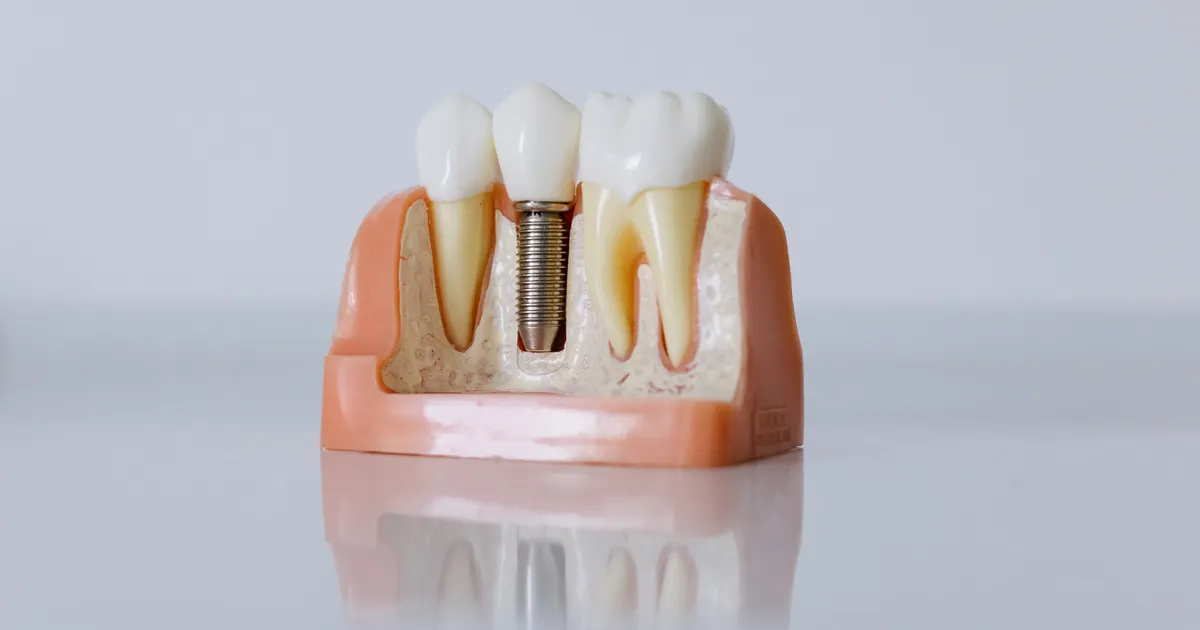
A dental implant is a small titanium screw placed into the jawbone to replace the root of a lost tooth. Over time the bone bonds with the surface of the implant; this is called osseointegration. After that, an abutment and an artificial tooth — a crown, bridge or prosthesis — are attached to the implant. Treatment usually goes through the stages of examination and 3D planning, surgical placement, healing and the prosthodontic phase. The order and duration of the stages differ from patient to patient.
Key points
- An implant replaces the root of the tooth; the part you see in the mouth is the crown attached on top of it.
- The basis of its strength is osseointegration: the bone comes into direct contact with the implant surface.
- One tooth, several teeth or a full jaw — an implant can act as a support in all three situations.
- Suitability is determined not by age but by general health, the condition of the gums and the volume of bone.
- The placement and loading protocol (immediate, delayed, staged) is chosen individually for each case.
What parts does an implant consist of?
When patients say ‘implant’, they often mean the whole construction. In fact there are three parts joined to one another:
- The implant body (fixture). The screw-shaped part that sits inside the bone. It is made of titanium or a titanium alloy — materials that have been used in dentistry for decades because of their compatibility with body tissues.
- The abutment (support part). The intermediate element that connects the implant body to the artificial tooth. It passes through the gum and shapes the emergence profile of the crown.
- The crown, bridge or prosthesis. The part that is visible in the mouth and does the chewing. For a single tooth it can be an individual crown, for several teeth a bridge on implants, and for a full jaw either a fixed or a removable prosthesis.
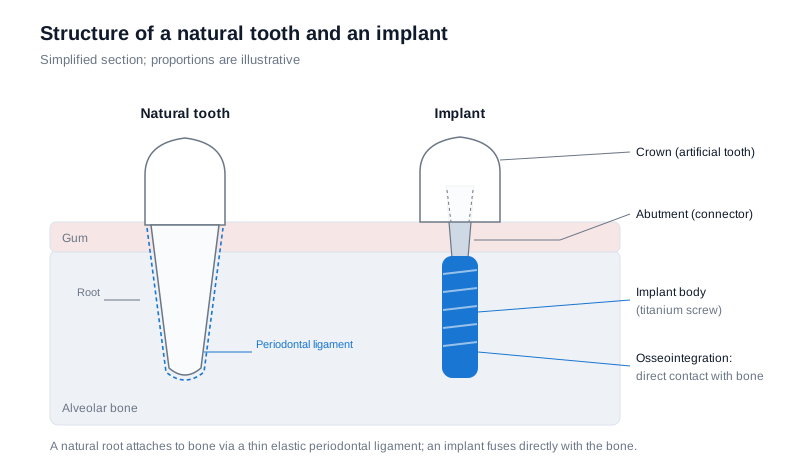
The root of a natural tooth is attached to the bone by a thin periodontal ligament; an implant, on the other hand, is in direct contact with the bone.
During the healing period an additional component is sometimes used — the healing cap (gingival former). This is a temporary part that helps the gum form correctly around the implant. In some cases the implant is left completely under the gum and is uncovered later with a small second procedure. Which option is chosen depends on the clinical situation.
What is osseointegration and why does it matter so much?
Once an implant has been screwed into the bone, it does not immediately become a ‘ready tooth’. In response to the micro-injury created during placement, the bone begins a healing process and gradually comes into direct contact with the implant surface. According to the American Dental Association’s explanation for patients, this is exactly what makes an implant stable — the bone grows around it and holds the implant in place. This process takes time; in many patients it is necessary to wait several months before the artificial tooth can be attached.
Two practical conclusions follow from this. First, there is no need to rush healing: early loading is only possible when certain conditions are met. Second, factors that can interfere with osseointegration — uncontrolled systemic diseases, smoking, poor bone quality, active infection — must be assessed before treatment.
Who may be suitable for an implant?
The general criteria are as follows:
- one or more teeth have been lost, or a tooth is in a condition where it cannot be kept for long;
- the volume and quality of the jawbone allow the implant to be accepted (or will allow it after preparatory procedures);
- the gums are healthy and any infection is under control;
- general health allows a minor surgical procedure;
- the patient is ready for daily hygiene and regular check-ups.
Age in itself is not an obstacle. An implant is placed once jaw development is complete — that is, in adulthood — and there is no upper age limit; the ADA also stresses that general health matters more than age. Even so, some situations call for extra attention: chronic conditions such as diabetes can affect healing, while tobacco use slows healing down. In the patient information from Guy’s and St Thomas’ NHS Foundation Trust, stopping smoking before an implant is specifically recommended, because this reduces the risk of complications. Each of these factors is taken into account when the plan is drawn up.
Having little bone does not automatically mean ‘no’ either. In such cases bone grafting, short or narrow implants and angled placement are discussed — we have looked at these options in detail in our article on what is done when there is not enough bone.
What stages does implant treatment go through?
1. Examination, 3D diagnostics and planning
First a clinical examination is carried out, the medical history is taken and imaging is performed. In our clinic, planning is built on 3D cone-beam computed tomography (CBCT) and digital impressions: the width and height of the bone and the position of the sinus cavity and the nerve canal are assessed, and the position of the implant is determined in advance. Once the plan is ready, the steps, the approximate duration and the price are agreed together with you.
2. Preparation (not needed for everyone)
Sometimes bone grafting, gum treatment or the extraction of a tooth that cannot be saved is required before the implant or at the same time as it. According to the patient information from the NHS clinic, a bone graft can extend the overall treatment time by several months.
3. Placement of the implant
The procedure is usually carried out under local anaesthesia: the gum is lifted, a socket is prepared in the bone with special drills, the implant is placed and sutures are put in. The sutures are most often removed after a week. This is a minor surgical procedure and takes a few tens of minutes. We have explained what you feel during and after the operation in our article on whether an implant is painful.
4. Healing and osseointegration
During this period the bone bonds with the implant. The waiting time depends on the quality of the bone, the initial stability of the implant and any additional procedures; the NHS information notes that at least several months are awaited before the artificial tooth is attached. In some selected cases a temporary tooth can be fitted earlier.
5. The prosthodontic phase
When healing is complete, the abutment is fitted, an impression is taken — we usually do this digitally with an intraoral scanner — and the permanent crown, bridge or prosthesis is made in the laboratory. After the try-in, shade selection and adjustment of the bite (occlusion), the work is fixed in place.
6. Follow-up and care
The work does not end once the implant is placed. Regular check-ups, professional cleaning and daily hygiene play a decisive role in the long-term fate of the implant. The follow-up interval is set individually for each patient.
How long does treatment take?
The exact duration depends on your situation. Guy’s and St Thomas’ NHS Foundation Trust explains to its patients that treatment is carried out in several stages and that the total time from the first examination to the fitting of the permanent tooth is approximately 6–12 months; if a bone graft is needed, this period can be longer still.
In some cases it is possible to place an implant on the day the tooth is extracted. The review by Group 5 of the 7th ITI Consensus Conference stresses that this protocol gives good clinical results in low-risk cases, but is not routinely recommended in high-risk ones. In other words, the option exists, but it is not suitable for every situation; you can find the details in our article on implant placement on the day of extraction.
An implant is not the only option
The space left by a lost tooth can also be restored with a bridge or a removable prosthesis. Each option has its own advantages and limitations; we have given a comparison in the article on implant versus bridge. The decision is made according to the position of the tooth, the condition of the neighbouring teeth, the volume of bone and your expectations. In our clinic, the plan for dental implantation is also shaped precisely after this discussion.
Frequently asked questions
How does an implant differ from a natural tooth? A natural tooth is attached to the bone through the periodontal ligament and has a certain amount of movement; an implant, by contrast, integrates directly with the bone. For that very reason, protecting the tissues around the implant and adjusting the bite correctly are of particular importance.
Do implants cause problems in metal detectors or during an MRI scan? Dental implants are small and usually do not cause problems in airport scanners. Before an MRI scan, however, the right approach is to inform the radiologist about all the constructions in your mouth.
Is one implant needed for every tooth when several teeth are missing? No. Most often a bridge is made on several implants. The number of implants depends on the condition of the bone, the length of the gap and the type of prosthesis planned.
Is it possible to remove an implant? Yes. If the need arises — for example, if integration does not take place — the implant is removed, and after healing, repeat placement is in most cases discussed. The decision is based on clinical examination and X-rays.
Is the artificial tooth fitted straight after the implant? In some selected cases a temporary tooth can be fitted early, but this is not a universal rule; whether the conditions are suitable is determined during planning.
What is done if there is an allergy to titanium? Titanium is considered a material compatible with body tissues, and reactions are rare. If there is any doubt, appropriate testing and alternative materials (for example, zirconia-based implants) can be discussed.
Conclusion
A dental implant is a system made up of three parts: the titanium screw in the bone, the abutment on top of it and the artificial tooth. The result is determined mainly by the right choice, precise planning, following the healing instructions and long-term care. Only an examination and 3D imaging can show whether an implant is possible in your case and which stages will be needed. A consultation is the right starting point for assessing your individual situation.
Sources
- Dental implants - Overview — Guy's and St Thomas' NHS Foundation Trust
- Dental implants - Having a dental implant — Guy's and St Thomas' NHS Foundation Trust
- Implants — MouthHealthy, American Dental Association
- Implant Placement and Loading Protocols at the 7th ITI Consensus Conference: A Narrative Review of the Findings of Group 5 — Forum Implantologicum, International Team for Implantology (ITI), 2024
This article is for general information only and does not replace an individual diagnosis, examination or treatment. Consult a doctor for a decision about your case.