

Can an implant be placed on the day a tooth is extracted? Immediate implant placement
Yes, in some cases an implant can be placed at the very same appointment as the extraction — this is called immediate implant placement. However, it is not suitable for every tooth. The decision depends on three things: whether the walls of the extraction socket are intact, whether the inflammation can be cleared, and whether the implant can sit firmly in the bone. Very often a precise answer to these questions is only possible once the tooth has been removed and the socket has been inspected. If the conditions are not right, an implant placed after healing is the more predictable route.
Key points
- A ‘same-day implant’ refers to when the implant is placed; fixing a tooth on top of it on the same day (loading) is an entirely separate decision.
- An implant can be placed at the same appointment as the extraction (immediate), after the gum has healed (early), or into fully healed bone (delayed).
- The main conditions are: atraumatic removal of the tooth, the ability to clean the socket, and the presence of healthy bone for the implant to engage.
- In the front teeth, immediate placement carries a risk of the gum margin receding — which is why planning and 3D imaging are especially important.
- The plan can change on the operating table. This is not a failure; it simply means the safer option has been chosen.
What is immediate implant placement?
When an implant is placed is defined according to the stage of healing after the extraction. The ITI consensus classification describes four options:
- Type 1 (immediate) — the implant is placed directly into the socket at the same appointment as the extraction.
- Type 2 (early, after soft tissue healing) — the gum has covered the site, but there is still no noticeable bone fill in the socket.
- Type 3 (early, after partial bone fill) — bone fill in the socket has begun clinically or radiographically.
- Type 4 (delayed) — the site has healed completely and the implant is placed into mature bone.
The logic of immediate placement is simple: the socket is already there. The implant is seated between the walls of that socket, in a three-dimensional position planned in advance, and the gap remaining between the implant and the bony wall is usually filled. This makes it possible to avoid a second surgical appointment.
If you are not sure how an implant works in general or what parts it consists of, it is useful to read the article on what a dental implant is first.
A ‘same-day implant’ and a ‘same-day tooth’ are not the same thing
This is exactly the point that confuses patients most. There are two separate decisions: when the implant is placed into the bone, and when a tooth is fixed on top of it. The implant can be placed on the day of the extraction and left to heal with nothing on it. Under certain conditions, however, a temporary crown can be fitted on the same day.
A Cochrane review comparing different loading times found no convincing difference in terms of implant and prosthesis loss, but it rated the quality of the evidence as very low and advised caution in interpreting the results. That same review also emphasises that, for immediate or early loading, the implant is required to be seated with an insertion torque of at least 35 N·cm. In plain terms: if the implant does not feel ‘solid’ under the finger, no tooth is placed on it that day.
Under what conditions is a same-day implant possible?
Several factors are assessed together here:
- The walls of the socket, and particularly the front (buccal) bone plate, are intact. The 2023 ITI consensus lists, as conditions for immediate implant placement and immediate restoration of a single tooth in the anterior upper jaw, a radiographically intact or minimally damaged front bone wall, bone that will provide primary stability in the ideal position, and healthy neighbouring teeth.
- Primary stability is achieved. The implant must engage healthy bone either beyond the base of the socket or along its side walls.
- The inflammation can be cleared completely. According to the consensus, an old (chronic) periapical infection is not in itself an obstacle — provided there is no fistula, the site can be cleaned thoroughly, and enough bone remains for stability. In acute, suppurative inflammation, however, we usually wait.
- The tooth can be removed atraumatically. We work with as little trauma as possible, often without raising the gum; the socket is then cleaned and the integrity of the walls is checked.
- General health and habits. Uncontrolled systemic conditions, active gum disease and a strong clenching habit can change the plan.
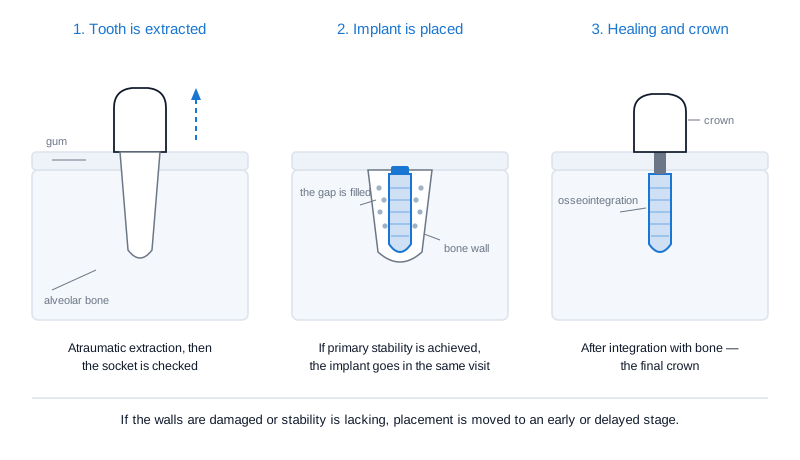 Cross-section of the extraction socket: if the walls have remained intact, the implant is seated at the same appointment and the gap between it and the wall is filled.
When is it better to wait?
Immediate placement is not suitable for every situation. If the front bone wall has been lost extensively, if there is an acute infection at the site, if the shape of the socket does not allow the implant to be held in the correct position, or if the implant simply does not sit firmly, waiting is the wiser choice.
Among the advantages of early placement (Type 2), the ITI consensus lists an increase in soft tissue volume and the opportunity to allow the problem associated with the tooth to heal before the implant is placed. In Type 3, because partial bone has formed in the socket, primary stability is easier to achieve.
If bone volume already appears insufficient at the first examination, the conversation goes in a completely different direction — we have written about this in detail in what to do if there is not enough bone for an implant and in the articles on bone grafting.
Same-day placement compared with delayed placement
| Criterion | Day of extraction (Type 1) | After healing (Types 2–4) |
|---|---|---|
| Number of surgical appointments | Extraction and implant combined | Usually two separate appointments |
| Overall treatment time | Shorter | Longer |
| Positioning of the implant | The shape of the socket can make it harder | More controlled in healed bone |
| Primary stability | Not always easy to achieve | Usually easier |
| Soft tissue coverage | Limited | More volume available |
| Risk of the gum margin receding | Relatively high (especially in the front region) | Relatively low |
This comparison is based on the advantages and disadvantages listed in the ITI consensus: on one side, the merging of appointments and the shortening of treatment time; on the other, the anatomy of the site making the ideal position and stability more difficult, the limited soft tissue, and the risk of the margin receding.
How does the procedure go?
- Planning. Clinical examination, three-dimensional imaging and a digital plan. For these sites, the ITI consensus strongly recommends a good-quality periapical X-ray and cone-beam computed tomography (CBCT); and when a CBCT is taken, simulating the ideal implant position in the software is also a strong recommendation. This stage is the foundation of the dental implantation plan.
- Atraumatic extraction. Special instruments may be used to protect the bony walls. ‘Dry socket’, which can occur in the first days after an extraction, and the aftercare rules are explained in the article on dry socket.
- Inspection of the socket. The walls, any remaining inflammation and the available bone are assessed. It is precisely here that the plan is either confirmed or changed.
- Placing the implant and filling the gap. The consensus states that, at the level of the implant shoulder, the gap between the implant and the front bone wall should ideally be more than 2 mm, and that this dimension should be assessed together with the loading conditions, the diameter of the implant and the dimensions of the socket.
- Healing and the prosthetic stage. Once osseointegration (the union of the implant with the bone) is complete, the permanent crown is made.
The ITI classifies the immediate implant and immediate restoration protocol as a complex procedure: an experienced team is required on both the surgical and the prosthetic side.
Can the plan change during the operation?
Yes, and this is entirely normal. The consensus states openly that it is not possible to complete the protocol at every site selected in advance — the reason is most often something that happens during the extraction, or a failure to achieve primary stability. In such cases, the implant may be placed and left to heal without loading; if the implant cannot be placed at all, we switch to early placement, or the socket is grafted and the implant placed later.
This is exactly why two scenarios — ‘same day’ and ‘wait’ — are discussed in advance at the consultation. That way, if the decision changes during the day, it does not come as a surprise to you.
What about wisdom teeth and the back teeth?
Because the back (molar) teeth have several roots, the socket is also divided into several parts. Firm seating of the implant is usually possible thanks to the bony septum between the roots. For these sites, the literature emphasises atraumatic extraction, preservation of the septal bone, a minimal-flap or flapless approach, grafting of the gap between the implant and the socket, and covering the site with soft tissue or a membrane.
Wisdom teeth, however, are not usually replaced with an implant — their removal has its own indications, and we have written about this separately in the article on wisdom tooth extraction.
Frequently asked questions
How long do you have to wait for an implant after a tooth is extracted? There is no single answer for everyone. If the conditions are favourable, the implant can be placed at that very appointment. There are also the options of waiting for the gum to heal or for partial bone to form in the socket. The choice is made according to the condition of the socket and the planned prosthesis.
If an implant is placed on the same day, is a tooth also fitted that day? Not always. A temporary crown is only considered when the implant is seated firmly enough and the contact in the bite can be kept under control. Otherwise the implant heals without taking any load.
If there is a cyst or inflammation at the tip of the tooth, is a same-day implant possible? Old, chronic inflammation is not necessarily an obstacle in itself. The conditions are: no fistula, the site can be cleaned completely, and enough bone remains for the implant to engage. In acute infection, however, we usually wait.
Is a same-day implant in a front tooth risky aesthetically? In the front region, the possibility of the gum margin receding is taken into account. A thin tissue type and a thin or damaged front bone wall increase this risk. In such cases, either additional tissue procedures or a different protocol is discussed.
Does a same-day implant mean less healing time? The overall duration can be shorter, because one surgical stage is removed. However, the biological time needed for osseointegration remains as it is — it cannot be rushed.
Conclusion
A same-day implant after an extraction is a real approach and one that has been widely studied in the scientific literature; it simply is not suitable for everyone. Suitability depends on the anatomy of the socket, the state of the inflammation, the stability of the implant and the aesthetic risk; and part of the decision only becomes clear at the moment the tooth is removed. To assess your individual situation, a consultation based on an examination and three-dimensional imaging is advisable.
Sources
- Implants in Postextraction Sites — Consensus Statements — ITI (International Team for Implantology) Consensus Conference, 2008
- Selection Criteria for Immediate Implant Placement and Immediate Loading for Single Tooth Replacement in the Maxillary Esthetic Zone — ITI Consensus Conference, Lisbon 2023
- Immediate implant placement in fresh extraction sockets — Journal of the Korean Association of Oral and Maxillofacial Surgeons, 2021
- Interventions for replacing missing teeth: different times for loading dental implants — Cochrane Database of Systematic Reviews, 2013
This article is for general information only and does not replace an individual diagnosis, examination or treatment. Consult a doctor for a decision about your case.