

What determines the price of a dental implant?

The price of a dental implant is not a single figure but the sum of several parts: the implant itself that is placed in the bone, the connecting part on top of it (the abutment), the visible tooth (crown or prosthesis), diagnostics and planning, and, if needed, additional procedures (tooth extraction, bone grafting, sinus lift). Each of these parts varies depending on the implant system, the condition of the bone and the material of the prosthesis. That is why the honest answer to the question «how much does one implant cost?» is the plan written after an examination and 3D imaging; our clinic's current prices are on the Prices page.
This article is not here to give you a figure — it is here to explain the structure of the price, so that when you compare offers you know what you are comparing with what. The treatment itself, its stages and how we plan it at our clinic are described on the dental implantation service page, and what an implant actually is is explained in a separate article.
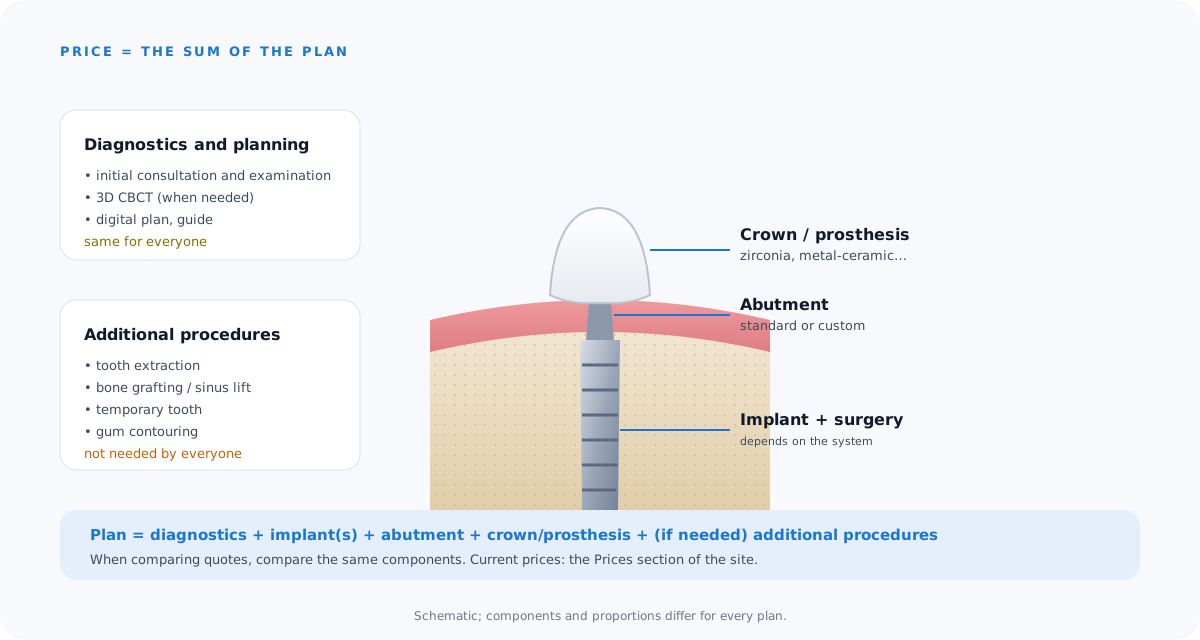 The price is the sum of the whole plan, not of a single implant: each component is calculated separately. The diagram is schematic.
What is included in the price of an implant?
Most patients use the word «implant» to mean the whole process; in the clinic, however, it consists of several separate stages and components:
- Diagnostics and planning — the initial appointment, clinical examination, and, where necessary, 3D CBCT (cone-beam computed tomography) and a digital plan. The guidelines of the European Association for Osseointegration (EAO) recommend cross-sectional imaging of the implant site in justified cases — this is not an «extra cost», it is the foundation of the plan.
- The implant itself (fixture) — the titanium support placed in the bone. At our clinic this stage is priced separately according to the implant system and covers the surgical placement.
- The abutment — the connecting part between the implant and the crown; it can be standard or custom-made (CAD/CAM).
- The crown or prosthesis — the visible tooth: zirconia, metal-ceramic, or, in a full-arch prosthesis, an acrylic-titanium or zirconia framework. This is often a cost no smaller than the implant itself.
- Additional procedures — tooth extraction, bone grafting, sinus lift, gum correction, a temporary tooth. Not everyone needs these; when they are needed, they are written into the plan separately.
When assessing an offer, the first question is this: which parts are included in this figure? «Implant — X AZN» often covers only point 2.
Does the implant system affect the price?
Yes — and this is the most visible difference. At our clinic we work with three systems: NeoBiotech (Korea), Megagen AnyRidge (Korea) and Straumann BLT (Switzerland); the price difference can be several-fold. Behind that difference lie surface technology, design, the range of prosthetic components, long-term clinical documentation and the manufacturer's pricing policy. But the equation «expensive = always a better result» is not true: a 2019 systematic review found the 10-year survival rate of modern implants to be above 96% overall, and the outcome is influenced less by the system than by planning, surgical technique, hygiene and patient factors (smoking, general health conditions). The choice of system is made according to the clinical situation — bone quality, the position of the tooth, the likelihood of immediate loading — and the budget. More on the differences: Straumann, Megagen, NeoBiotech.
Why does the price of bone grafting vary?
After a tooth is lost, the bone resorbs; if there is not enough height and width for an implant, bone grafting (augmentation) or, in the upper jaw, a sinus lift may be needed. The price of these procedures is not fixed, because the volume differs: a small local graft and a large sinus lift differ in materials, in time and in the number of stages; sometimes the implant is placed in the same session, sometimes you have to wait months for the graft to mature and a second surgery is needed. That is why the answer to «how much does bone grafting cost?» is given after 3D measurements. On what is needed in which cases: what the options are when there is not enough bone.
Why can the price of a single implant and of full-arch treatment not be compared?
Restoring a single tooth means one implant + one abutment + one crown. In a fully edentulous jaw, however, the plan involves 4–6 implants, extraction of the remaining teeth, bone correction, a temporary prosthesis, the final full-arch prosthesis (a wide range depending on material and design) and sometimes a surgical guide. Here the price is not «implant × number» — the prosthesis itself is a large separate component, and the temporary and final stages are two different pieces of work. On full-arch options: All-on-4 implant treatment.
How does the prosthetic material affect the price?
For the tooth on top of the implant, the main options are zirconia (aesthetic, wear-resistant, monolithic or layered), metal-ceramic (long-established, more affordable), and, for a full arch, a titanium framework with acrylic or composite teeth, or a zirconia framework. Besides the material, custom fabrication of the abutment, additional stages for gum aesthetics in the front teeth and a temporary crown also affect the plan. The material is chosen according to the bite load, the position of the tooth, the opposing jaw and the aesthetic requirement — not the most expensive one, but the one that suits the situation. In detail: implant-supported prosthesis: zirconia, metal-ceramic.
Why is it not right to decide based on a figure you see online?
Because two different «single implants» are two different plans. Behind the same figure, these things can differ: the implant system; whether the abutment and the crown are included; whether 3D diagnostics and the plan are included; the need for bone grafting; whether a temporary tooth is included; follow-up visits and warranty terms. Health economics reviews recommend assessing an implant over the long term: although the initial cost is higher compared with a bridge or a removable denture, not having to prepare the neighbouring teeth, the preservation of bone and the long service life change the overall picture. An unrealistically low figure may come at the expense of diagnostics, materials or follow-up — when comparing, compare plans with the same content.
How is the price calculated at Smile?
- Initial appointment and examination — your concerns, expectations, medical history, an examination of the mouth; any existing X-rays are assessed.
- 3D CBCT — when needed — the height and width of the bone, the nerve and the sinus; a repeat scan only when justified.
- A written plan — which system, how many implants, whether additional procedures are needed, the type of prosthesis, the stages and an approximate timeline; each component is listed separately.
- The price — the components of the plan are calculated using the clinic's current price list; the list is openly available in the Prices section of the site and comes from the same source as the table on the service page.
- Discussion — alternative options (for example, a different system or staged treatment) and payment terms are discussed at the consultation.
The reason an exact price is not quoted over the phone is not secrecy — it is that the plan does not exist yet.
What is useful to bring to the examination?
- Any existing X-ray or CBCT files (DICOM);
- Information about your general health and the medicines you take;
- Your questions: which system, which stages, what is included, and what the warranty and follow-up terms are.
Frequently asked questions
Why is an exact price not given over the phone? Because the price depends on the condition of the bone, the number of implants and the stages required; these become clear only through an examination and, where needed, 3D imaging.
Is an implant more expensive than a bridge? The initial cost is often higher, but an implant does not require preparing the neighbouring teeth and works out differently over the long term. The choice is made according to the medical situation.
How much does bone grafting add to the price? It depends on the volume — from a small local graft to a large sinus lift. Some patients do not need it at all; a precise answer is given after 3D measurements.
Is a cheap implant dangerous? The price alone is not an indicator of danger. The question is «what is included?»: without diagnostics, planning, quality components and follow-up, a low figure can affect the long-term outcome.
Where can I see the clinic's current prices? In the Prices section of the site; the table on the service page is also shown from the same source.
Sources
- Long-term (10-year) dental implant survival: A systematic review and sensitivity meta-analysis — Journal of Dentistry, 2019
- Evaluating the health economic implications and cost-effectiveness of dental implants: a literature review — International Journal of Oral & Maxillofacial Implants, 2013
- E.A.O. guidelines for the use of diagnostic imaging in implant dentistry 2011. A consensus workshop organized by the European Association for Osseointegration — Clinical Oral Implants Research, 2012
This article is for general information only and does not replace an individual diagnosis, examination or treatment. Consult a doctor for a decision about your case.