

Straumann, MegaGen and NeoBiotech implant systems: what are the differences?
Straumann BLT, MegaGen AnyRidge and NeoBiotech — all three are titanium implants and all three have been used worldwide for years. The difference is not in the name but in the technical details: the body and threads of the implant, the surface treatment, the connection between the implant and the abutment (the support), the range of prosthetic components, the volume of research behind it and the price (500, 800 and 1700 AZN at our clinic). There is no single system that is the most correct for every case. The choice is determined by the condition of your bone, the position of the tooth, the prosthetic plan and the dentist's experience with that particular system.
Key points
- We compare systems not by advertising slogans but by things that can be measured: design, surface, connection, availability of components.
- A Cochrane review found no strong evidence that any one implant type is clearly superior to others. Planning, surgical work and aftercare influence the outcome at least as much as the system does.
- The conical (Morse) connection stands out in research in terms of preserving the bone around the implant neck, but on its own it is not a reason to choose a system.
- The price difference is mainly related to the manufacturer's research volume, the material, the production technology and the worldwide availability of components. Being expensive does not guarantee the outcome.
- The system is chosen after a 3D CBCT (cone-beam computed tomography — a three-dimensional X-ray of the jaw) has been reviewed, according to the specific site.
What do we mean by an implant system?
An implant system is not just the titanium screw placed into the bone. A system includes three things: the part in the bone (the fixture), the abutment that sits on top of it (the support that connects the prosthesis to the implant) and the prosthetic components. Plus the surgical instrument kit needed to place them. We have written about the structure of an implant and how it joins with bone in our article what is a dental implant.
The practical meaning for you is this: when you choose a system, you are choosing not only the screw but also the future prosthesis, the ability to source components and any possible repairs years later.
What do we look at when comparing systems?
Surface
The surface of the implant affects how bone cells attach to it. Most of today's systems use a micro-rough surface — for example, a sandblasted and acid-etched SLA-type surface. Manufacturers modify this in different ways: some make the surface hydrophilic (moisture-attracting), others add calcium. According to the Cochrane review, the evidence on how differences in surface, shape and material affect long-term outcomes is limited; there are few studies comparing systems directly head to head.
Implant–abutment connection
How does the abutment seat onto the implant? There are several options: internal hex, conical (Morse), platform switching (the abutment being slightly narrower than the implant). The type of connection can affect both mechanical durability and whether bone is preserved at the implant neck. In meta-analyses, conical connections appear somewhat better in terms of bone loss around the implant. However, the difference is not decisive and is assessed together with other factors.
Body and thread design
A tapered (narrowing towards the tip) body and large threads are designed to seat the implant firmly from day one in soft bone. This matters, for example, in cases where the implant is placed on the same day the tooth is extracted. A cylindrical body, on the other hand, allows more controlled placement in dense bone.
Availability of components and support
A simple question: in 8–10 years, will it be possible to find the abutment, the screw or a prosthetic component for this implant? For systems that have been on the market for a long time and have a wide distribution network, the answer to this question is clearer.
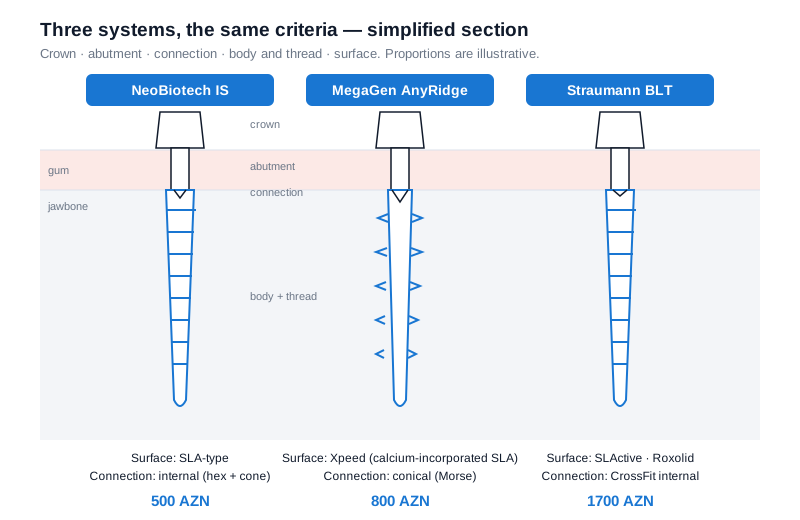 Simplified diagram: three systems compared by the same criteria — body, thread, surface, connection. Proportions are indicative.
Straumann BLT
Straumann is a Swiss company. It has collaborated with universities for many years and invests heavily in long-term follow-up studies. BLT stands for Bone Level Tapered: a tapered implant placed at bone level.
According to the manufacturer's technical documentation, this implant can be made from Roxolid material (a titanium-zirconium alloy), comes with the SLActive surface and uses the CrossFit internal connection. What does that give you? The possibility of placing a small-diameter implant in narrow bone and a wide range of prosthetic components.
At our clinic, Straumann BLT costs 1700 AZN. We plan it mostly for the visible front region, in complex bone conditions and in cases where extensive documentation is particularly important.
MegaGen AnyRidge
MegaGen is a South Korean company. The AnyRidge model is known for its large knife-thread design. According to the manufacturer, the wide spacing between the threads creates conditions for bone to fill in there. Its surface is the calcium-modified, SLA-based Xpeed surface, and its connection is of the conical (Morse) type.
In practice, this design can be a reason to choose it when firm stability is needed from day one in soft bone. At our clinic, MegaGen AnyRidge costs 800 AZN.
NeoBiotech
NeoBiotech is also made in South Korea and is known for its widely used IS series. According to the manufacturer, the IS-II Active has a tapered body, an SLA surface and an internal connection (hex plus a conical element). Its surgical instruments are easy to source and the prosthetic stage is relatively straightforward.
At our clinic, NeoBiotech costs 500 AZN. In treatment plans requiring many implants, it makes it possible to keep the overall budget realistic.
Comparison table
| Criterion | NeoBiotech (IS series) | MegaGen AnyRidge | Straumann BLT |
|---|---|---|---|
| Origin | South Korea | South Korea | Switzerland |
| Body design | Tapered, bone level | Tapered, large knife-thread | Tapered, bone level |
| Surface | SLA-type micro-rough surface | Calcium-modified, SLA-based Xpeed | SLActive |
| Material | Titanium | Titanium | Titanium and Roxolid (titanium-zirconium) |
| Connection | Internal (hex + conical element) | Conical (Morse) | CrossFit internal connection |
| Research base | Manufacturer and regional studies | Manufacturer and independent design research | Extensive, long-term university studies |
| Price at our clinic | 500 AZN | 800 AZN | 1700 AZN |
| Typically used for | Standard cases, multiple implants | Soft bone, when primary stability matters | Front region, complex bone conditions |
The technical information in the table is taken from the manufacturers' publicly available documentation; it may vary depending on the specific model and diameter.
Where does the price difference come from?
From the sum of several things: the funds the manufacturer invests in research and long-term follow-up, the material and surface technology, quality control in production, the worldwide availability of components and the distribution network. In other words, a high price may indicate that there is more documentation behind it — but it does not provide an individual guarantee for your implant.
The outcome is also affected by bone quality, general health and habits (smoking, for example), the precision of the surgical work, the design of the prosthesis and subsequent hygiene. We have covered these in our article how many years does an implant last.
What does the scientific evidence say?
The most important point: the differences between systems have often not been proven by direct comparative clinical studies. According to the Cochrane review, the available evidence does not conclusively show that any one implant type works better than another; most studies are short-term and the methods of comparison differ.
That is why the practical approach is simple: choose a well-documented system whose components can be sourced and that the dentist is comfortable working with, then focus your attention on the planning rather than the brand name. We have written about the selection criteria separately in our article how is an implant system chosen.
The role of planning in the choice
The decision is made by the plan, not by the name of the system. The sequence is as follows:
- Clinical examination: bite, gums, neighbouring teeth, your expectations.
- 3D CBCT: the width, height and density of the bone; the position of the sinus and the nerve canal. Why this stage is important is explained in our article CBCT before an implant.
- Prosthetic plan: the position of the future crown determines the position and diameter of the implant.
- Only after this are the system and the size chosen.
The same patient may have different systems in different sites — this is normal, and each site is justified separately. When a dental implantation plan is being prepared, we explain this choice to you openly.
Frequently asked questions
Does a cheap implant mean a bad implant? No. The price reflects the volume of documentation and the technology; on its own it does not determine the outcome. A budget system that is correctly chosen and correctly placed can be more reliable than an expensive system that has been planned incorrectly.
Can implants from two different systems be placed in the same jaw? Yes. What matters is that each implant is restored with the components of its own system and that this is documented — so that the necessary part can easily be found years later.
Can a prosthesis be made here on an implant placed abroad? In most cases yes, but the system and model of the implant must be known precisely. For this, the previous records, the implant passport and an X-ray are needed. Choosing components without knowing the system is risky.
Does the brand of the implant interfere with an MRI scan? Titanium implants are generally not a problem for an MRI; the image may just be slightly distorted in the area of the implant. It is enough to tell the doctor before the examination that you have an implant.
Which system has the longer warranty? Manufacturers announce their own terms for the implant itself, but the terms vary by country and distributor. In practice, what matters more is the clinic's follow-up schedule and the availability of components — ask about this in writing at your consultation.
Conclusion
Straumann BLT, MegaGen AnyRidge and NeoBiotech are systems of different origin, with different designs and different prices, each documented in clinical use. The differences are real, but they are rarely decisive. The outcome is determined less by the name of the system than by accurate diagnostics, a prosthetically driven plan, surgical precision and subsequent care. To determine which system suits your bone conditions, a consultation is needed.
Sources
- Technical Information: Straumann Dental Implant System — Basic Information on the Surgical Procedures — Institut Straumann AG, texniki sənəd
- Correlation between Insertion Torque and Implant Stability Quotient in Tapered Implants with Knife-Edge Thread Design — BioMed Research International, 2018 (MegaGen AnyRidge implantları üzrə klinik tədqiqat)
- IS-II Active implant — məhsul məlumatı — Neobiotech Co., Ltd., istehsalçı məhsul səhifəsi
- The influence of implant-abutment connection to peri-implant bone loss: A systematic review and meta-analysis — Clinical Implant Dentistry and Related Research, 2018
- The role of implant surface modifications, shape and material on the success of osseointegrated dental implants. A Cochrane systematic review — PubMed, Cochrane əsaslı sistematik icmal, 2005
This article is for general information only and does not replace an individual diagnosis, examination or treatment. Consult a doctor for a decision about your case.