

How long does a dental implant last, and what determines its lifespan?

It would not be right to give a single number for the lifespan of an implant. In long-term follow-up studies, the vast majority of implants are still in the mouth after 10 years — in other words, this is a restoration designed to last for many years. But that is not an individual guarantee. The outcome is determined by the condition of your bone, the position of the implant, your bite, daily cleaning and regular check-ups. There is also one important distinction: the titanium part in the bone and the crown on top of it do not have the same lifespan.
Key points
- In 10-year follow-up data, implant survival (that is, remaining in the mouth) is high, but this figure is a group average, not a personal guarantee.
- The implant in the bone usually serves longer than the crown on top of it; the crown is replaced when necessary.
- The main reason an implant is lost is not the titanium wearing out — it is inflammation accompanied by bone loss (peri-implantitis) and problems with mechanical loading.
- Patients on a regular professional maintenance programme experience fewer diseases around the implant.
- Only a dentist can assess your prognosis, and only after an examination and imaging.
Why we do not give an exact number in answer to how long it lasts
An implant is a titanium (sometimes titanium-zirconium) screw that replaces the tooth root and bonds directly with the bone. This bond is called osseointegration. We have explained separately which parts an implant consists of: what is a dental implant.
Titanium does not decay and is resistant to wear. In other words, an implant does not have a predetermined service life like a car part. An implant serves for as long as the bone and gum around it stay healthy and the prosthesis on top of it distributes the load correctly. That is why the honest answer is not X years, but rather many years, provided these conditions are maintained.
What the research shows
Systematic reviews rate the long-term outcome of implants highly. In a meta-analysis combining 10-year follow-up data, approximately 96% of implants remained in place — the measure here is implant survival, that is, whether or not it remained in the mouth over that period. In the same review, a more cautious calculation that takes missing data into account brings the figure down slightly, and the figure is also relatively lower in older age groups.
How should this figure be read? It is the average outcome across thousands of implants. The fate of your implant, however, is decided not by the average but by your own circumstances — your bone, your general health and your care. And let us not confuse one point: survival means the implant remaining in the mouth. An implant can stay in place while inflammation begins around it, or a technical problem develops on the prosthetic side.
The lifespan of the implant and the lifespan of the crown are not the same
These two things are often confused during consultations. The system consists of two parts:
- The implant (fixture) — the part inside the bone. It stays in place as long as the bone remains healthy.
- The abutment and crown (prosthesis) — the part visible in the mouth that carries the chewing load. It wears down, it can fracture, its screw can loosen and its cement can weaken.
In a large review examining fixed prostheses on implants, implant survival was higher than that of the prostheses. In the same review, at least one biological or technical complication was recorded in approximately one third of patients over 5 years of follow-up — the measure here is how frequently complications occur, not implant loss. The most common technical problems are: chipping of the veneering ceramic, screw loosening and loss of retention in cemented prostheses.
The practical conclusion is simple: renewing the crown or tightening the screw years later does not mean the implant failed. This is the normal service cycle of the repairable part of the system.
What affects the lifespan of an implant
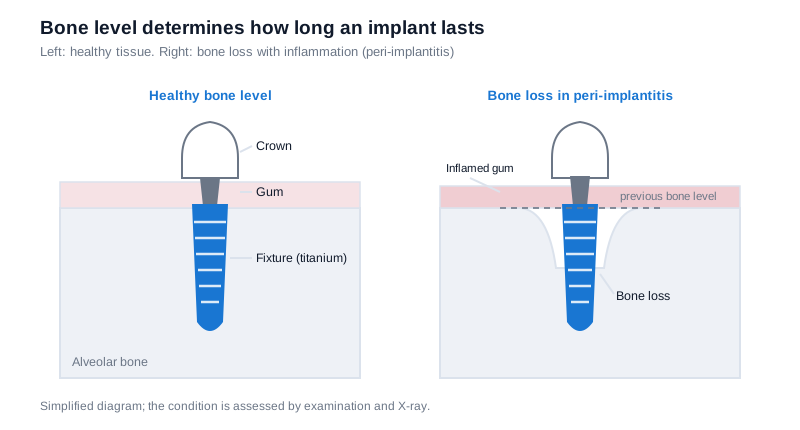 The lifespan of an implant is determined first and foremost by the level of the bone holding it.
Factors related to you
General health, smoking, poorly controlled diabetes and a history of severe gum disease (periodontitis) are studied as factors affecting the stability of the tissues around the implant. This does not mean that such patients cannot have implants. It simply means the plan is drawn up more carefully and monitoring is more frequent.
Planning and the surgical stage
The volume and quality of the bone, the size of the implant, its three-dimensional position and its primary stability lay the foundation for the long-term outcome. An implant placed at the wrong angle or without tissue support is difficult to clean — and that increases the risk of inflammation in the future. This is why planning at our clinic is carried out on 3D CBCT (cone-beam computed tomography) images; if there is not enough bone, restoring the volume is discussed first.
Prosthesis and bite
An implant has one important difference from a natural tooth: it has no periodontal ligament, meaning the cushion that softens the load is gone. For this reason, precise adjustment of the bite and, if there is night-time clenching or grinding (bruxism), the question of a protective appliance are part of the long-term plan.
Hygiene and monitoring
When bacterial plaque builds up around an implant, reversible inflammation of the mucosa (peri-implant mucositis) can develop first, and later peri-implantitis, which involves bone loss. According to the consensus report of the 2017 World Workshop, peri-implantitis is characterised by plaque-associated, inflammatory bone loss that progresses over time. We have explained step by step how this process begins in the article what is peri-implantitis.
Check-ups — the simplest way to extend the lifespan
Data from systematic reviews and meta-analyses show that patients on a regular supportive maintenance programme experience fewer diseases around the implant. In other words, this part is entirely in your hands.
A check-up appointment usually goes like this:
- the condition of the gums and bleeding on probing are checked;
- plaque and tartar are cleaned with instruments suited to the implant surface;
- the bite and prosthetic screws are checked;
- if the dentist considers it necessary, a follow-up X-ray is taken to compare the bone level.
The interval is not the same for everyone: a history of gum disease, smoking and hygiene habits determine this period. We have gathered together matters such as daily cleaning technique, interdental brushes and water flossers in the article long-term care after an implant.
And what if the implant is lost?
An implant can be lost early (when osseointegration does not take place) or years later (mainly as a result of bone loss). Conditions such as persistent swelling of the gum, pus or movement of the implant call for an examination without delay — we have written about these signs separately in the article signs of implant failure.
In many cases it is possible to place a new implant where one has been lost, but this requires waiting for the bone to heal and, very often, restoring the bone volume. That is exactly why planning the first implant correctly and then keeping it under regular review saves both time and money. In the dental implantation process, every step of the plan follows this long-term logic.
Frequently asked questions
Is the phrase that an implant lasts a lifetime true? This phrase is used a great deal in advertising language, but it is not used in scientific language. The correct approach is this: an implant is a long-term solution and serves for as long as it is surrounded by healthy tissue; no medical restoration comes with an absolute guarantee.
How often does the crown need to be replaced? Not according to the calendar, but according to its condition. If the crown is intact, its margins fit tightly and it matches the bite, it is left alone. It is renewed when chipping of the ceramic, a marginal discrepancy or a screw problem appears.
Can I feel bone loss around an implant myself? Most often, no. The early stage is painless and is only visible on examination, probing and X-ray. That is why you should attend check-ups even if you have no complaints.
Does age affect the lifespan of an implant? Age in itself is not an obstacle. The main role is played by general health, the medicines you take, the condition of the bone and how well you are able to maintain hygiene. Although some studies show slightly lower figures in older groups, the decision is always made individually.
Does the condition of my natural teeth affect the lifespan of an implant? Yes. Active gum disease changes the bacterial environment in the mouth and can also affect the tissues around the implant. That is exactly why an implant plan is often completed after the natural teeth have been treated.
Conclusion
The lifespan of an implant cannot be expressed as a single number. Long-term follow-up studies show that most implants reach the ten-year mark in function, but what maintains this outcome is not the material — it is correct planning, a suitable prosthesis, daily hygiene and regular check-ups. Renewing the crown years later is part of a normal technical cycle.
To have your individual situation assessed, having a plan prepared on the basis of a consultation and imaging is the best possible start.
Sources
- Long-term (10-year) dental implant survival: A systematic review and sensitivity meta-analysis — Journal of Dentistry, 2019 (PubMed)
- A systematic review of the survival and complication rates of implant-supported fixed dental prostheses (FDPs) after a mean observation period of at least 5 years — Clinical Oral Implants Research, 2012 (DARE, NCBI Bookshelf)
- Peri-implant diseases and conditions: Consensus report of workgroup 4 of the 2017 World Workshop — Journal of Clinical Periodontology, 2018 (EFP)
- Impact of Maintenance Therapy for the Prevention of Peri-implant Diseases: A Systematic Review and Meta-analysis — Journal of Dental Research, 2016
This article is for general information only and does not replace an individual diagnosis, examination or treatment. Consult a doctor for a decision about your case.