

What are the signs of dental implant failure?
The main signs that an implant has failed are: mobility of the implant, pain that does not go away or grows stronger even after the initial healing period is over, persistent bleeding at the gum margin, swelling, pus, a bad taste in the mouth, and the metal part becoming visible as the gum recedes. Early loss usually happens in the first few months — the bone does not fuse with the implant. Late loss, on the other hand, begins years later, against a background of inflammation or a loading problem. If a sign persists, do not wait and tell yourself it might pass; an examination and an X-ray are needed.
Key points
- Movement of the implant when you touch it with a finger or chew is the most serious sign. Always have this checked.
- Most of the signs are non-specific: the same complaint sometimes comes simply from a loose screw or a problem with the crown.
- Early loss (before the prosthesis is fitted) and late loss (after the prosthesis is fitted) have different causes and follow different courses.
- Bone loss can progress painlessly. That is why a follow-up check-up and an X-ray are needed even if you have no complaints.
- Inflammation caught early can very often be managed without losing the implant.
What does failure actually mean?
A dental implant is a titanium post placed in the jawbone. Bone cells attach to its surface and fuse with it (this is called osseointegration), and the implant works like the root of an artificial tooth. Failure means that this bond either never forms at all, or is lost later on.
One point to note: in the scientific literature there is no single, universally accepted definition of implant failure. Mobility of the implant, loss of the bond with the bone and fracture of the implant are clear-cut cases; the remaining boundaries are still under discussion. In practice, two scenarios are distinguished — early and late loss. A large observational study covering more than 15,000 implants shows that during the osseointegration stage (that is, the period between implant placement and fitting of the prosthesis) the vast majority of implants fuse with the bone. But this is not a guarantee for any individual patient — the outcome depends on individual circumstances.
Early failure
Early loss occurs before the prosthesis is fitted, usually within the first weeks to months. The problem is that the bone does not fuse with the implant. The cause can vary: overheating of the bone during surgery, poor initial stability of the implant, post-operative infection, smoking, or general health conditions that slow healing.
Late failure
Late loss comes to light months or even years after the implant has been in function. The most common cause is bacterial inflammation of the tissues around the implant — peri-implantitis — and the resulting resorption of the supporting bone. There are other causes too: uneven distribution of the load on the prosthesis, problems with screws and components, and uncontrolled general health conditions.
| Criterion | Early failure | Late failure |
|---|---|---|
| Timing | Before the prosthesis is fitted, first months | Months to years after the prosthesis is in function |
| Main mechanism | The bond with the bone does not form | An established bond is lost |
| Typical causes | Poor initial stability, surgical trauma, early infection, factors that impair healing | Peri-implantitis, hygiene problems, load/prosthetic factors, uncontrolled risk factors |
| Characteristic signs | Persistent pain, mobility, ongoing swelling or discharge at the surgical site | Bleeding gums, pus, gum recession, bone loss on the X-ray, then mobility |
| Usual management | The implant is removed, the site heals, a new plan is discussed | Treatment of the inflammation, correction of hygiene and loading; removal in severe cases |
Which signs should you watch for?
Movement of the implant or of the tooth on top of it. An implant fused with the bone should not move. Any sensation of movement calls for an examination. But do not rush to worry: sometimes it is not the implant that is moving, but a loose screw or a crown whose cement has come away.
Pain that does not settle or gets worse. Discomfort in the first days after surgery is normal and should ease day by day. If the pain increases instead of easing, or comes back after settling down — that is a warning sign. We have explained what is normal in the first week in our article is implant placement painful.
Bleeding and swelling of the gums. If the gum around the implant bleeds at a light touch, this is a key sign of inflammation. Healthy tissue does not swell, redden or bleed.
Pus, a bad taste or odour. Pus coming from the gum margin means an active infection. This is not something to wait on.
Gum recession, visible metal. For example, if the grey edge of the implant is starting to show on a front tooth, this is not only an aesthetic problem — the surrounding tissue and bone level may have changed.
A change in how chewing feels. A feeling that the tooth is high when you close your teeth, pain when you clench, or food newly getting trapped — something has changed in the prosthesis or on the implant side.
Long-lasting numbness in the lower lip. Numbness in the lower jaw that lasts more than a few days after surgery needs to be checked separately.
An important nuance: bone loss can progress for a long time without causing any pain. That is why, even if you have no complaints, scheduled check-ups and X-rays where needed are the main way to monitor the condition of the implant.
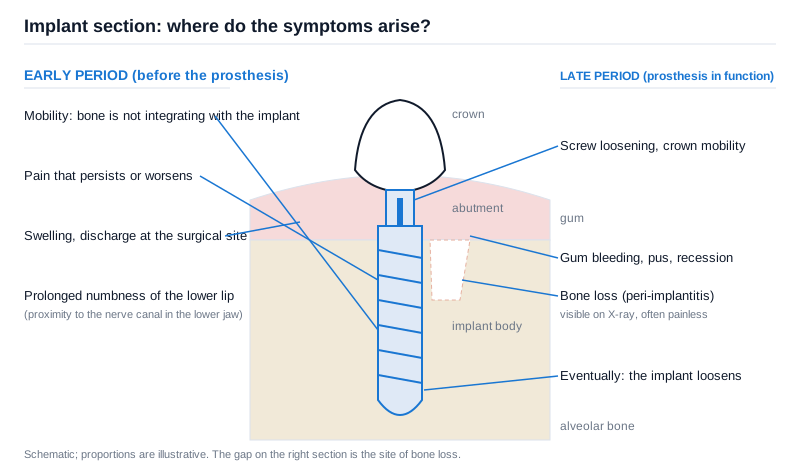 Simplified cross-section: which sign arises at which part of the implant — the early period on the left, the late period on the right. Proportions are schematic.
What does the dentist check?
The examination usually goes like this: first it is checked whether the implant moves. Then the condition of the gum is assessed — the depth of the pocket is gently measured with a special instrument (a probe), and the presence of bleeding and pus is recorded. The prosthesis and screws, and the way the teeth meet, are checked. If there are signs of inflammation, an X-ray is taken to see the bone level and, where possible, compared with earlier images.
According to international recommendations, the first measurements and a baseline X-ray should be kept after the prosthesis is fitted. In later years, changes can be compared precisely against this baseline.
Distinguishing where the complaint comes from is very important. Gum inflammation, a loose screw, a fractured crown and loss of the bond with the bone all require different interventions. In dental implantation planned with 3D imaging, this distinction is made through a combined assessment of the examination and the images.
When should you seek help urgently?
In these situations, do not leave the appointment until next week:
- the implant or prosthesis moves visibly;
- pus is coming from the gum, there is spreading swelling in the face, a temperature, or swallowing or opening the mouth has become difficult;
- the pain is getting worse and painkillers do not help;
- bleeding after surgery does not stop;
- numbness in the lower lip is dragging on.
Milder but persistent signs — bleeding when brushing, occasional swelling, a bad odour — are not emergencies. But they too call for a scheduled examination within a few days.
Causes in brief
Behind early problems there are usually factors linked to surgery and healing, while behind late problems lie inflammation and loading. The most common causes are: build-up of bacterial plaque around the implant and the body responding to it with inflammation, a history of periodontitis (gum disease), smoking, uncontrolled diabetes, a prosthesis shape that is hard to clean, teeth clenching (bruxism) and not attending follow-up check-ups.
How the stages of inflammation — peri-implant mucositis and peri-implantitis — differ, how they are detected and treated: we have covered this in our article what is peri-implantitis. The influence of general health and habits is the subject of the article smoking, diabetes and implant outcomes.
There is a sign — can the implant be saved?
That depends on the type of problem and how early it is caught. If there is only gum inflammation and the bone level has been preserved, professional cleaning, correcting the hygiene technique and, where needed, adjusting the shape of the prosthesis can reverse the situation. If bone loss has begun, non-surgical and surgical treatment options are discussed. The outcome depends on the extent of the loss, the position of the implant and how well the risk factors are controlled.
If the implant is fully mobile, the bond with the bone has already been lost and the implant is usually removed. This is not the end of the road. Once the site has healed — with bone grafting if necessary — it is very often possible to draw up a new plan. The most important task here is to find the cause of the first failure: hygiene, smoking, the bite, or the construction? If the cause remains unknown, the repeat attempt may go the same way.
How can the risk be reduced?
- Clean around the implant every day — including with an interdental brush or an irrigator (a water-cleaning device).
- Come for professional cleaning and check-ups at the intervals your dentist advises. We have written about how this is arranged in our article long-term care after an implant.
- Stop or cut down smoking; keep your blood sugar under control.
- If you clench your teeth, discuss a night guard with your dentist.
- Do not ignore fractures, gaps or newly appearing food trapping in the prosthesis.
Frequently asked questions
If the implant moves, does it definitely have to be removed? No. First it is determined what exactly is moving: sometimes a screw has come loose, sometimes the cement of the crown has come away — these are fixable situations. If the titanium body itself is moving within the bone, the bond has been lost and the implant is usually removed.
I have no pain, but I was told the bone level has changed on the X-ray. What does that mean? Bone loss around an implant can progress painlessly for a long time. This finding does not necessarily mean treatment, but closer monitoring, a review of hygiene techniques and follow-up with images are needed.
After how many months can you say the danger has passed? There is no such clear-cut boundary. Problems with bonding to the bone show up mostly in the first months, whereas inflammatory problems can begin even years later. That is why monitoring should be long-term. What affects the lifespan of an implant — we have explained this in a separate article.
My gum bleeds around only one implant, the others are healthy. What could be the cause? The cause is most often local: the brush or interdental aid does not reach that spot, the shape of the prosthesis makes cleaning difficult, excess cement has been left under the gum, or there is a gap between components. The exact cause becomes clear with an examination and an X-ray.
If an implant has been lost, can a new one be placed in the same site? Usually yes, but not immediately. Healing of the tissues is awaited, the bone volume is assessed and, if needed, augmented. Then the size and position of the new implant are planned.
Conclusion
Almost all serious implant-related problems are easier to solve when they are caught early. Mobility, persistent pain, ongoing bleeding, pus and gum recession do not belong on the list of things that pass on their own. Even in the absence of pain, scheduled monitoring and X-ray follow-up are the main condition for an implant to work for many years. When you come for a consultation so that your individual situation can be assessed, it is useful to bring your existing images and the implant documents (the implant passport) with you.
Sources
- Peri-implantitis: Prevent, Recognize & Treat — International Team for Implantology (ITI), 2021
- Observational Study on the Success Rate of Osseointegration: A Prospective Analysis of 15,483 Implants in a Public Health Setting — BioMed (MDPI), 2022
- Dental implants - Overview — Guy's and St Thomas' NHS Foundation Trust
This article is for general information only and does not replace an individual diagnosis, examination or treatment. Consult a doctor for a decision about your case.