

How do smoking, diabetes and general health affect implant outcomes?

Your general health has a direct effect on how an implant heals and how long it stays in place. Meta-analyses show that implant loss (the implant having to be removed) is more common in smokers than in non-smokers. In poorly controlled diabetes, inflammation around the implant and late loss are more frequent; in patients whose blood sugar is well controlled, outcomes are close to those of healthy patients. A history of periodontitis, bruxism, bone medications and radiotherapy also affect the plan. In most cases these are not a ban — the condition is that the risk is identified in advance and managed.
Key points
- A risk factor does not make an implant «impossible». It changes the plan, the timing of the stages and how often you are reviewed.
- Smoking interferes both with healing and with the gums' resistance to infection. This is the main modifiable factor for the tissues around an implant.
- In diabetes, what matters is not the diagnosis itself but how well blood sugar is controlled.
- If there is a history of periodontitis, gum treatment is needed before the implant, followed by ongoing supportive treatment.
- Bruxism (clenching/grinding) tends to cause mechanical problems — screw loosening, fracture of the prosthesis. This is managed through prosthetic design.
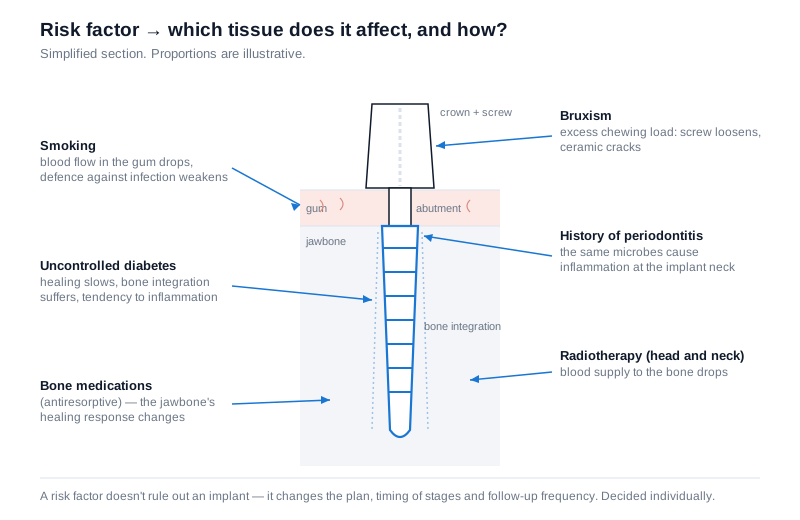 Each factor strikes a different place: smoking and diabetes — the gums and the healing bone, periodontitis — the neck of the implant, bone medications — the bone itself, bruxism — the crown and the screw. The proportions are indicative.
What does the outcome of an implant depend on?
On two stages. The first is osseointegration — the direct union of the titanium surface with the bone. This depends on your capacity to heal, blood supply and infection being under control. The second is the environment that keeps the implant in place for years: the health of the surrounding gum and bone, hygiene, and the distribution of chewing load.
General health affects both. Sometimes an implant integrates with the bone without any problem, but years later inflammation — peri-implantitis — begins around it. That is why risk relates not only to the day of surgery but also to the years that follow. More detail: what is peri-implantitis.
How does smoking affect an implant?
Smoking is the most extensively studied modifiable risk factor in implantology. In large meta-analyses, implant loss (the implant losing its function and being removed) was clearly higher in smokers than in non-smokers; because the follow-up periods of the included studies varied, the reviews do not give a specific number of years. The same analyses also linked radiotherapy to the head and neck region with an increase in implant loss.
The mechanism works in several directions:
- Blood supply deteriorates. Nicotine narrows the blood vessels; less oxygen and fewer nutrients reach the wound.
- The immune response weakens. According to the CDC's explanation, smoking weakens the body's defences against infection and makes healing more difficult once the gums have been damaged.
- The risk of gum disease increases. Smoking is linked with periodontitis and tooth loss; the same environment is also unfavourable for the tissues around an implant.
- Extra risk with bone grafting. Where a graft and membrane have been placed, primary closure and the blood supply of the wound are even more critical.
Does quitting smoking help?
Stopping completely is the best option. If that is not possible, dentists usually advise avoiding cigarettes in the days before surgery and during the healing period — because this is exactly when the wound closes and the bone gives its first response. If you continue to smoke, this does not mean giving up on an implant. The plan changes: the surgical approach is chosen more cautiously, the healing period may be allowed to take longer, and the intervals between reviews and professional cleanings are shortened.
Long-term data on e-cigarettes and heated tobacco is still limited; there is no basis for regarding them as a «safe alternative».
Is diabetes an obstacle to an implant?
Diabetes in itself is not an absolute contraindication to an implant. According to a systematic review, peri-implantitis is more common in patients with poorly controlled blood sugar and implant loss is higher over long-term follow-up; where diabetes is under control, however, outcomes are close to those in healthy patients. That same review states that, with the necessary precautions, implant treatment is a safe way to restore teeth in patients with diabetes and prediabetes.
Older meta-analyses, on the other hand, found no statistically clear link between diabetes and implant loss. The main reason for the difference is that the «diabetes» group in the studies was not uniform — well-controlled and poorly controlled patients were counted together. What this means for you: the decisive factor is not the name of the diagnosis but how well your blood sugar is controlled.
What is done:
- Contact with an endocrinologist or family doctor before treatment; HbA1c (the average blood sugar level over the last 2–3 months) and current treatment are taken into account.
- Oral hygiene and the gums are stabilised before surgery.
- The healing period is planned to be a little longer and reviews are more frequent.
- If blood sugar control is disturbed, the stage is postponed.
The general link between diabetes and oral health: diabetes and dental health.
A history of periodontitis
If you have lost teeth because of gum disease (periodontitis), the tissues around an implant are exposed to the same microbial environment and the same immune response. That is why a history of periodontitis is noted separately in the plan.
The approach is simple: first the gums are treated and stabilised, then the implant stage begins. And after the implant, supportive treatment — professional cleaning and monitoring — does not stop. When this sequence is broken, the likelihood of inflammation recurring around the implant increases. More detail: periodontitis and gum disease.
Osteoporosis and medications that affect bone
Osteoporosis itself is usually not an obstacle — meta-analysis data has found no statistically clear link between osteoporosis and implant loss. The more important issue is medications.
Medications that reduce bone loss (antiresorptive agents such as bisphosphonates and denosumab) can carry the risk of a rare but serious complication in the jawbone — medication-related osteonecrosis of the jaw (the death of part of the bone). The risk varies greatly depending on the dose, the route of administration (oral or intravenous), the duration and the underlying condition (osteoporosis or cancer treatment). Therefore:
- Always tell us at your consultation the name of every medication you take and how long you have been taking it.
- In patients receiving high-dose antiresorptive treatment for cancer, the surgical decision is made together with the treating doctor.
- Do not stop a medication without agreeing it with your doctor.
Bruxism and mechanical load
Bruxism (clenching/grinding the teeth during sleep or in the daytime) creates a mechanical rather than a biological problem: loosening of the abutment screw, cracking of the ceramic, fracture of the prosthesis and sometimes load-related bone changes around the implant. The shock-absorbing ligament of a natural tooth is absent in an implant — excess force is transmitted directly to the structure.
Management is mainly on the prosthetic side: distributing the load, building the bite carefully, choosing the material and using a night guard. More detail: bruxism and night guards.
Other general conditions
- Radiotherapy to the head and neck region. In meta-analyses this is linked with an increase in implant loss; it is planned together with the oncology team, taking into account the radiation dose, the field and the time interval.
- Immunosuppressive treatment, autoimmune diseases. Individual assessment is needed; in most cases these are not an obstacle, but the healing and monitoring regime changes.
- Cardiovascular disease, blood thinners. These matter mainly for the day of surgery (bleeding control), not for union with the bone.
- Age. Age in itself is not a criterion; what matters is general health and bone quality.
What is clarified at the consultation?
Risk assessment starts with a conversation. You will usually be asked about: chronic conditions and how well they are controlled; all medications and supplements you take; smoking; previous gum treatment and the reason the tooth was lost; signs of clenching; previous operations and allergies.
Then, with an examination and 3D CBCT (a three-dimensional X-ray of the jaw), bone volume and anatomy are assessed and the plan is tailored to you. If a risk factor is present, the plan is usually more staged: first the gums and hygiene, then the surgical stage, followed by close monitoring. When a dental implantation plan is prepared, these factors are explained together with the expected outcome and the timeline.
To recognise the first signs of a problem: signs of implant failure.
Frequently asked questions
I smoke a few cigarettes a day. Can I still have an implant? In most cases yes, but the risk is not zero. The less you smoke, the lower the risk; the best option is a complete break during the healing period. The decision is made together with the state of the bone, the need for a graft and gum health.
My blood sugar is controlled with medication. Should I wait? If control is stable, there is usually no need to wait. Your latest test results and the opinion of your treating doctor are taken into account; if your readings are unstable, the surgical stage may be postponed.
I take medication for osteoporosis — does that mean an implant is not for me? There is no such blanket ban. What matters is the type of medication, the dose, the route of administration and the duration; high-dose treatment given for cancer and a tablet taken by mouth for osteoporosis do not carry the same risk. The decision is made together with your treating doctor.
If I have a risk factor, will the implant definitely be lost early? No. Risk means an increased likelihood, not a «certain outcome». Hygiene, monitoring, prosthetic design and management of the factor change the outcome considerably.
Which tests might be needed? Most often: blood sugar and HbA1c, a full blood count, clotting values, and sometimes vitamin D and bone turnover markers. The list is determined individually according to your general health.
Conclusion
Smoking, poorly controlled diabetes, a history of periodontitis, certain medications and bruxism are factors that can change the outcome of an implant — and most of them can be managed. The correct sequence is this: first assessment and stabilisation, then the surgical stage, followed by uninterrupted monitoring. So that your individual situation can be assessed, it is important that you tell us at your consultation about all your chronic conditions and medications.
Sources
- Systematic review on diabetes mellitus and dental implants: an update — International Journal of Implant Dentistry, 2022
- Smoking, Radiotherapy, Diabetes and Osteoporosis as Risk Factors for Dental Implant Failure: A Meta-Analysis — PLOS ONE, 2013
- Smoking, Gum Disease, and Tooth Loss — Centers for Disease Control and Prevention (CDC)
This article is for general information only and does not replace an individual diagnosis, examination or treatment. Consult a doctor for a decision about your case.