

What should you look for when choosing an implant system?

We choose an implant system based on the data behind it, not on the brand name. What we look at: is there long-term clinical follow-up data; are the design and surface explained scientifically; which prosthetic options does the implant–abutment connection allow; will the components still be available years later; does the dentist have real experience with this system; how good is the documentation. The choice is individual — the condition of your bone, the position of the tooth and the planned prosthesis show which system is suitable.
Key points
- A good system is measured by independent clinical data and follow-up duration, not by advertising.
- The surface and thread design matter, but they do not determine the outcome on their own. Planning and surgical work are equally important.
- If an abutment or screw is needed years later, identifying the system and finding the part is a very real issue.
- The system a dentist works with every day, whose protocol and instruments they know well, usually gives a more predictable result.
- The final decision is made after diagnostics. In the same patient, different diameters and lengths may be chosen for different areas.
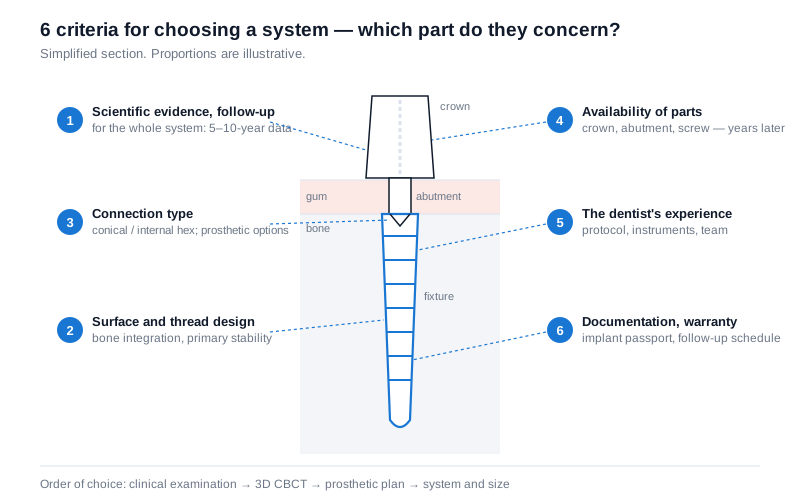 Each criterion relates to a specific part of the implant or to a process around it — the diagram shows this.
What is an implant system?
A system is not just the titanium screw placed in the bone. It includes the implant itself (the fixture), the abutment (the connecting part between the implant and the prosthesis), connecting screws, impression and scan components, surgical drills and the manufacturer's protocol. In other words, when you choose a system you are choosing both the surgical and the prosthetic stage together. You can read about the structure of an implant in our article on what a dental implant is.
There are dozens of manufacturers on the market and they are not all documented to the same standard. So the question is not which brand is advertised the most, but the six practical criteria below.
Criterion 1: Scientific evidence and follow-up duration
The most important question: are there clinical studies on this system published in independent journals, and how many years do they cover? A study lasting a few months, or one carried out only in the manufacturer's own laboratory, does not carry the same weight as multicentre data followed over many years.
What is useful to look at:
- Follow-up duration. A 1-year result shows early healing; 5–10 years of follow-up shows the long-term behaviour of the implant.
- Study design. Randomised comparative trials and systematic reviews are stronger than individual case reports.
- Independence. Who funded the study is stated in the paper.
- Patient group. A result obtained in healthy bone cannot simply be transferred to complex cases.
There is one nuance: the scientific literature often does not give a yes/no answer. For example, a systematic review comparing different implant surfaces in patients with a history of periodontitis (gum disease) concluded that there is little data with follow-up longer than 5 years, study designs differ and confounding factors have not been well accounted for — so it is not possible to say anything definitive about the difference between surfaces. This does not mean the surface makes no difference. It simply means that advertising messages relying on surface claims alone should be treated with caution.
Criterion 2: Surface and design
The implant surface affects how bone cells attach to it, that is, osseointegration (fusion with the bone). Most modern systems use a surface that is rough at the microscopic level; the properties of the surface are linked to initial stability and healing speed, and there are separate reviews on this topic.
In practical terms, here is what we look at in the design:
- Thread shape and taper. In soft bone, a different shape may be chosen to achieve initial stability.
- Range of diameters and lengths. Is there an option for cases that need a narrow site or a short implant?
- Flexibility of the surgical protocol. Can the drilling sequence be adjusted according to bone type?
The main message for you is simple: these parameters exist so that the dentist can choose an implant suited to your bone. There is no universal design equally suitable for every case.
Criterion 3: Connection type and prosthetic options
The connection between the implant and the abutment (conical, internal hex and so on) affects both mechanical durability and the choice of prosthesis. At the planning stage we find answers to these questions:
- Are both screw-retained and cement-retained prostheses possible?
- For full-arch solutions (for example, a fixed prosthesis on several implants), are the necessary angled abutments available?
- Is the system compatible with a digital workflow — are there scan bodies for the intraoral scanner and CAD/CAM library files?
These questions are especially important in the smile zone and in complex prosthetic plans, because the position of the implant and the shape of the future prosthesis depend on each other. In our clinic, planning is built on 3D CBCT (a three-dimensional X-ray of the jaw) and a digital scan; the diameter, length and position of the implant are chosen according to the future prosthesis.
Criterion 4: Will components still be available years later?
This is one of the criteria patients think about least, but one of the most important in the long term. An implant can remain in the bone for decades, but the crown or screw on top of it may need to be replaced at some point. If the system is not identifiable or has left the market, finding the right component becomes a problem.
The literature confirms this too: a review devoted to identifying unknown implants states that the growing number of manufacturers, dental tourism and the price factor make it harder for dentists to determine the system and find the matching component.
What you can do:
- Keep the implant passport given to you after the implant is placed (the document stating the name of the system, the reference number, the diameter and the length).
- If there is a chance you may move to another city or country, systems available internationally offer a practical advantage.
- Do not hesitate to ask for the name of the system. Any dentist treating you in the future will need it.
You can read about the differences and prices of the three systems we work with — NeoBiotech, Megagen AnyRidge and Straumann BLT — in our article on the comparison of implant systems.
Criterion 5: The dentist's experience and the clinic's capabilities
Every system has its own surgical protocol, drilling sequence, torque values and prosthetic logic. With a system the dentist works with regularly, the steps are clearer, and in an unexpected situation an alternative component is at hand. That is why, in practice, the question which system is better becomes the question which system does this dentist and this team work with most reliably.
The clinic's capabilities also affect the choice: the sterilisation regime, the surgical motor and torque measurement, 3D planning, a surgical guide when needed, and a digital link with the laboratory. Choosing a dentist and a clinic is a separate topic — we have written about it in our article on how to choose an implantologist.
Criterion 6: Documentation, warranty and follow-up
The word warranty is used a lot, but what it means varies from clinic to clinic. It is worth clarifying:
- Does the warranty apply to the implant itself (the manufacturer's warranty) or to the prosthesis on top of it?
- In which situations does it become void — for example, if you do not attend follow-up visits, or if hygiene is neglected?
- Are the follow-up schedule and follow-up X-rays included in the plan?
The truth is this: no system and no dentist can give an absolute guarantee of the outcome, because the outcome also depends on your general health, your hygiene and your habits. We have written about these separately in our article on how many years an implant lasts.
Where does the difference between a cheap and an expensive system come from?
Usually from the sum of several things: the funds the manufacturer invests in research, the quality of the materials and manufacturing, a long-term follow-up database, the breadth of the component range and international support. This does not mean that an expensive system will give a better result in every patient — simply that there may be more documented data behind it.
The opposite is also true: a well-documented system can be lost through a poor plan or weak hygiene. That is why the decision is a combination of three things: diagnostics + execution + aftercare. A dental implantation plan is built in exactly this order.
Questions you can ask at your consultation
- Which system, which diameter and which length are planned for me — and why this one in particular?
- Is there long-term clinical data on this system?
- If a component is needed in the future, will it be available in Azerbaijan?
- Will I be given an implant passport?
- What does the warranty cover and on what conditions does it apply?
- How often will follow-up visits take place?
Frequently asked questions
Is it good or worrying if a clinic has several systems? Working with several documented systems is normal: different cases may require different diameters, lengths and prosthetic solutions. What matters is that the system is chosen for a specific reason rather than at random.
Can implants from two different systems be in the same mouth? Yes, especially if the implants were placed in different years. In this case each implant needs its own components, so keeping the documents is even more important.
I do not know the system of the implant that was placed abroad. What should I do? The dentist tries to identify the system based on X-rays, the existing prosthesis and an examination; sometimes this is not easy. The quickest way is to request the document from the previous clinic.
Does the difference between titanium and zirconia implants affect the choice? Today, the majority of clinical use involves titanium and titanium alloys; zirconia implants are used in more limited cases. The choice of material is a separate discussion and requires individual assessment.
Can I choose the system myself? Your preference is taken into account, but the final decision has to match the diagnostics: bone volume, bone quality and the planned prosthesis may limit some options.
Conclusion
Choosing an implant system is not a contest between brands, it is a planning decision. Long-term clinical data, how well the design suits your situation, the availability of components, the dentist's experience and transparent documentation are all assessed together. A consultation and 3D imaging will clarify which option is suitable for you.
Sources
- Current technology for identifying dental implants: a narrative review — Bulletin of the National Research Centre, 2021
- Effect of dental implant surface roughness in patients with a history of periodontal disease: a systematic review and meta-analysis — International Journal of Implant Dentistry, 2019
- Correlation between Implant Surface Roughness and Implant Stability: A Systematic Review — Dentistry Journal (MDPI), 2024
This article is for general information only and does not replace an individual diagnosis, examination or treatment. Consult a doctor for a decision about your case.