

How is implant treatment planned in a fully edentulous jaw: removable denture, overdenture or fixed prosthesis?
There are three main routes for a fully edentulous jaw: a conventional removable denture (without implants), a removable denture on implants (an overdenture — usually 2 implants in the lower jaw and 4 or more in the upper jaw), and a fixed prosthesis screwed onto implants. Which one suits you is determined together by bone volume, the shape of the jaw, general health, budget and your expectations. The plan is built on 3D imaging (CBCT) and a digital scan of the mouth; the prosthesis is designed first, and the implants are placed to match it.
At the clinic, the concept of a fixed prosthesis on four or six implants is planned as our All-on-4 implant treatment service.
Key points
- According to international consensus statements, an overdenture on two implants in an edentulous lower jaw gives better stability and chewing than a conventional denture, and is recommended as the first-choice option.
- In the upper jaw, where the bone is softer and the sinus is close, at least 4 implants are recommended for an overdenture.
- A fixed (non-removable) prosthesis requires more implants, more bone and a higher budget, but it sits in the patient's mouth like their own teeth.
- A good plan starts from the prosthesis: first the position of the future teeth is determined, then the position of the implants is chosen.
- Each option has its own care requirements and likelihood of future repairs; the choice is made not just for today, but with a 10-15 year horizon in mind.
Why does a fully edentulous jaw require a special approach?
When one or several teeth are lost, the neighbouring teeth still hold the jaw together: they maintain the bite height, lip support and the direction of chewing. When all the teeth are lost, these reference points disappear. Because the bone no longer receives any load, it begins to resorb (this is called alveolar bone resorption), the lower jaw gradually becomes thinner, while the upper jaw collapses inwards. The lips are left without support and the face looks somewhat older.
That is why, in a fully edentulous jaw, it is not simply a matter of putting the teeth back. The dentist first has to restore three things: the bite height (vertical dimension), lip and cheek support, and a stable chewing surface. Only then is the question answered: what will hold these teeth — the gums or implants? We have written separately about how bone resorbs after tooth loss: tooth loss and jaw bone loss.
The three main options: in plain language
1. Conventional removable denture (without implants)
An acrylic denture that rests on the gums and the palate. It is the simplest and cheapest route and requires no surgery. Its weak point — especially in the lower jaw — is that the denture does not stay in place. The lower jaw has no wide supporting surface like the palate, and the tongue constantly pushes the denture. As the bone resorbs, the denture becomes looser still and has to be adjusted again. Most complaints about lower dentures are precisely about stability.
2. Removable denture on implants (overdenture)
The denture is still removable, but it clips onto 2-4 implants rather than resting on the gums. A small attachment sits on top of the implant (for example, a locator-type stud, or a bar connecting the implants), and its counterpart sits inside the denture. The patient takes the denture out daily to clean it, but while eating and speaking the denture does not move.
In 2002, the experts gathered at McGill University (the McGill consensus) declared an overdenture on two implants the first-choice standard for the edentulous lower jaw. That decision was based on measurable improvements in chewing, speech and denture stability compared with a conventional denture, along with patient satisfaction. The 2013 consensus of the ITI (International Team for Implantology) also indicates two or more implants in the lower jaw and four or more in the upper jaw as the basis for an overdenture.
Who does this option suit? For patients whose bone is not sufficient for a fixed prosthesis, who want to keep surgery to a minimum, whose budget is limited, or who can easily handle a denture with their hands, it is often the most sensible route.
3. Fixed implant prosthesis (hybrid / bridge)
Here the prosthesis does not come out: it is screwed onto 4-6 (sometimes more) implants and can only be removed by the dentist. The All-on-4 concept, in which the posterior implants are placed at an angle when bone is limited, also belongs to this group; we have explained it separately: All-on-4 full-arch implant treatment. The question of four versus six implants is covered in a separate article too: All-on-4 or All-on-6.
The Global Consensus published in 2026 (on the edentulous upper jaw) favours placing the most posterior implant in the first molar region where possible in fixed full-arch prostheses, along with a screw-retained (cement-free) design. In the same document, both patients and experts stated that they expect implants to serve for more than 10 years — this is not a measured outcome but a consensus of expectations, yet it shows the horizon of the planning.
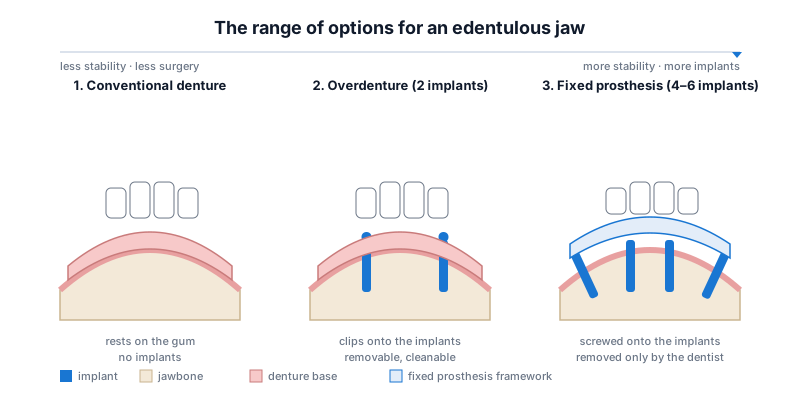 From left to right: conventional removable denture, overdenture on 2 implants, fixed prosthesis on 4-6 implants. As the number of implants and the bone requirement increase, so does stability.
Why are the lower and upper jaws planned differently?
The bone of the lower jaw is dense and solid, and no nerve runs through the front section (between the two mental foramina). That is why two implants can be placed here safely and predictably, and in some cases the denture can even be loaded early.
In the upper jaw the situation is different: the bone is more porous, the maxillary sinus lies at the back, and at the front the bone thins quickly. That is why at least 4 implants are recommended for an overdenture, and often connecting them to one another (a bar) as well; the ITI consensus considers the evidence base for immediate loading in the upper jaw weaker than in the lower jaw. Read about the options when there is not enough bone in the upper jaw: there is not enough bone for an implant.
Comparison: the three options in one table
| Criterion | Conventional removable denture | Overdenture (2-4 implants) | Fixed prosthesis (4-6+ implants) |
|---|---|---|---|
| Surgery | None | Minor | Moderate to major |
| Bone requirement | Minimal | Moderate (the front section is enough) | More bone, or an angled/grafting solution |
| Stability when chewing | Low (especially the lower jaw) | Good | Closest to the feel of your own teeth |
| Palatal coverage (upper jaw) | Full palate | Can often be reduced | None |
| Daily care | Take out and rinse | Take out and rinse + clean around the implants | Cleaning in the mouth with floss/irrigator |
| Likelihood of repairs | Frequent relining | Occasional replacement of studs/clips | Wear of screws/teeth, servicing at the dentist |
| Budget | Low | Moderate | High |
Planning step by step
1. Conversation and expectations. What do you want most — that the denture does not move, a denture without a palate, or never to hear the word removable at all? That answer sets the direction of the plan.
2. General health. How well diabetes is controlled, smoking, bone medications (bisphosphonates), blood thinners. These change the precautions rather than the option itself.
3. 3D imaging (CBCT). A two-dimensional X-ray does not show the width of the bone. With CBCT, bone height and width, the position of the nerve and the floor of the sinus are measured in millimetres. We have written separately about why this matters: why CBCT matters for implants.
4. Designing the prosthesis in advance. A digital or wax trial denture is prepared: the length of the teeth, lip support and bite height are checked together with the patient. This prosthesis is then superimposed on the scan, and the position of the implants is chosen according to the future teeth. This approach is called backward planning from the prosthesis, and it is the opposite of placing implants first and then fitting the teeth to them.
5. Surgical guide. The plan is often transferred to a 3D-printed guide; the implants are placed through those openings.
6. The interim period. With an overdenture, the old denture can be used with a soft liner during healing. With a fixed prosthesis, in some cases a temporary prosthesis is screwed in on the same day; the conditions for this (the primary stability of the implant) are assessed by the surgeon during the operation.
7. The final prosthesis and review schedule. After healing, the final prosthesis is made; the choice of material is a separate topic: materials for implant-supported prostheses. Annual check-ups and professional cleaning are then planned.
Studs or a bar for an overdenture?
Patients often ask: what will there be on top of the two implants? Individual studs (stud/locator attachments) are the simpler option, they take up less space and are easy to clean. A bar links the implants to one another and gives the denture broader support, but there is more space underneath it for food debris to collect. According to the ITI 2013 consensus, splinting the implants together and the type of attachment had no effect on one-year implant survival — meaning the choice is made mainly according to the shape of the mouth, manual dexterity and the space available for the prosthesis.
Which option suits whom?
- A patient whose lower denture does not stay in place and who wants minimal surgery: an overdenture on two implants — the first choice in the consensus statements.
- A patient who wants an upper denture without a palate: an overdenture on at least 4 implants, or a fixed prosthesis; the decision depends on bone volume.
- A patient who says they want nothing removable, and whose bone and budget allow it: a fixed implant prosthesis.
- A patient with a serious systemic illness or who is not ready for surgery: a well-made conventional denture first, moving on to implants when the situation changes.
You can find a broader comparison of removable dentures and implants here: denture or implant. At the clinic, this planning is carried out with CBCT and an intraoral scanner; more details: dental implantation.
Frequently asked questions
Are two implants in the lower jaw too few, or are they enough? For a removable overdenture, two implants are accepted as the basic standard in international consensus statements. For a fixed prosthesis, however, two implants are not enough — there you need 4 or more implants.
Can my old denture be adapted onto implants? Sometimes yes — if the denture is in good condition and the bite is correct, attachment housings can be added inside it. But for a very old, worn denture it is better to make a new one.
When there is little bone in the upper jaw, is a sinus lift always necessary? No, not in every case. If there is bone in the front section, an overdenture can be built on 4 anterior implants; with a fixed prosthesis, angled placement makes it possible to bypass the sinus. The decision is made with CBCT.
Should an overdenture be taken out at night? Yes. This is recommended so that the gums and the tissue around the implants can breathe overnight, and so that the denture and the implants can be cleaned.
How long does planning take? Usually 1-2 appointments: imaging, scanning and a trial denture. The date of surgery is set after that.
Conclusion
In a fully edentulous jaw, the question of whether or not to place implants is really the question of how many implants, which prosthesis and in what order. In the lower jaw, an overdenture on two implants is a simple and evidence-backed starting point; the upper jaw requires more implants and more careful planning; and a fixed prosthesis delivers the greatest comfort with the greatest requirements. To assess your individual situation, all the options can be reviewed together at a consultation with CBCT and a trial denture.
Sources
- Two implant overdenture – the first alternative treatment for patients with complete edentulous mandible — Journal of Medicine and Life, 2011
- Loading Protocols for Implant-Supported Overdentures in Edentulous Jaws (5th ITI Consensus Conference) — ITI Academy, Consensus Statements, 2013
- Consensus Report of Group 4 of the 1st Global Consensus for Clinical Guidelines for the Rehabilitation of the Edentulous Maxilla: Conventional Dentures, Implant Overdentures and Implant-Supported Fixed Dental Prostheses — Clinical Oral Implants Research, 2026
This article is for general information only and does not replace an individual diagnosis, examination or treatment. Consult a doctor for a decision about your case.