

What is All-on-4: how a full jaw is restored on 4 implants
All-on-4 is a treatment concept that restores a jaw which has lost (or is about to lose) all of its teeth with a fixed, non-removable bridge supported by four implants. The two front implants are placed straight, while the two back implants are placed at an angle of 30–45°; thanks to this angle, the implant bypasses the sinus in the upper jaw and the nerve in the lower jaw, and makes use of the bone that is already there. If there is sufficient initial stability, a temporary bridge is often fitted on the same day or within a few days; the permanent prosthesis is made after healing.
How this treatment is planned at the clinic, its stages and the factors that affect the price are set out on the All-on-4 implant treatment service page.
Key points
- All-on-4 is not a "package" but a planning concept: the position of the implants is chosen individually for each jaw using 3D imaging (CBCT).
- In many cases, angled back implants make it possible to avoid bone grafting and a sinus lift.
- The temporary prosthesis depends on initial stability — the consensus document requires an insertion torque above 35 Ncm for immediate loading.
- Long-term follow-up (10–18 years) shows that the vast majority of implants stay in place, but that mechanical adjustments to the prosthesis are commonplace.
- The final decision is made on the basis of smoking, bone volume, the teeth in the opposing jaw and oral hygiene habits.
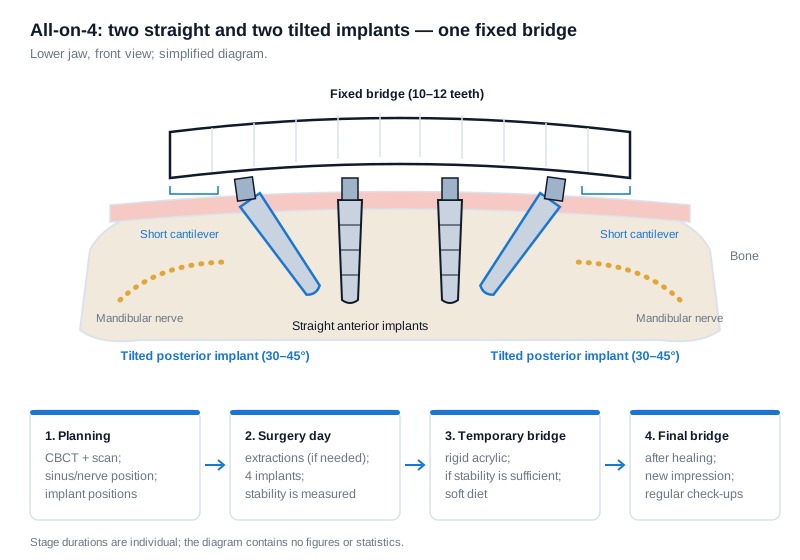 Angled back implants move the rear support further back, which shortens the cantilever (the unsupported tail end of the bridge).
What problem does All-on-4 solve?
When all the teeth are lost, the jawbone gradually resorbs — particularly at the back. In the upper jaw the maxillary sinus takes over the space left by the back bone, while in the lower jaw the jaw nerve runs through the bone at the back. With the classic approach, bone has to be grafted first in order to place straight implants on each side; that means an extra operation and months of waiting.
All-on-4 solves this problem in a different way: by placing the back implant at an angle, it both uses a long implant and moves its emergence point further back. As a result, four implants create broad support along the front-to-back direction of the jaw and carry a bridge of 10–12 teeth. The 2017 consensus document describes the concept precisely as a main indication for atrophic (resorbed) jaws.
We have compared all the options available when there is little bone (grafting, short implants, angled placement) in the article not enough bone for an implant.
Who is it suitable for, and who is it not?
It is usually considered when:
- all or most of the teeth in one jaw have been lost and the remaining ones cannot be saved (advanced periodontitis, root decay);
- a removable denture does not stay in place and chewing and speaking are uncomfortable;
- there is little bone at the back and the patient does not want a lengthy bone grafting process;
- general health allows surgery (the consensus document refers to ASA I–II patients, that is, healthy patients or those with a controlled chronic condition).
Caution is needed, or treatment is postponed, in cases of:
- uncontrolled diabetes, active smoking (follow-up studies show that smoking reduces implant survival);
- medicines that affect bone metabolism (bisphosphonates, certain oncology drugs) — to be discussed separately with the doctor;
- insufficient bone even at the front of the jaw to place four implants stably — in this case zygomatic implants or a different plan may be needed;
- severe bruxism (clenching at night) — the risk of the prosthesis fracturing is high, so a night guard is planned.
For a general comparison of removable dentures and implant-supported solutions, see the article denture or implant. Cases where four implants are not enough, and the six-implant option, are a separate topic — difference between All-on-4 and All-on-6.
The stages step by step
1. Examination and digital plan
A panoramic image is not enough; with CBCT the width and height of the bone and the position of the sinus and the nerve canal are measured to the millimetre. In many cases an intraoral scan is also taken, so that the shape of the future teeth can be matched to the position of the implants. This stage is not simply "taking an X-ray" — it is the plan itself. For the steps in planning and a list of questions, there is the article implant planning for a fully edentulous jaw.
2. Surgery day
Under local anaesthesia (with sedation if preferred), the necessary teeth are extracted, the bone is smoothed and four implants are placed. The insertion torque of each implant is measured — this indicates how firmly the implant is seated in the bone. Special angled abutments (intermediate supports) are screwed onto the angled implants so that the bridge screws emerge through the tops of the teeth.
3. Temporary fixed prosthesis
According to the consensus document, if the implants are seated with a torque above 35 Ncm, immediate loading is possible: the laboratory or the clinic makes a strong acrylic bridge within a few hours to a few days and secures it to the implants with screws. The temporary bridge is deliberately made from a rigid, non-flexible material so that the healing implants are not exposed to micro-movement. During this period, a soft food regime is important.
If stability is insufficient, the dentist may forgo immediate loading and provide a temporary removable denture. This is not a "failure" but the safe version of the plan.
4. Healing and the permanent prosthesis
Osseointegration (the implant fusing with the bone) usually takes a few months; the duration varies according to the jaw and the quality of the bone. Impressions are then taken again and the permanent bridge is made. The consensus document lists metal-ceramic constructions or acrylic on a metal framework for the permanent prosthesis; today, versions with a zirconia framework are also widespread. Materials are the subject of a separate article.
What is the difference between the temporary and the permanent prosthesis?
| Criterion | Temporary bridge | Permanent bridge |
|---|---|---|
| When | Surgery day / first few days | After healing |
| Material | Strong acrylic (sometimes with metal reinforcement) | Metal-ceramic, metal-acrylic or zirconia |
| Number of teeth | Usually 10 (the cantilever is kept short) | Usually up to 12 |
| Purpose | Function and aesthetics during healing | Long-term function, aesthetics, hygiene |
| What to expect | Wear and fracture are possible | Periodic check-ups and screw checks |
What do studies show over the long term?
It is important to read the figures together with their source:
- Lower jaw, 10–18 years of follow-up (Maló et al., 2019; 471 patients, 1884 implants): prosthesis survival 98.8%, implant survival 93.0%. In the same study, biological complications at implant level (inflammation, bone loss) were 11.8% and mechanical complications (screw loosening, acrylic fracture, etc.) 36.7%. In other words, most implants stay in place, but repairs to the prosthesis are commonplace.
- Upper and lower jaw, 3–17 years of follow-up (Uesugi et al., 2023; 561 patients, 2364 implants): survival at implant level was 97.4% in the upper jaw and 98.9% in the lower jaw. Early losses (the first 24 months) were more frequent in the upper jaw; survival was 97.9% in smokers and 99.2% in non-smokers.
- Systematic review (Soto-Peñaloza et al., 2017; 24 studies): the most common prosthetic problem is fracture or loosening of the acrylic bridge; the most common biological problem is peri-implantitis, which begins after roughly 2 years.
These figures are results from individual centres and cannot automatically be transferred to your situation.
Afterwards: how is this prosthesis looked after?
Because the bridge does not come out, you cannot clean underneath it with ordinary dental floss. Superfloss, interdental brushes and a water flosser are the everyday tools; the dentist can also periodically remove the bridge and clean underneath it. The detailed routine is in the article long-term care after implants. At the clinic, the All-on-4 plan is built on 3D CBCT — there is information about this on the dental implantation page.
Frequently asked questions
Will I have to go without teeth after All-on-4? In most cases, no: if stability is sufficient, a temporary fixed bridge is fitted within the first few days. If stability is low, a temporary removable denture is provided for the healing period.
Is an angled implant weaker than a straight one? The available reviews find no difference in survival between straight and angled implants within the All-on-4 framework. The special abutment on top of the angled implant transfers the load to the bridge correctly.
Is the outcome different in the upper and lower jaw? In follow-up studies, early implant loss has been somewhat more frequent in the upper jaw — the upper bone is softer. This is taken into account in planning; sometimes an additional implant may be suggested in the upper jaw.
Can I have All-on-4 in one jaw and keep my own teeth in the other? Yes. The condition of the teeth in the opposing jaw and the bite are taken into account in planning; because natural teeth generate strong chewing forces, the prosthesis material is chosen accordingly.
What happens if the temporary bridge breaks? This is the most common mechanical problem in the studies, and it does not mean the implant has been lost. The bridge is repaired or replaced, and the patient is advised to return to a soft food regime.
Conclusion
All-on-4 is a concept that gives an edentulous jaw fixed teeth with a small number of implants, often without bone grafting and within a short time. Its strength is the intelligent use of the bone that is already there; its weakness is the need for repairs and care of the prosthesis over the years. A CBCT-based consultation is the first step in assessing your individual situation.
Sources
- The all-on-four treatment concept: Systematic review — Journal of Clinical and Experimental Dentistry, 2017
- Consensus statements and clinical recommendations on treatment indications, surgical procedures, prosthetic protocols and complications following All-On-4 standard treatment — Journal of Clinical and Experimental Dentistry, 2017
- The All-on-four concept for fixed full-arch rehabilitation of the edentulous maxilla and mandible: a longitudinal study in Japanese patients with 3–17-year follow-up and analysis of risk factors for survival rate — International Journal of Implant Dentistry, 2023
- The All-on-4 treatment concept for the rehabilitation of the completely edentulous mandible: A longitudinal study with 10 to 18 years of follow-up — Clinical Implant Dentistry and Related Research, 2019
This article is for general information only and does not replace an individual diagnosis, examination or treatment. Consult a doctor for a decision about your case.