

What happens after splint therapy? Outcome, relapse and next steps
When splint therapy (an occlusal splint — a rigid plate worn over the teeth) comes to an end, three scenarios are possible: the symptoms have resolved and only monitoring continues; the symptoms have eased but return from time to time, and the splint is worn at night on and off; or the symptoms partly remain and another approach — physiotherapy, behavioural measures, and in rare cases orthodontics or a prosthesis — is discussed. Research shows a short-term benefit from splints, while over the longer term the difference compared with other conservative methods is small. That is why the plan for life after the splint is built individually.
Key points:
- A splint is not a cure but a management tool; the return of symptoms is not a failure but an expected possibility.
- According to meta-analyses, the benefit of a stabilisation splint for pain is clear in the first 3 months; after 3 months the difference from other treatments disappears statistically.
- Once splint therapy ends, irreversible steps that change the bite (reshaping the teeth, prosthetic work) are considered only when there is a separate indication for them.
- Lifelong splint wear is not required; however, if bruxism is present, a night guard may continue for a separate purpose.
- At review visits, pain, mouth opening and function are measured again — the decision is based on these measurements.
The splint course is over: does that mean I am cured?
Temporomandibular disorders (TMD) often follow a fluctuating course: they flare up, settle down and then return. A splint is used to soften the painful phase of that wave. We have explained the types of splint and how they work in our article on TMJ splint therapy; here we are talking only about the stage that follows.
After the splint, we assess the situation with measurements rather than as a binary cured/not cured. The international DC/TMD diagnostic criteria (2014) provide two axes for exactly this purpose: Axis I — clinical examination (the site of the pain, mouth opening, joint sounds); Axis II — pain intensity, its effect on daily function, psychological burden and parafunctional habits (for example, daytime clenching). After the splint, the same measurements are taken again and compared with the baseline. If the pain has not dropped to zero but mouth opening has returned to normal and daily life is not disrupted, that is a good outcome.
What does the research say about splint outcomes?
We need to be honest here, because patients often expect a splint to be a permanent solution.
A 2017 meta-analysis (PLOS ONE) pooled 33 randomised studies with a total of 1,779 TMD patients. The result: over the first 3 months, stabilisation splints outperformed control groups in terms of pain reduction, muscle tenderness and mouth opening; with follow-up longer than 3 months, however, no statistically significant difference in pain intensity was found between splints and other treatments. In other words, over the long term other conservative methods (physiotherapy, exercises, behavioural measures) reach a similar result.
A 2025 systematic review (Saudi Dental Journal, 8 RCTs, more than 400 patients aged 15–40) shows a similar picture: over 1–12 months of follow-up, splints produced a moderate-to-large effect for short-term pain reduction, with a stronger effect in studies with follow-up shorter than 3 months; data on outcomes beyond 6–12 months, however, are sparse.
An umbrella review published in 2026 covering 21 systematic reviews (Journal of Oral Rehabilitation) sums up the overall conclusion as follows: splints have a small positive or neutral effect on pain and mouth opening in TMD, while the quality of the evidence is variable.
Two practical conclusions follow from these figures for patients:
- In the first few months a splint plays the role of a bridge well — it carries you through the acute phase.
- Long-term stability depends less on the splint itself than on overall management (muscle exercises, changing habits, sleep and stress).
Why do symptoms come back?
The most common reasons for relapse (the return of symptoms) are:
- Parafunction continues. Daytime clenching or the habit of pressing the tongue against the teeth is not corrected by a splint; as soon as the splint is removed, the load returns. There is more on this in our article on bruxism and night guards.
- Stress and sleep. This is precisely what the biopsychosocial model of TMD pain says: muscle tension does not arise from mechanical causes alone.
- The splint was worn only when there was pain. In the meta-analysis mentioned above, consistent use was associated with better outcomes; irregular use reduces the effect.
- The structure of the joint. If there is disc displacement or degenerative change in the joint, sounds and occasional discomfort may persist even after the splint. This is not always a problem — in most cases it is painless and functional.
When a relapse occurs, the first step is another examination, not a new splint.
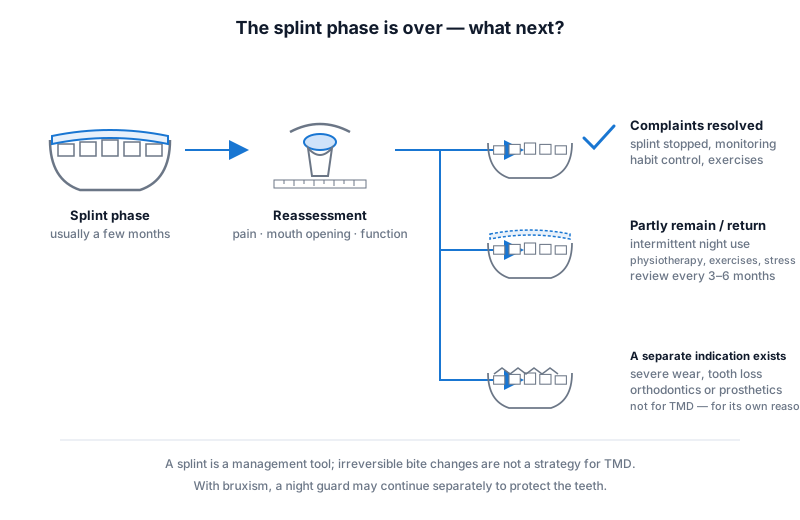 After splint therapy ends, decisions are based on measurements: pain, mouth opening and function. Irreversible steps come at the end of the path and only with a separate indication.
What paths are there after the splint?
1. Monitoring and doing nothing
If the symptoms have resolved, the right way forward is often to do nothing: the splint is stopped, a review follows after 3–6 months, and further visits are arranged as needed. The patient is shown muscle exercises and habit control (keeping the teeth apart during the day, not resting the chin on the hand).
2. Intermittent use
If the symptoms have eased but return during tense periods, the splint is kept in reserve: it is worn at night during stressful weeks or when jaw fatigue is felt in the morning. For many patients this is a comfortable regimen that continues for years, and no harm from it has been demonstrated, provided the splint is checked periodically (so that the bite does not change and the appliance is not worn through).
3. Additional conservative measures
If pain persists: physiotherapy and jaw exercises, warm compresses, short-term medication support and, where needed, cooperation with pain and sleep specialists. Research shows that over the long term these methods give results comparable to a splint; and when they are combined, things are usually more comfortable still.
4. Orthodontics
If a bite problem (for example, the teeth not meeting correctly) is an indication for orthodontic treatment in its own right, that treatment is carried out for its own purpose. However, orthodontics as a treatment for TMD is not supported by separate evidence; this is discussed openly at the TMJ and gnathology consultation.
5. Occlusal adjustment and prosthetic work
This is the path that is most often misunderstood. Patients sometimes think: I am comfortable in the splint, so my teeth should be reshaped or restored to match this position. A 2017 systematic review (Journal of Prosthetic Dentistry) examined this question: no randomised studies on the topic were found, and the conclusion is this — prosthetic changes to the bite are not yet accepted as a strategy for resolving TMD symptoms or stopping bruxism; caution is advised with irreversible occlusal changes.
A prosthesis or extensive restoration is planned only when there is a separate reason for it — the teeth are severely worn, there is significant tooth loss, or function is impaired. In such cases the splint stage serves as a useful rehearsal for testing the jaw position; this process is explained in our article on occlusion in full-mouth rehabilitation. For more on the jaw's reference position, see what is centric relation.
Is a splint for life?
No. A stabilisation splint is not a device that helps while you wear it and harms when you take it out. Its purpose is to carry you through the acute phase and to reduce the load that parafunction places on the teeth and the joint. When the symptoms resolve, it is stopped. Long-term use continues in two situations:
- If bruxism has been confirmed (morning muscle fatigue, wear, a note from a bed partner) — here the aim is no longer TMD but protecting the teeth.
- If intermittent use gives the patient comfort and examination shows no change in the bite.
One important warning: if a splint is worn 24 hours a day, for months and without supervision, the position of the teeth may change. That is why periodic checks are essential with long-term use.
What is checked at a review visit?
Follow-up after a splint is brief but specific:
| What is checked | How | Why it matters |
|---|---|---|
| Pain (0–10 scale) and its site | Questioning + palpation | Comparison with baseline |
| Mouth opening (mm) | Measured with a ruler | An objective indicator of function |
| Joint sounds | Examination | A sound on its own is not an indication for treatment |
| Daytime habits | Questioning (Axis II) | The main cause of relapse |
| Condition of the splint | Visual | Wear-through, changes in the bite |
| Signs of wear on the teeth | Examination, photos/scan | Whether bruxism is continuing |
X-rays or MRI are not routine after a splint; they are considered only when the clinical picture changes (a sharp restriction in mouth opening, a sudden change in the bite, persistent joint pain).
When should you see the dentist again?
- Mouth opening has noticeably reduced compared with before, or the jaw locks.
- The way the teeth meet has changed — the feeling that my teeth no longer come together as they used to.
- The pain has returned more strongly than during the splint period and does not pass within 1–2 weeks.
- The splint has worn through or broken.
- Pain in the head or around the ear has started again in the mornings.
All of these signs are explained in more detail in our article on signs of a TMJ problem.
Frequently asked questions
How many weeks after stopping the splint can symptoms return? There is no fixed timeframe. Some people have months of calm, while for others a single stressful week is enough. If symptoms return, habits and sleep are reviewed first, and the splint is reintroduced temporarily if needed.
Can a splint move my teeth? A properly made stabilisation splint worn only at night and under supervision does not move the teeth. The risk increases with 24-hour, months-long, unsupervised use and with appliances that cover only part of the arch.
Should I have my teeth reshaped to the position where I feel comfortable in the splint? Systematic reviews do not support this as a treatment for TMD. Irreversible changes to the bite are discussed only when there is a separate prosthetic or orthodontic indication.
The sounds are still there but there is no pain — should I continue? A joint sound that is painless and does not disrupt function often needs no treatment; it is simply monitored. When the sound is accompanied by pain or locking, another examination is needed.
How many years can I keep my old splint? If the appliance has not worn through and still seats correctly on the bite, it can be kept for years; however, it is advisable to have it checked every 6–12 months.
Conclusion
When splint therapy ends, the goal is not complete cure but measurable comfort and function. Research shows a short-term benefit from splints and, over the long term, results similar to other conservative methods; that is why the follow-on plan is built around monitoring, intermittent use and habit control. Irreversible changes to the bite are not planned for TMD, but only where there is a separate indication. To assess your individual situation, your baseline and current measurements are compared side by side at a consultation.
Sources
- Occlusal stabilization splint for patients with temporomandibular disorders: Meta-analysis of short and long term effects — PLOS ONE, 2017
- Occlusal Splint Therapy in the Management of Temporomandibular Disorders — Evidence from Systematic Reviews — Journal of Oral Rehabilitation, 2026
- Centric stabilization occlusal splints vs. other conservative therapies in the management of temporomandibular disorders: a systematic review and meta-analysis — The Saudi Dental Journal, 2025
- Diagnostic Criteria for Temporomandibular Disorders (DC/TMD) for Clinical and Research Applications — Journal of Oral & Facial Pain and Headache, 2014
- Prosthodontic planning in patients with temporomandibular disorders and/or bruxism: A systematic review — Journal of Prosthetic Dentistry, 2017
This article is for general information only and does not replace an individual diagnosis, examination or treatment. Consult a doctor for a decision about your case.