

Veneers or Teeth Whitening? How to Make the Right Aesthetic Choice
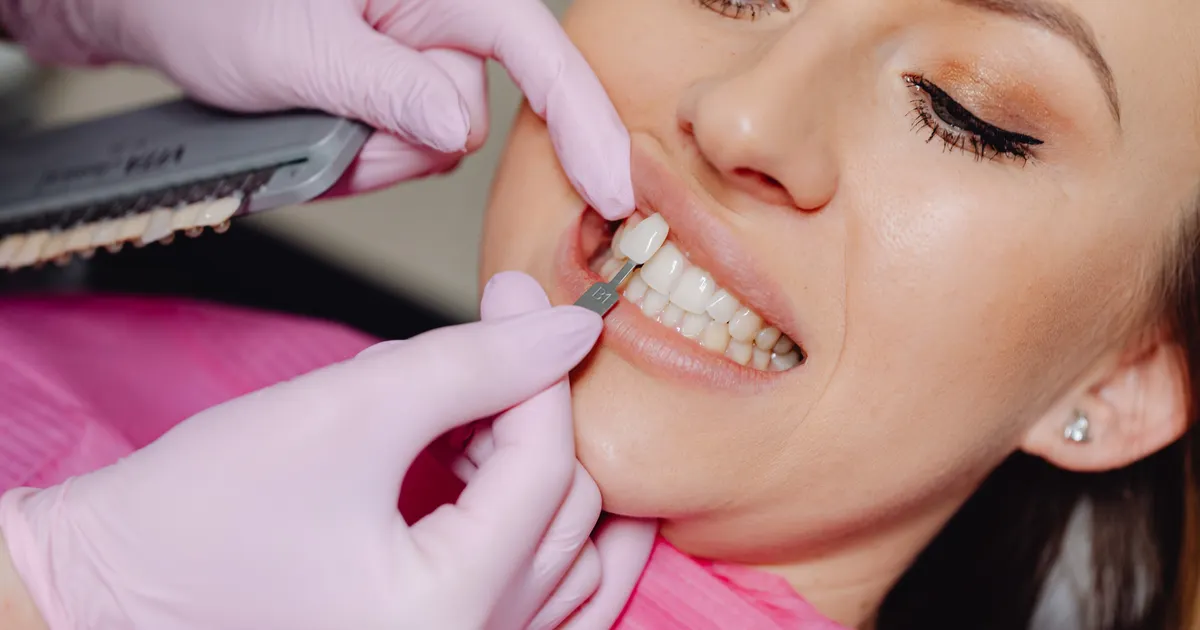
Teeth whitening only lightens the tooth's own shade, does not alter the enamel and is reversible; a veneer, on the other hand, is a thin ceramic or composite shell bonded to the front surface of the tooth — it changes the colour, shape, size and surface all at once, but most often requires a small amount of enamel to be prepared away, and it is not reversible. The rule is simple: if you are happy with the shape and alignment of your teeth and only want a lighter shade — whitening comes first; if there are chips, wear, gaps, shape irregularities or a colour that does not respond to whitening — then veneers are worth discussing. Whitening does not change the colour of existing fillings, crowns or veneers — a factor that often influences the choice.
What does the research say? The 2018 Cochrane review shows that dentist-supervised at-home whitening (carbamide or hydrogen peroxide gels) genuinely lightens teeth compared with placebo, and that the most common side effects are temporary tooth sensitivity and gum irritation; the certainty of the evidence is low. The ADA states that peroxide-based whitening is considered safe under dentist supervision, but that it does not change the colour of fillings and crowns. A 2025 systematic review and meta-analysis on the survival of ceramic veneers confirms high survival rates for feldspathic, leucite and lithium disilicate veneers; the most common complications are debonding, marginal discolouration and chipping. The NHS, for its part, emphasises that whitening should only be carried out by a registered dentist and that the effect is not permanent.
Related: veneer service · teeth whitening service · is teeth whitening safe
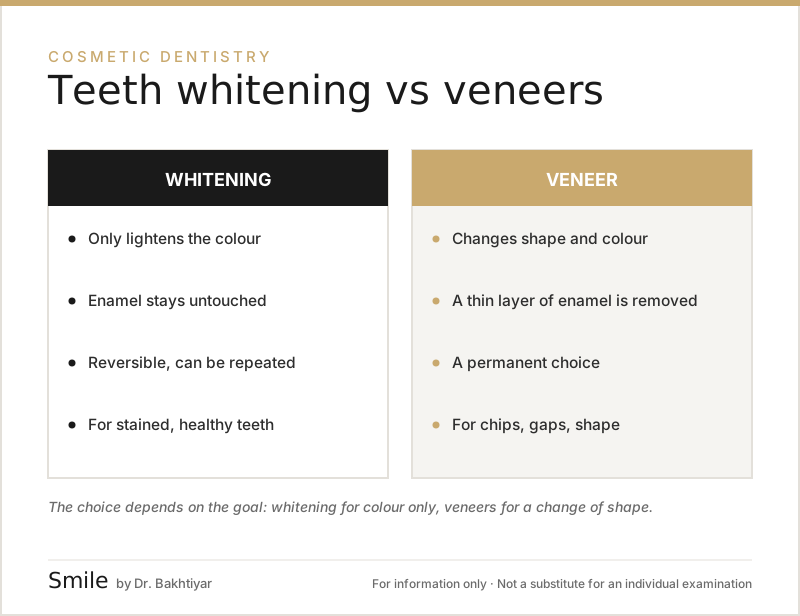
Teeth whitening and veneers: when each one is right.
What is teeth whitening?
Whitening is a peroxide-based gel penetrating the enamel and dentin and breaking down the molecules that cause discolouration. There are two main methods:
- In-clinic whitening — under dentist supervision, with a higher-concentration gel, with results in 1–2 sessions;
- At-home whitening — with custom trays made by your dentist and a milder gel, over 1–2 weeks.
Whitening does not alter the structure of the tooth; the result depends on the starting shade and the type of stain: yellow-brown tones respond well, while grey and tetracycline-related discolouration responds poorly (tooth discolouration and stains). The effect is not permanent — depending on diet and smoking it lasts 1–3 years and can be repeated.
What is a veneer?
A veneer is a 0.3–0.7 mm thick shell bonded to the front surface of the tooth — either ceramic (feldspathic, lithium disilicate) made in a laboratory, or composite shaped chairside. A veneer corrects the colour, shape, size, gaps between teeth and surface all at once; it also covers discolouration that does not respond to whitening. In most cases a small amount of enamel is prepared away from the front surface of the tooth so that the veneer sits at a natural thickness; this step is not reversible. Minimal-preparation and no-preparation options are possible in certain cases (do teeth need to be prepared for veneers). More detail: what is a veneer.
Comparison: when is each one right?
| Criterion | Teeth whitening | Veneer |
|---|---|---|
| What it changes | Colour only | Colour + shape + size + surface |
| Intervention | Minimal, enamel untouched | Usually a small amount of enamel prepared |
| Reversibility | Reversible | Usually not reversible |
| Fillings and crowns | Colour unchanged — a mismatch may appear | Covered |
| Longevity | 1–3 years, repeatable | Years; may need replacing over time |
| Side effects | Temporary sensitivity, gum irritation | Risk of debonding, marginal discolouration, chipping |
| Suitable case | Shape is good, colour is yellow-brown | Chips, wear, gaps, shape irregularities, colour that does not respond to whitening |
The table is general guidance; the right choice for you is made after an examination, photographic analysis and a discussion of what you would like.
Which should you choose? Questions to ask yourself
- Am I unhappy with the colour only, or also with the shape, size and alignment?
- Are there fillings or crowns on my front teeth? (Whitening does not change their colour — a shade mismatch may appear.)
- Am I ready for an irreversible intervention?
- Are my expectations realistic? A natural shade that suits your face looks better than an artificial, ‘too white’ one.
Dentists often suggest a step-by-step approach: whitening first, two weeks for the shade to settle, and then, if it is still needed, veneers on the problem teeth only. The veneer shade is matched to the post-whitening tone; the other way round is not possible.
Safety and expectations
Both procedures are reliable when carried out under dentist supervision. Temporary sensitivity after whitening is common and passes within a few days; unsupervised, frequently repeated whitening is not recommended. The lifespan of a veneer is determined by careful planning, quality materials, the bite (a night guard if you have bruxism) and hygiene (how many years do veneers last). No aesthetic procedure is ‘for life’ — regular check-ups protect the result.
Frequently asked questions (FAQ)
Does teeth whitening damage the enamel? Whitening carried out under dentist supervision at the correct concentration does not alter the structure of the enamel; the most common side effect is temporary sensitivity. Unsupervised, overly frequent use is not recommended.
Does my tooth need to be prepared for a veneer? In most cases a small amount of enamel (0.3–0.7 mm) is prepared away from the front surface; in certain cases a minimal-preparation or no-preparation veneer is possible. Suitability is determined by an examination and photographic analysis.
Which lasts longer? A veneer is a long-term solution that serves for years, but it may need replacing over time. The effect of whitening lasts 1–3 years and can be repeated.
Does whitening change the colour of fillings and crowns? No. Only natural tooth tissue is lightened; if you have fillings or crowns on your front teeth, their colour may stand out after whitening and they may need to be replaced.
Which should I try first? If you are happy with the shape — whitening, being the less invasive option, is the first step. Veneers are only considered when there is an issue with shape, chips, gaps or a colour that does not respond to whitening.
Sources
- Home-based chemically-induced whitening (bleaching) of teeth in adults — Cochrane Database of Systematic Reviews, 2018
- Whitening — Oral Health Topics — American Dental Association (ADA)
- Survival and complication rates of feldspathic, leucite-reinforced, lithium disilicate and zirconia ceramic laminate veneers: a systematic review and meta-analysis — Journal of Esthetic and Restorative Dentistry, 2025
- Teeth whitening — NHS (UK National Health Service)
This article is for general information only and does not replace an individual diagnosis, examination or treatment. Consult a doctor for a decision about your case.