

Can you have a dental X-ray during pregnancy?

Pregnancy is not a contraindication to dental X-rays. According to Committee Opinion No. 723 from ACOG (the American College of Obstetricians and Gynecologists), low-dose examinations such as dental X-rays are not associated with harm to the foetus at any stage of pregnancy — the beam is directed at the jaw, and the dose reaching the foetus is lower than the natural background radiation we receive each day. In practice, an X-ray with a clinical indication (pain, infection, trauma) is not postponed; non-urgent, routine examinations can be moved to after the birth at the patient's request and the dentist's discretion. In every case the examination is justified, and the smallest possible field and dose are chosen.
For women who develop a dental problem during pregnancy, this is a sensitive question. On one hand there is concern about radiation; on the other, long-lasting toothache carries risks of its own. In this article I explain, on a scientific basis, when an X-ray can be taken, when it is postponed and how protection is ensured.
For general context: Are dental X-rays dangerous?; on gums, tooth decay and the timing of treatment in pregnancy: Pregnancy and dental health.
The science: how much radiation does a dental X-ray deliver to the foetus?
The dental X-ray beam is directed at the teeth and jaw and is limited by collimation; the abdominal area where the foetus lies is not in the direct beam path, and only a very small amount of scattered radiation reaches it. For comparison: the effective dose of a single intraoral X-ray is 2–5 µSv and that of a panoramic X-ray is 10–24 µSv (Ludlow et al., JADA, 2008) — and only a tiny fraction of that reaches the foetus.
According to ACOG Committee Opinion No. 723, when the dose reaching the foetus is below 50 mGy there is no observed increase in the risk of congenital anomalies, growth restriction or miscarriage; a dental X-ray is far, far below this threshold. This is why that document recommends that an indicated radiographic examination in a pregnant woman should not be postponed.
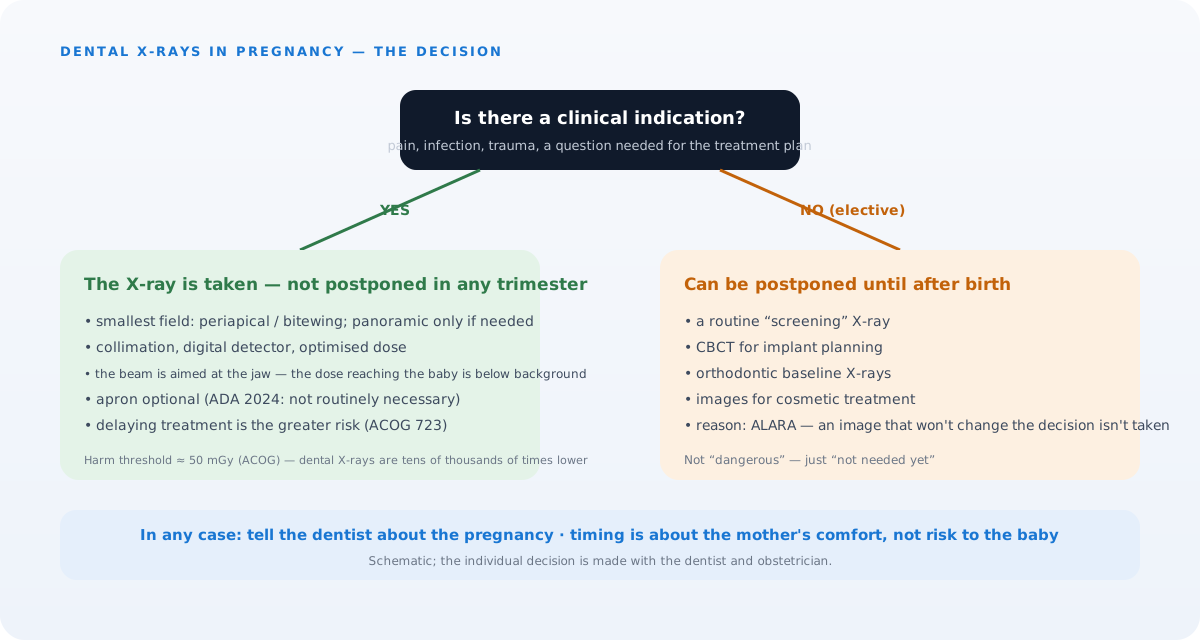 The decision is made by asking not «is she pregnant?» but «is there a clinical indication?». The chart is schematic.
Why are non-urgent X-rays still sometimes postponed?
Despite the figures, in practice non-urgent examinations are often moved to after the birth. The reason is not that they are «dangerous» — it is the ALARA principle: an examination that will not change the clinical decision is not taken at all, in pregnancy or otherwise. Add to this peace of mind, and the fact that many problems can be monitored clinically until the birth. In other words, the rule is not «no X-rays in pregnancy», but «in pregnancy too, only necessary X-rays are taken».
Which situations count as an urgent need?
Urgent indications — that is, cases where the X-ray should not be postponed:
- Severe, persistent toothache — suspected abscess or inflammation of the pulp.
- Oral surgical trauma — jaw fracture, tooth fracture.
- Active abscess and infection — controlling the infection is essential, because in a pregnant woman a systemic infection can also pose a risk to the foetus.
- Growth of a cyst or suspicion of a large pathology.
- Unexplained signs of nerve damage.
In these situations, postponing treatment can carry more risk than the X-ray itself: pain, sleeplessness, disrupted nutrition and spreading infection all affect the mother's general condition. ACOG recommends that dental treatment during pregnancy, including any necessary radiography, should not be postponed.
Which situations are postponed?
Elective X-rays — that is, those that can wait until after the birth:
- Routine screening X-rays (with no specific complaint).
- CBCT for implant planning — implant treatment is planned for after the birth.
- Initial X-rays for starting orthodontic treatment.
- X-rays for cosmetic treatment.
- Routine treatment of tooth decay, if the plan can be made from the clinical examination alone.
Does the trimester make a difference?
The first trimester is when the organs are forming and is considered the most sensitive stage for medical radiation in general; however, the dose of a dental X-ray is so far below the threshold for harm that ACOG does not recommend postponing an indicated examination in any trimester. The second trimester is usually considered the most comfortable period for planned dental treatment (nausea has eased and lying back is not yet difficult); in the third trimester, lying on your back for a long time can be uncomfortable. So the timing is chosen according to the mother's comfort and clinical need, not according to risk to the foetus.
Protective measures — what actually helps?
- Justification — an X-ray is taken only if it will change the clinical decision.
- Collimation and a small field — the beam is directed only at the tooth or area that needs it; if CBCT is required, the smallest possible FOV is used.
- Digital detectors and optimised protocols — a lower dose.
- Lead apron — it has been standard for decades and is harmless; however, with modern collimated digital equipment the scattered radiation is so low that the ADA's 2024 recommendations no longer consider routine use of an apron and thyroid collar necessary. If the patient wishes and it does not interfere with the exposure, it can be used — for reassurance, not as the foetus's «only protection».
Real protection comes from keeping the beam away from the foetus (direction + collimation) and from not taking unnecessary X-rays.
Which dental problems are more common during pregnancy?
An increase in dental problems during pregnancy is normal and has several causes:
- Hormonal changes — a greater tendency towards gum inflammation (pregnancy gingivitis).
- Vomiting and stomach acid — erode the enamel.
- Eating habits — more frequent snacking.
- Changes in calcium metabolism (the myth that «the baby takes calcium from the teeth» is not scientifically correct — if the mother eats well, her teeth are not affected).
This is why women planning a pregnancy are advised to have a dental examination before conceiving — it reduces the need for X-rays during pregnancy.
What does the dentist do when a pregnant woman comes to the clinic?
The standard clinical flow:
- She is asked whether she is pregnant and how many weeks (this is asked of all women of childbearing age).
- A clinical examination is carried out.
- It is assessed whether the X-ray is clinically essential.
- If it is needed, the type of exposure and the FOV / dose that give the lowest dose are chosen.
- An apron is provided on request (not a routine requirement).
- The X-ray is taken.
- The result is explained to the patient.
If your dentist does not follow these steps, asking about the clinic's protocol is a responsible choice.
I had an X-ray before I knew I was pregnant — should I be worried?
No. The dose reaching the foetus from a dental X-ray taken before the pregnancy was known is very low and poses no clinical risk. Even so:
- Tell your dentist about the pregnancy.
- Consult your gynaecologist.
- Do not have another X-ray without a new clinical indication.
Practical advice
- If you are pregnant or might be, always tell the clinic.
- Postpone elective work until after the birth.
- As a precaution, have a dental examination before pregnancy.
- Choose a clinic with digital equipment.
- Asking about the clinical protocol is entirely your right.
Choosing a clinic for pregnant patients in Baku
In a good clinic, special attention to pregnant patients is standard:
- The pregnancy question is asked at every first appointment.
- Elective X-rays are automatically postponed.
- A specific protocol is applied when there is an urgent indication.
- Consultation with the gynaecologist is arranged when needed.
These protocols are applied as part of our clinic's dental radiology services.
Official recommendations — the international position
- ACOG (Committee Opinion No. 723, 2017/2019): diagnostic radiography, including dental X-rays, is not associated with harm to the foetus at any stage of pregnancy; at doses below 50 mGy there is no increase in the risk of anomalies or miscarriage; an indicated examination should not be postponed.
- ADA (2024, JADA): every exposure is justified and optimised; with collimated digital equipment, an apron and thyroid collar are not a routine requirement.
- ICRP (Publication 103): medical radiation exposure is always governed by the benefit–risk balance and the principle of optimisation (ALARA) — in pregnant patients too.
No international document says «dental X-rays are forbidden in pregnant women»; they all say they «must be justified and optimised».
Breastfeeding (lactation) — what changes?
During breastfeeding, dental X-rays are taken according to standard clinical indications. Unlike in pregnancy, there is no risk of direct exposure to a foetus. Radiation does not pass into breast milk — X-rays do not «stay» in the body, and nothing is emitted once the machine is switched off. So the usual dental X-ray protocols apply to a breastfeeding mother.
The one-sentence summary
Dental X-rays during pregnancy are not forbidden: an indicated X-ray is taken, and a non-urgent examination can be moved to after the birth if you prefer; in every case the smallest field and a justified dose are chosen. The dose reaching the foetus is far, far below the threshold for harm.
Frequently asked questions (FAQ)
Can you have a dental X-ray during pregnancy?
Yes — when there is an indication (pain, infection, trauma) it is not postponed in any trimester; a non-urgent, routine examination can be moved to after the birth if you prefer. According to ACOG, dental X-rays are not associated with harm to the foetus.
Which trimester of pregnancy is safest for an X-ray?
The dose of a dental X-ray is so far below the threshold for harm that ACOG does not recommend postponing an indicated examination in any trimester. The second trimester is usually the most comfortable period for planned dental treatment — but that is about the mother's comfort, not risk to the foetus.
Does a lead apron protect the foetus?
It has traditionally been used and is harmless, but with modern collimated digital equipment the scattered radiation reaching the foetus is already very low; the ADA in 2024 does not consider a routine apron necessary. It can be worn if you wish — real protection comes from directing the beam at the jaw and from not taking unnecessary X-rays.
I had an X-ray and then found out I was pregnant — should I be worried?
No. The dose reaching the foetus from a single dental X-ray is lower than the natural background radiation we receive each day, and according to ACOG it is not associated with harm. It is still worth informing your dentist and your gynaecologist.
I have toothache during pregnancy — is treatment possible without an X-ray?
Many emergency treatments (root canal treatment, pain relief, antibacterial therapy) can be carried out without an X-ray or with a minimum of X-rays. The dentist starts with a clinical examination.
About the author
Dr. Bakhtiyar Aliyev — dentist and clinical director of the Smile by Dr. Bakhtiyar clinic. This article has been medically reviewed by Dr. Bakhtiyar.
This article is for general information only and does not replace individual medical advice. During pregnancy, always consult your dentist and your gynaecologist before any medical procedure.
Book an appointment
If you have any dental question during pregnancy or while planning one, you are welcome to contact our clinic. Book online or get in touch with us.
Sources
- ACOG Committee Opinion No. 723: Guidelines for Diagnostic Imaging During Pregnancy and Lactation — Obstetrics & Gynecology, 2017 (reaffirmed 2019), American College of Obstetricians and Gynecologists
- Optimizing radiation safety in dentistry: Clinical recommendations and regulatory considerations — Journal of the American Dental Association, 2024
- Patient risk related to common dental radiographic examinations: the impact of 2007 International Commission on Radiological Protection recommendations regarding dose calculation — Journal of the American Dental Association, 2008
- ICRP Publication 103: The 2007 Recommendations of the International Commission on Radiological Protection — International Commission on Radiological Protection, 2007
This article is for general information only and does not replace an individual diagnosis, examination or treatment. Consult a doctor for a decision about your case.