

Are immediate implant and immediate loading the same thing?
No, these are two separate decisions. An immediate implant means the implant is placed on the same day the tooth is extracted. Immediate loading means attaching a temporary or permanent tooth onto the implant within one week of placement. An implant may be placed on extraction day and still be left without a tooth for months; conversely, an implant placed into healed bone may be loaded with a tooth on the same day. The timing of loading is determined by the implant primary stability in the bone, bone quality, position and chewing load.
The requirements and stages of immediate loading in a full arch are explained separately on the All-on-4 implant treatment page.
Key points
- Two separate questions: when the implant is placed (extraction day / early / delayed) and when it is loaded (immediate / early / conventional).
- According to the ITI classification, immediate loading is within 1 week, early loading is from 1 week to 2 months, and conventional loading is after 2 months.
- The main requirement for immediate loading is implant primary stability; if stability is not achieved, the protocol changes.
- An immediately loaded temporary tooth in the front is usually kept out of chewing contact — this is aesthetic loading, not full function.
- Large reviews show implant survival with immediate and conventional loading is similar, but immediate loading requires careful case selection.
Two different meanings of immediate: what is placed, when it is loaded
Most patients think of these two concepts as one, because both contain the word immediate. Let us separate them.
Placement is the timing of putting the implant into the bone. The ITI consensus describes three types: Type 1 — extraction day (immediate); Types 2–3 — after soft tissue or partial bone healing, roughly 4–16 weeks; Type 4 — into fully healed bone, usually after 4–6 months. We have covered this in detail in our article on same-day implants after extraction.
Loading is the timing of attaching the tooth (temporary or permanent) onto the implant. Here too there are three protocols: A — immediate (within 1 week), B — early (1 week to 2 months), C — conventional (after 2 months).
Combining the two axes gives 9 combinations: for example, Type 1A — implant on extraction day and a temporary tooth that same week; Type 4C — implant into healed bone and a crown after 2–3 months. This is the classification used by Gallucci and colleagues in their systematic review in the journal Clinical Oral Implants Research.
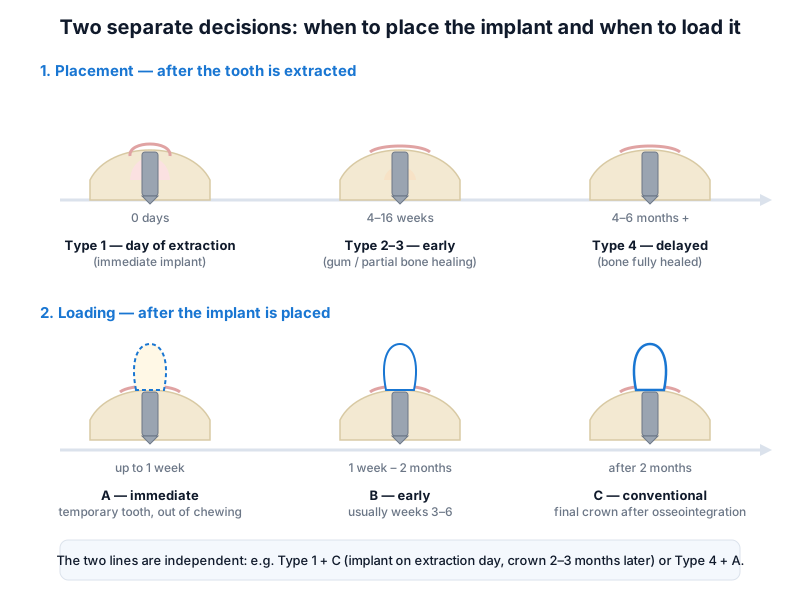 The upper line shows when the implant is placed, the lower line when the tooth is attached to it; both decisions can be made independently of each other.
Loading protocols: immediate, early, conventional
Conventional loading
The classic route. The implant is placed and waits for 2–4 months (often longer in the upper jaw) under the gum or with a small healing cap. During this period the bone bonds to the implant surface — osseointegration takes place. Impressions are then taken and the crown is made. It is the best documented and lowest-risk protocol. In our article what is a dental implant we explain the healing process in simple terms.
Early loading
From 1 week to 2 months — usually in weeks 3–6. Because modern implant surfaces speed up the early bone response, this protocol has become widespread. In the Gallucci review, early loading in healed bone (Type 4B) is among the protocols considered scientifically and clinically validated.
Immediate loading
Within 1 week — in practice, often the same day or the next day. There are two variants:
- Immediate provisionalisation — a temporary tooth is fitted but kept out of chewing contact. In the front teeth the main aim is appearance and shaping of the gum.
- Full functional loading — the tooth takes part in chewing. This is usually done in cases where several implants are connected to one another (splinted), for example in a full-arch hybrid prosthesis. The All-on-4 concept is the best-known example of this principle; we will not repeat it here.
Requirements for immediate loading: stability is everything
The mechanical grip of the implant in the bone at the moment of placement is called primary stability. There is no osseointegration yet; the implant is simply seated the way a screw sits in wood. If the implant moves during this period, soft tissue forms around it instead of bone and the implant does not integrate. That is why immediate loading requires:
- Sufficient primary stability. The dentist measures the insertion torque while placing the implant; many clinicians require a certain threshold for immediate loading. The ITI 2023 selection criteria list primary stability as the main requirement, but do not give a single figure — it varies with the implant system and the bone.
- Bone quality. In dense bone (front of the lower jaw) stability is easy to achieve; in soft bone (back of the upper jaw) it is difficult.
- Control of micromovement. The temporary tooth is made so that there is no contact during lateral movements; in the front teeth it is taken completely out of chewing contact. The ITI consensus recommends that the temporary crown be made without eccentric contacts and with light proximal contacts.
- Patient factors. Bruxism (clenching), uncontrolled diabetes and smoking — each of these can turn the protocol into conventional loading.
The conditions become clear on the operating table. Even if the plan is immediate loading, when stability is not achieved the dentist closes the implant and leaves it to heal. This is not a failure but the correct decision; the patient should know this in advance.
What do the numbers say?
Care is needed here: survival (the implant staying in the mouth) and the aesthetic result are separate measures.
- In the 2018 systematic review by Gallucci and colleagues (69 publications, partially edentulous patients), cumulative implant survival was 98.4% for Type 1A (extraction day + immediate), 97.9% for Type 4A (healed bone + immediate) and 97.7% for Type 4C (healed bone + conventional loading). The differences are small, but the authors note that with implants placed on extraction day the loading protocol does affect the outcome.
- In the same group's updated 2026 review (140 studies, 10,456 implants), Types 1A, 1C, 2–3C and all Type 4 protocols are considered scientifically and clinically validated; extraction-day implant + early loading (Type 1B), with a lower survival rate (91.6%), falls into the category requiring careful case selection.
- In a meta-analysis published in the Journal of Prosthetic Dentistry in 2019 (39 randomised studies), implant survival with immediate loading was statistically slightly lower than with conventional loading (relative risk 0.974), while no difference was found compared with early loading; no difference was noted in bone level, gum level or stability measures.
- In the 2013 Cochrane review (26 studies, 1,217 participants, 2,120 implants), no convincing clinical difference was found between the various loading times in terms of prosthesis or implant failure; in the first year the average implant failure across all groups was 2.5%. The authors stress that the quality of the evidence is limited.
The conclusion is simple: in properly selected cases immediate loading is a reliable protocol; in wrongly selected cases it risks the most basic thing — the implant integrating. For long-term lifespan you can read our article on how long a dental implant lasts.
Which protocol suits whom?
| Situation | Likely approach |
|---|---|
| Single front tooth, intact bone, good stability | Immediate temporary tooth (out of chewing contact) |
| Single front tooth, thin bone or poor stability | Conventional loading, removable temporary denture or a bonded tooth |
| Single back tooth | Usually early or conventional loading |
| Fully edentulous jaw, 4–6 implants | Immediate loading with a splinted temporary prosthesis is possible |
| Implant combined with bone grafting | Usually conventional loading |
| Bruxism, uncontrolled diabetes, smoking | Cautious approach, often conventional loading |
In the front teeth this decision directly affects the aesthetic result — we have written in detail about shaping the gum with a temporary tooth in our article on implant placement in the aesthetic zone.
How should you read same-day teeth advertising?
The phrase implant and tooth in one day can be technically correct — a Type 1A or 4A protocol. But there are three questions to ask:
- Is the tooth fitted that day temporary or permanent? In most cases it is temporary; the permanent crown is made after 3–6 months.
- If stability is not achieved, what is plan B? The answer should be: we leave it to heal and provide a temporary solution.
- Was the decision made with CBCT and planning, or promised in advance? Stability and bone quality cannot be fully predicted before surgery.
In a dental implantation plan, the timing of placement and of loading should be written down separately — the patient needs to know what to expect.
Frequently asked questions
Does an immediately loaded implant integrate faster? No. Osseointegration proceeds at the same biological pace. Immediate loading simply makes it possible not to be without a tooth during this period; the condition is that the implant be protected from micromovement.
What can I eat with an immediately loaded temporary tooth? Biting with that tooth is not advisable in the front; soft food and chewing with the neighbouring teeth are recommended. Your dentist will give you individual instructions.
The implant was placed on extraction day, but no tooth was fitted — why? Most likely the primary stability was not sufficient for immediate loading, or the labial bone was thin. In that case conventional loading is safer.
Is there a difference in outcome between early loading and immediate loading? The 2019 meta-analysis found no difference between these two protocols in implant survival or bone level. The choice depends more on the clinical situation.
Why is immediate loading used more often in a fully edentulous jaw? Because several implants are joined together by one prosthesis and the load is distributed; a single implant does not have this support.
Conclusion
Immediate implant is about the timing of placement, immediate loading about the timing of loading; the two are separate decisions and each combination has its own requirements. The key to immediate loading is primary stability and the prevention of micromovement. In properly selected cases the research considers this protocol reliable, but same-day teeth for everyone is not possible. A consultation with 3D planning is the first step in assessing your individual situation.
Sources
- Implant placement and loading protocols in partially edentulous patients: A systematic review — Clinical Oral Implants Research, 2018
- Current State of Evidence for Implant Placement and Loading in Partially Edentulous Patients: A Systematic Review — Clinical Implant Dentistry and Related Research, 2026
- Immediate versus early or conventional loading dental implants with fixed prostheses: A systematic review and meta-analysis of randomized controlled clinical trials — Journal of Prosthetic Dentistry, 2019
- Interventions for replacing missing teeth: different times for loading dental implants — Cochrane Database of Systematic Reviews, 2013
- Selection Criteria for Immediate Implant Placement and Immediate Loading for Single Tooth Replacement in the Maxillary Esthetic Zone — ITI Consensus Conference, Lisbon 2023
This article is for general information only and does not replace an individual diagnosis, examination or treatment. Consult a doctor for a decision about your case.