

Root canal treatment is carried out under local anaesthesia, so most patients feel no pain during the procedure — you may feel pressure and vibration. Pain before treatment comes from inflammation of the pulp (the nerve and blood vessel tissue inside the tooth) or from infection at the root tip; the aim of treatment is precisely to remove that pain. After treatment, sensitivity when biting and mild discomfort for a few days are normal and usually settle quickly. According to a systematic review, pain was reported in about 81% of patients before treatment, in about 40% after 24 hours and in about 11% after one week — in other words, pain decreases with treatment, it does not increase. In a tooth with acute inflammation, full numbness can be hard to achieve; in such cases additional anaesthesia techniques are used.
This article answers the question about pain; the stages of treatment, the price and the workflow in our clinic are on the root canal treatment service page.
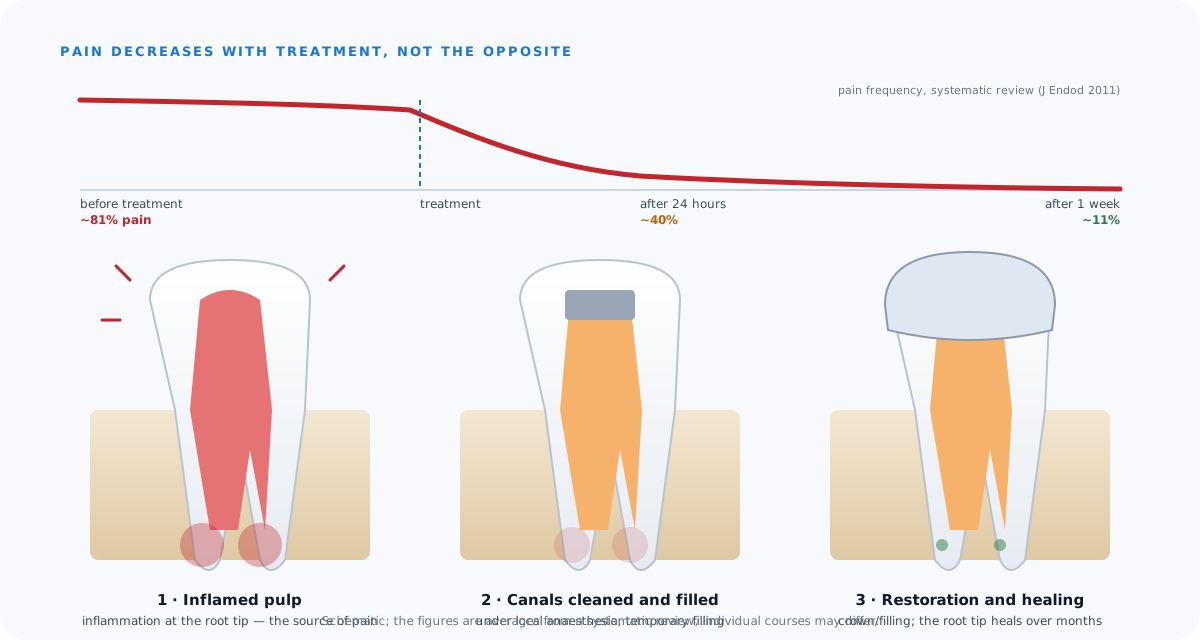 Pain is usually strongest before treatment; it drops quickly once the canals have been cleaned. The diagram is schematic.
Why does the tooth hurt before treatment?
Inside the tooth there is the pulp — tissue made up of nerves and blood vessels. When deep decay, a crack, bacteria under an old filling or trauma reach the pulp, inflammation (pulpitis) begins: pressure rises in tissue squeezed between hard walls, causing long-lasting pain to cold and heat, pain at night and pain that starts on its own. When the pulp dies the pain may ease for a while, but the infection passes from the root tip into the bone — pain on biting, swelling, an abscess (apical periodontitis). At this stage the idea that “the pain has gone, so no treatment is needed” is misleading: the infection continues. About the signs of an abscess: dental abscess and signs of infection; how inflammation at the root tip looks on an X-ray: does a jaw infection show on an X-ray.
Why might you feel no pain during treatment?
Because the work is done under local anaesthesia: nerve conduction is blocked, and while the dentist cleans the canals the patient feels pressure, vibration and sound, but not pain. A few important points:
- In a tooth with acute inflammation (a “hot” tooth) numbness can be harder to achieve — inflamed tissue responds less well to anaesthesia. In such cases additional techniques are used (intraligamentary or intrapulpal injection, a different solution); do not hesitate to tell your dentist that you can feel something — the anaesthesia is topped up and then the work continues.
- We do not promise that it is “completely painless”: the injection itself, keeping the mouth open for a long time and tiredness of the jaw muscles can cause discomfort. These are not pain, but they are real sensations and are managed with breaks.
- A rubber sheet (rubber dam) isolates the tooth — both for sterility and to protect the tongue and cheek; the ESE quality guidelines regard this as standard.
Fear of root canal treatment is widespread and often comes from old experiences; a calm, step-by-step explanation reduces it.
Is pain after root canal treatment normal?
Yes, within limits. Cleaning the canals causes a short-lived reaction in the tissue around the root tip: sensitivity when biting, mild pain on touch, sometimes a feeling that the tooth is “high”. This is also reflected in a 2011 systematic review — pain was recorded in about 40% of patients 24 hours after treatment and in 11% after one week, while the intensity of pain fell on a 100-point scale from about 54 beforehand to about 24 after 24 hours and about 5 after one week. In other words, discomfort after treatment is far lower than before treatment in both frequency and intensity, and is measured in days.
What helps: the painkiller recommended by your dentist (usually for the first 1–2 days), not chewing hard food on the treated side, and protecting the temporary filling. Antibiotics are not needed for pain and are not prescribed routinely — the dentist decides only when there is spreading infection, swelling and general symptoms.
How many days can the pain last?
There is no universal figure, but the typical course is this: the most noticeable discomfort in the first 24–48 hours, then a reduction every day; after a week it has practically gone in most patients. In teeth with a large area of inflammation at the root tip, with severe pain before treatment or requiring several sessions, it can take a little longer. What matters is the direction: the pain should be decreasing. If it increases instead, that is the subject of the next section.
Which signs mean you should see your dentist again?
- If after 2–3 days the pain increases instead of decreasing, or is not controlled by painkillers;
- If swelling appears or increases, with asymmetry of the face or redness of the skin;
- Fever, feeling unwell, difficulty swallowing;
- If the temporary filling has come out or broken — the canal can become contaminated again;
- If the tooth feels high when you close your mouth and hurts with every bite — adjusting the bite is a simple solution;
- If pain comes back weeks or months after the treatment was finished.
These do not always mean a serious problem, but they should be assessed; sometimes the medication inside the canal needs renewing, sometimes the bite needs adjusting, and in rare cases retreatment is required.
Why does root canal treatment sometimes require several sessions?
It is possible to complete it in one session, and in many cases that is what is done. Several sessions are planned in the following situations:
- Active infection and pus — the canal is cleaned, medication is placed inside it (for example, calcium hydroxide), and it is filled once the infection has settled;
- A large area of inflammation at the root tip — the start of healing with medication inside the canal is awaited;
- Complex anatomy — curved, narrow or extra canals; determining the full length of the canal accurately and cleaning it takes time;
- Retreatment — removal of old filling material, a fractured instrument, a calcified canal;
- Persisting symptoms — if numbness or inflammation makes it necessary to postpone the filling.
The ESE quality guidelines regard cleaning and filling every canal to its full length and documenting the result with an X-ray (usually a periapical X-ray) as fundamental; the number of sessions is a means of achieving that quality, not a goal. So that the tooth lasts after treatment, a timely crown or restoration is also part of the plan — a root-treated tooth is brittle, and without a restoration the risk of fracture increases; on diagnosing cracks: does a cracked tooth show on an X-ray.
Frequently asked questions
Will I feel pain during root canal treatment? Thanks to local anaesthesia most patients feel no pain; pressure and vibration are normal. With acute inflammation additional anaesthesia may be needed — tell your dentist.
How many days can there be pain after treatment? Usually sensitivity when biting for the first 1–3 days, and within a week it practically goes. Increasing pain should be checked.
If the pain has gone, is treatment no longer needed? No — when the pulp dies the pain can ease, while the infection continues. The diagnosis is made by the dentist and an X-ray.
Can I have the tooth extracted instead of root canal treatment? Extraction is one option, but a natural tooth that can be saved is usually preferable; an extracted tooth later requires an implant or a bridge. The decision is made together, according to the condition of the tooth.
How many sessions are needed? Most often one; two or more with active infection, complex anatomy or retreatment.
Sources
- Pain prevalence and severity before, during, and after root canal treatment: a systematic review — Journal of Endodontics, 2011
- Quality guidelines for endodontic treatment: consensus report of the European Society of Endodontology — International Endodontic Journal, 2006 (ESE)
- Outcome measures to assess the effectiveness of endodontic treatment for pulpitis and apical periodontitis for use in the development of European Society of Endodontology S3-level clinical practice guidelines — International Endodontic Journal, 2021 (ESE)
This article is for general information only and does not replace an individual diagnosis, examination or treatment. Consult a doctor for a decision about your case.